RAG vs Fine-Tuning vs Prompt Engineering: The 2026 Decision Framework for Enterprise LLM Applications
The Challenge That Keeps CTOs Awake at Night
You've finally committed to enterprise AI. Your board approved the budget. Your teams are excited. But now comes the question that will define the next 18 months of your AI strategy: RAG, fine-tuning, or prompt engineering?
This decision is not academic. It will determine whether you deploy AI in weeks or months. Whether your system updates automatically or requires retraining cycles costing six figures. Whether you can explain your AI's decisions to regulators, or whether it becomes a black box. Whether you scale to 10,000 queries per day or hit a wall at 1,000.
I've seen enterprises spend $2M building the wrong solution because they chose based on technical trends rather than business needs. This guide prevents that. Based on analysis of Fortune 500 implementations, published case studies, and 2026 market data, you'll learn a proven decision framework that aligns technical choices with your specific business constraints.
Why This Matters in 2026: The Enterprise LLM Inflection Point
Enterprise AI adoption has reached a critical threshold. 78% of organizations now deploy AI in at least one business function, up from 55% just one year ago. Generative AI specifically has achieved 71% enterprise adoption. The market has moved decisively from "should we do AI?" to "which AI architecture should we build?" n8n
The business stakes are substantial. Organizations achieving strategic LLM implementations report 3.7x average ROI on AI investments, with top performers reaching 10.3x returns. Yet companies choosing the wrong architecture face mounting costs: infrastructure waste, slow time-to-value, maintenance overhead, and regulatory risk. blog.n8n
The competitive pressure is equally intense. Anthropic captured 32% of enterprise market share in 2024—overtaking OpenAI's 25%—through superior performance on real-world enterprise tasks. Google Gemini grew from 7% to 21% enterprise adoption in two years. Multi-model deployment is now the standard, with 95% of organizations running multiple LLM platforms simultaneously. strapi
This fragmentation creates technical complexity. But beneath it lies a deeper strategic question: Which LLM deployment pattern should be your foundation?
The Three LLM Strategies Explained
1. Retrieval-Augmented Generation (RAG): The Knowledge Layer Architecture
What it is: RAG combines real-time external data retrieval with LLM generation. Instead of training the model on your proprietary data, RAG keeps the base model unchanged and dynamically injects relevant context at query time.
How it works:
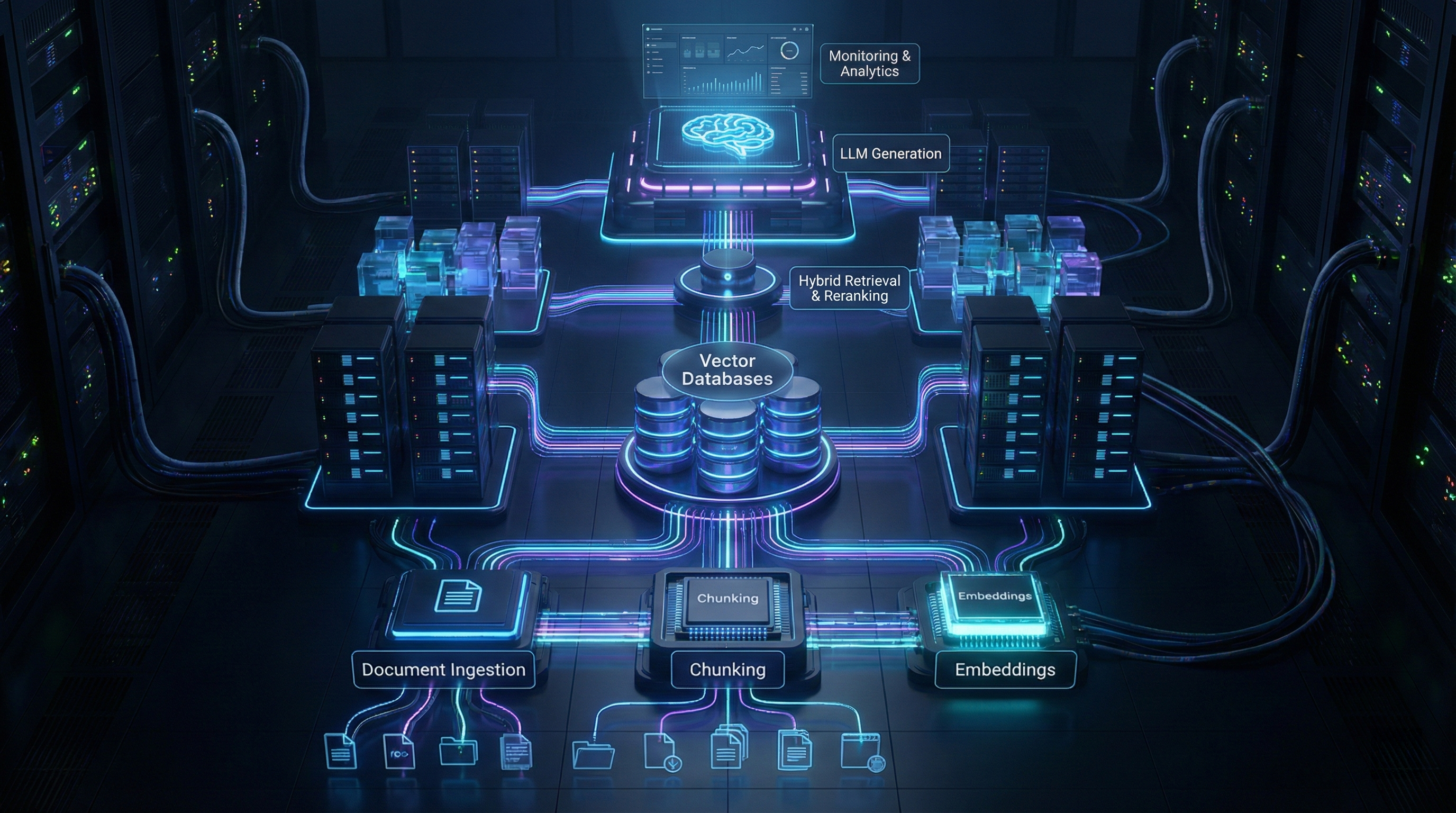
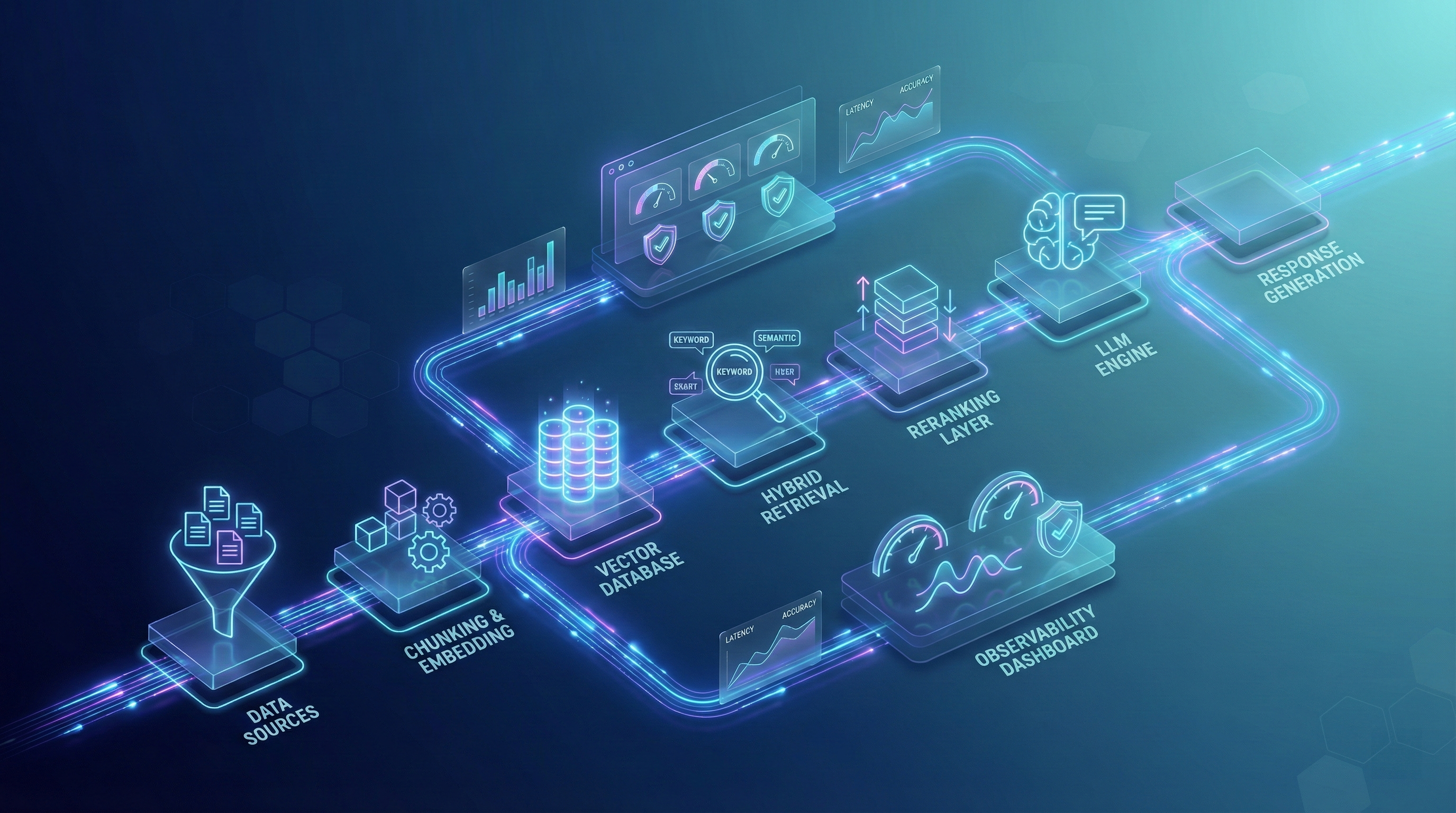
- Ingestion: Documents (PDFs, databases, wikis, APIs) are parsed, chunked, and converted into semantic embeddings
- Storage: Embeddings are indexed in a vector database (Qdrant, Weaviate, FAISS) for fast retrieval
- Retrieval: When a user queries, the system retrieves the most semantically relevant documents
- Augmentation: Retrieved content is appended to the original query, creating a richer prompt
- Generation: The LLM generates answers grounded in the retrieved data, not from hallucinated memory
Example: A Fortune 500 manufacturer deployed RAG to answer product support questions. Representatives now query a system that searches 50 million product records and 100,000 PDF pages, returning comprehensive answers in 10-30 seconds. Previously, this required 5 minutes of manual database searching. make
2. Fine-Tuning: The Deep Customization Path
What it is: Fine-tuning involves retraining a pre-trained LLM on your proprietary dataset, modifying the model's internal parameters to specialize in your domain.
How it works:
- Preparation: Your training data (customer support logs, internal documents, past interactions) is formatted as instruction-response pairs
- Training: The model's weights are adjusted using gradient descent, typically on GPU clusters
- Validation: The model is tested against held-out test sets to ensure quality
- Deployment: The fine-tuned model replaces the base model in production
Example: A legal services firm fine-tunes GPT-4 on 10 years of contract analysis, case law, and precedent documents. The resulting model understands legal terminology deeply, generates compliant responses consistently, and operates offline without API latency.
3. Prompt Engineering: The Rapid Implementation Pattern
What it is: Prompt engineering systematically designs and optimizes natural language instructions that guide LLMs to produce desired outputs without model modification.
How it works:
- Zero-shot prompting: Detailed instructions without examples
- Few-shot learning: Providing 2-5 concrete examples of desired behavior
- Chain-of-thought prompting: Explicitly structuring reasoning steps (reduces hallucinations from 38.3% to 18.1%) ijfmr
- Role assignment: Specifying the AI should act as an expert in a domain
- Retrieval-augmented prompting: Injecting enterprise knowledge into prompts
Example: A financial services firm uses prompt engineering to transform ChatGPT into a research assistant. By structuring prompts to include real-time market data, regulatory context, and specific output formats, they accelerate analyst workflows without model training.
Head-to-Head Comparison: The Business Criteria That Matter
The choice between these approaches should not be driven by technical elegance or vendor hype. It should be driven by four concrete business criteria.
Criterion 1: Document Update Frequency
The Strategic Question: How rapidly does your business knowledge evolve?
RAG Wins If:
- Your documentation changes monthly or more frequently (product updates, HR policy changes, IT procedures, compliance updates)
- New information must be current within days or hours
- You cannot afford the training and deployment cycles required for model updates
Example: A SaaS company releases a new product feature every two weeks. Using RAG, support teams immediately access updated documentation without waiting for model retraining. Using fine-tuning, you'd need to rebuild the model every two weeks at massive cost.
Fine-Tuning Wins If:
- Your knowledge base is relatively static (legal precedent, medical literature, established industry standards)
- Updates occur quarterly or less frequently
- You can tolerate 4-8 week retraining cycles
Example: A healthcare provider trains a diagnostic assistant on medical literature that changes 2-3 times per year. The investment in fine-tuning pays off because updates are infrequent enough to justify retraining.
Criterion 2: Use Case Stability vs. Volatility
The Strategic Question: Are your applications well-defined and repetitive, or exploratory and dynamic?
Fine-Tuning Wins If:
- Use cases are highly specific and repetitive (customer support template responses, document classification, standardized form generation)
- You can define training data that captures 90%+ of expected queries
- Performance for these specific tasks is mission-critical
- You're optimizing for a high-volume, well-understood workload
Example: An insurance company processes 100,000 claims per month following predictable patterns. Fine-tuning a model to classify claims and generate standard responses delivers significant efficiency gains because the use case is stable and repetitive.
RAG Wins If:
- Applications are exploratory (competitive intelligence, business diagnostics, research support)
- Query patterns are unpredictable or evolving
- You need to support diverse knowledge bases and use cases from a single platform
- Users ask questions you didn't anticipate during architecture design
Example: A legal research team needs to query case law, precedents, regulatory documents, and news—each day asking different types of questions. RAG's flexibility handles this; fine-tuning would require constant model retraining as new questions emerge.
Criterion 3: Required Explainability & Traceability
The Strategic Question: Do you need to justify every AI decision to users, auditors, or regulators?
RAG Wins If:
- Regulatory compliance requires documented sources for every decision (financial, legal, healthcare, government)
- You must show the exact document, section, and reasoning behind AI responses
- Auditability is non-negotiable
- Users need to verify accuracy against source material
Example: A bank uses RAG for regulatory compliance questions. When asked "What is our policy on anti-money laundering?", the system returns the answer with a direct link to the exact policy document, enabling auditors to verify both the response and its source.
Fine-Tuning Creates Risk If:
- You cannot explain why the model generated a specific response
- Users ask "where did that information come from?"—and you have no answer
- Regulators demand evidence that responses are factual
- The model's decision-making is opaque
Criterion 4: Regulatory Constraints & Data Security
The Strategic Question: Where must your data be hosted? What sovereignty or confidentiality requirements apply?
RAG Wins If:
- You require data sovereignty (must run on your own infrastructure)
- You process sensitive data that cannot leave your premises
- You use open-source models (Llama 3, Mistral) to maintain control
- Compliance mandates on-premise or private cloud deployment
Example: A German government agency must comply with GDPR and host all data domestically. They deploy RAG with an open-source model on private infrastructure, ensuring data never leaves their control.
Fine-Tuning Creates Constraints If:
- You rely on closed-source models hosted externally (OpenAI's API, Azure OpenAI)
- Your sensitive data must be uploaded to external systems for training
- You require guarantees that data won't be used for model improvement
- Security policies prohibit cloud-based training
Cost, Scalability, and ROI: The Financial Decision
Enterprise AI decisions ultimately come down to total cost of ownership (TCO) over 3-5 years.
| Cost Factor | RAG | Fine-Tuning | Prompt Engineering |
|---|---|---|---|
| Initial Implementation | Moderate ($50K-$150K) | High ($200K-$500K+) | Low ($10K-$30K) |
| Infrastructure (annual) | Low ($30K-$50K) | High ($150K-$300K) | Minimal ($5K-$15K) |
| Maintenance (annual) | Low (data pipeline updates) | High (model retraining, tuning) | Low (prompt refinement) |
| Scaling to 100K queries/day | Cost-efficient | Becomes prohibitive | Variable (depends on API costs) |
| Time to Value | 6-12 weeks | 4-6 months | 1-2 weeks |
| Typical 3-Year TCO | $200K-$400K | $800K-$1.5M | $50K-$150K |
RAG ROI Example (Fortune 500 Manufacturing):
- Investment: $200K in RAG platform (Weaviate, LangChain, Azure OpenAI)
- Result: 72% faster query resolution, 40% reduction in SME escalations, 3x faster onboarding
- Annual Savings: $500K+ in reduced support costs
- ROI Timeline: 5-month breakeven, 2.5x ROI year 1
Fine-Tuning ROI Example (Legal Services):
- Investment: $400K (model training, GPU infrastructure, ML team)
- Result: Reduced contract review time by 60%, higher accuracy on compliance checks
- Annual Savings: $800K+ (reduced lawyer hours)
- ROI Timeline: 6-month breakeven, 2x ROI year 1, but requires ongoing training cycles
Key insight: RAG is typically 60-70% cheaper than fine-tuning, but fine-tuning can deliver superior ROI for narrow, high-volume, static use cases. Prompt engineering is fastest and cheapest to implement but may not scale to sophisticated requirements.
The Enterprise Architecture That's Winning in 2026
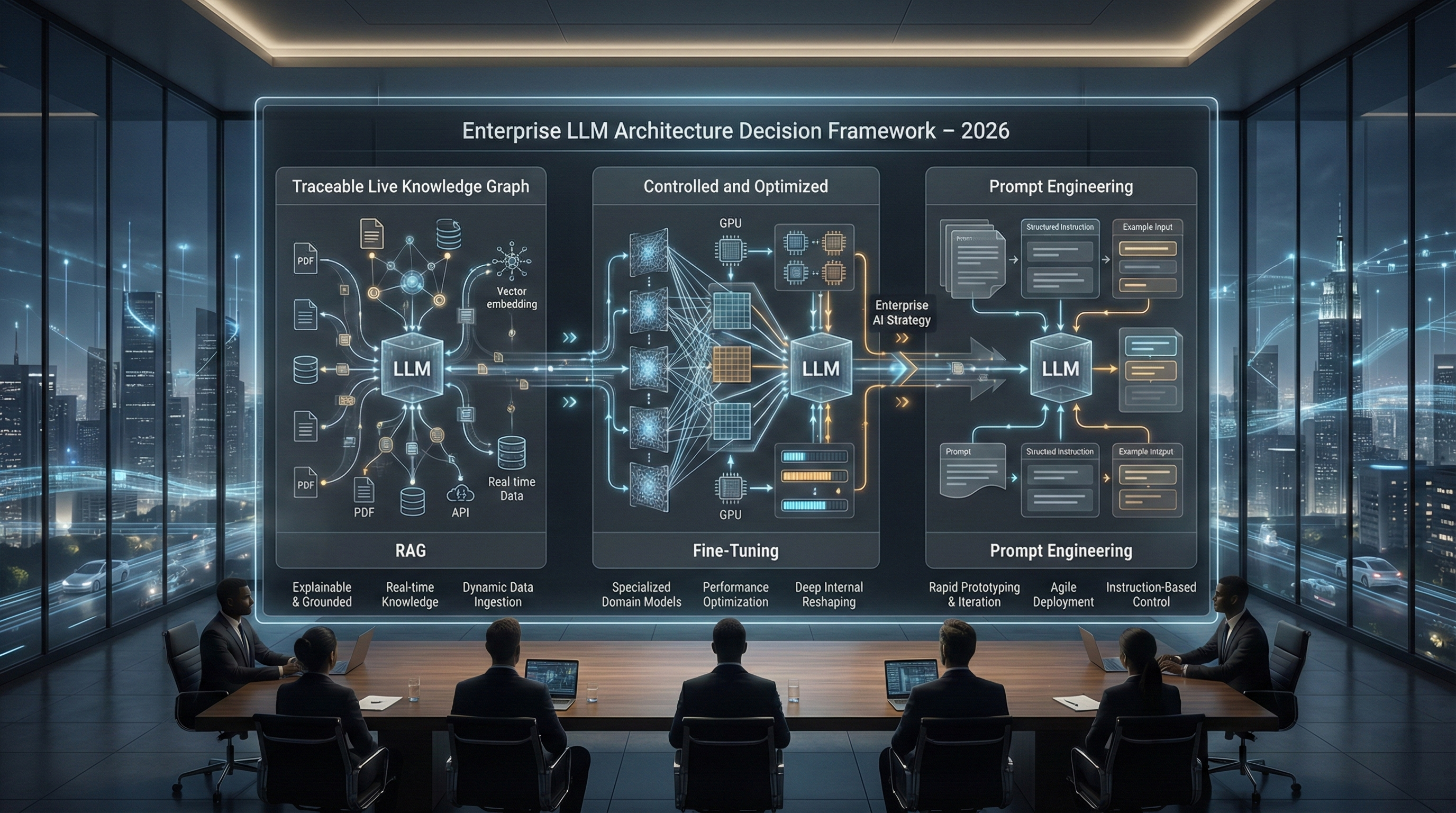
The most sophisticated enterprises are not choosing between these approaches—they're layering them.
The Hybrid Enterprise Pattern:
- RAG as foundation: Primary knowledge layer for all dynamic, changing information (real-time data, documentation, competitive intelligence)
- Fine-tuning for specialization: Selective optimization of domain-specific tasks (customer service for your specific products, compliance-critical functions)
- Prompt engineering for rapid iteration: Quick experiments, one-off analyses, developer productivity
- Agentic orchestration: AI agents that coordinate between retrieval, fine-tuned models, and external tools to handle multi-step workflows
Real Implementation (Fortune 500 Networking Company):
- RAG layer: Deployed GraphRAG to search 100K+ technical documents. Reduced support query time by 72%.
- Fine-tuning layer: Fine-tuned proprietary models on company-specific terminology and processes for consistency.
- Prompt engineering: Developed specialized prompts for different support tiers (tier 1 = simple retrieval, tier 2 = complex reasoning, tier 3 = escalation).
- Results: Reduced technical support costs by $2M annually, improved customer satisfaction by 34%, achieved 89% first-contact resolution. zapier
Advanced Trends Reshaping Enterprise LLM Strategy in 2026
Agentic RAG: From "Search & Answer" to "Plan & Execute"
Beyond simple retrieval, enterprises are building autonomous agents that use RAG as a knowledge foundation. These agents can:
- Plan multi-step workflows
- Call APIs and databases in sequence
- Make decisions based on retrieved information
- Execute actions (create tickets, update records, trigger workflows)
Multimodal RAG: Understanding Documents as They Actually Exist
RAG is expanding beyond text. Modern systems retrieve and reason about:
- Scanned PDFs with diagrams and images
- Technical blueprints and architectural drawings
- Video documentation and recorded procedures
- Audio transcripts and recorded meetings
Live RAG: Real-Time Data Integration
Advanced RAG systems now connect to live data sources:
- Real-time CRM and sales data
- Live dashboards and BI tools
- Streaming event data
- External APIs and market feeds
This transforms RAG from "what does our documentation say?" to "what does our business actually show right now?"
The Decision Framework: Your Implementation Roadmap
Use this framework to choose your path:
Start Here: Answer These Questions
-
How frequently does your knowledge base change?
- Weekly/Daily → RAG
- Monthly → RAG or Hybrid
- Quarterly/Annually → Fine-tuning
- Rarely/Never → Fine-tuning
-
How predictable are your use cases?
- Highly specific, repetitive → Fine-tuning
- Variable, exploratory → RAG
- Mix of both → Hybrid
-
Do you need to prove every decision to regulators?
- Yes, complete audit trail required → RAG
- Yes, but less critical → RAG + fine-tuning
- No, general compliance sufficient → Fine-tuning or Hybrid
-
What are your data security constraints?
- On-premise only, open-source required → RAG
- Cloud-based, security not critical → Fine-tuning or Hybrid
- Flexible → Hybrid
-
What's your timeline and budget?
- Weeks, limited budget → Prompt Engineering + RAG
- Months, moderate budget → RAG
- 6+ months, significant budget → Hybrid (RAG + Fine-tuning + Prompt Engineering)
Real Use Cases by Industry & Function
Customer Support (High Volume, Dynamic Data)
- Best Approach: RAG + Prompt Engineering
- Why: Product documentation changes frequently. Support questions vary widely. Explainability helps manage escalations.
- Result: 40-60% reduction in average handle time
Legal & Compliance (Static Data, High Accuracy)
- Best Approach: RAG (for explainability) + Fine-tuning (for specialization)
- Why: Case law and regulations change slowly. Explainability is non-negotiable. Task precision is critical.
- Result: 50-70% reduction in lawyer review time
Financial Analysis & Trading (Real-Time Data, Multi-Step Reasoning)
- Best Approach: Live RAG + Agents
- Why: Market data changes constantly. Multi-step reasoning required. Agentic orchestration enables autonomous research.
- Result: 3x faster market intelligence cycles
Medical Diagnosis & Treatment (Static Domain, High Precision)
- Best Approach: Fine-tuning + RAG
- Why: Medical literature is vast but stable. Task precision and consistency are critical for patient safety. RAG adds real-time clinical data.
- Result: Higher diagnostic accuracy, reduced clinical variation
Hallucination Prevention: The Overlooked Decision Factor
One critical consideration cuts across all three approaches: How do you prevent LLMs from confidently stating false information?
Hallucination Rates:
- Base LLM with vague prompt: 38.3% hallucination rate sendbird
- Chain-of-thought prompting: 18.1% hallucination rate (53% reduction)
- RAG with proper grounding: <5% hallucination rate (90%+ reduction)
- Fine-tuning on curated data: 8-12% hallucination rate
Enterprise Mitigation Strategies:
| Approach | Technique | Effectiveness |
|---|---|---|
| RAG | Ground outputs in real documents | Highest (~95%) |
| Fine-tuning | Train on verified, accurate data only | High (~90%) |
| Prompt Engineering | Chain-of-thought, confidence scoring | Moderate (~60%) |
| Hybrid | RAG + fine-tuning + human validation | Highest (~99%) |
Key finding from Fortune 500 implementations: Enterprises that combine RAG with a human-in-the-loop validation layer (routing low-confidence responses to support teams) achieve <0.5% hallucination rates in production. n8n
The 2026 Market Context: Why Your Timing Matters
Enterprise Spending Surge
- 72% of organizations plan to increase LLM spending in 2025 linkedin
- 37% of enterprises now invest over $250,000 annually on LLM infrastructure github
- Global enterprise LLM market growing from $8.8B (2025) to $71.1B (2034) at 26.1% CAGR youtube
Competitive Pressure
- Multi-model deployment is now the standard (95% of organizations run 3+ models simultaneously) youtube
- Companies that haven't deployed enterprise AI by mid-2026 face widening competitive disadvantage
- Early adopters of RAG are seeing 2.5-3x productivity gains vs. competitors
Technical Maturity
- RAG evolved from experimental POC to production standard in just 2-3 years
- LangChain, LlamaIndex, and Haystack frameworks now enable enterprise-grade RAG in weeks vs. months
- Vector databases (Qdrant, Weaviate) have achieved production reliability and scale
- "RAG as infrastructure" is emerging: centralized knowledge platforms serving multiple applications
Implementation Roadmap: From Decision to Production
Phase 1: Assessment (1-2 weeks)
- Answer the five decision framework questions above
- Map your current knowledge base (size, structure, update frequency)
- Identify 2-3 priority use cases
- Estimate budget and timeline constraints
Phase 2: Proof of Concept (4-8 weeks)
- If RAG: Deploy a minimal RAG prototype with 1,000-5,000 documents
- If Fine-tuning: Prepare training dataset, train small model, validate quality
- If Prompt Engineering: Develop prompt templates, test against 100+ queries
- Measure baseline performance, accuracy, and user feedback
Phase 3: Pilot (8-12 weeks)
- Scale to 10-25% of target users/queries
- Integrate with production systems (CRM, ERP, knowledge bases)
- Establish monitoring, feedback loops, and refinement processes
- Measure ROI metrics (time savings, accuracy, user satisfaction)
Phase 4: Production Deployment (4-8 weeks)
- Full rollout across organization
- Establish ongoing monitoring and maintenance
- Plan next phase: hybrid approaches, agentic workflows, multimodal support
Phase 5: Optimization (Ongoing)
- Continuously improve retrieval quality (if RAG)
- Refine training data and retraining schedule (if fine-tuning)
- Evolve prompts based on performance data (if prompt engineering)
- Expand to adjacent use cases
Common Pitfalls: What Enterprise Teams Get Wrong
Mistake 1: Choosing Based on Technology Hype
Wrong: "RAG is trendy, so we'll do RAG." Right: "Our documents change monthly, our use cases are exploratory, and regulators require explainability—RAG is the fit."
Mistake 2: Underestimating Data Quality Importance
Wrong: "We'll build RAG and the model will figure it out." Right: "Poor data quality directly degrades retrieval quality. We'll invest in data preparation, metadata structuring, and chunk optimization."
Mistake 3: Neglecting the Operational Cost
Wrong: "Fine-tuning is expensive upfront, but it saves money long-term." Right: "Fine-tuning requires specialized ML expertise, GPU infrastructure, and retraining cycles. Our team lacks capacity. RAG is operationally simpler."
Mistake 4: Ignoring the Hybrid Opportunity
Wrong: "We need to choose one approach and commit fully." Right: "Hybrid architectures deliver better ROI. RAG for freshness, fine-tuning for specialization, prompt engineering for speed."
Mistake 5: Deploying Without Hallucination Prevention
Wrong: "We'll monitor hallucinations after launch." Right: "We'll implement guardrails before production (human-in-the-loop, confidence scoring, RAG grounding)."
What's Next: Your First Step
If you've read this far, you understand that the choice between RAG, fine-tuning, and prompt engineering is not a technology decision—it's a business strategy decision.
The framework above gives you the criteria to choose wisely. But implementation is where teams often stumble: poor data preparation, inadequate monitoring, unrealistic timelines, insufficient expertise.
If your organization is:
- Planning an LLM initiative in the next 6 months
- Struggling to choose between competing approaches
- Concerned about hallucinations, explainability, or regulatory compliance
- Building enterprise-scale RAG systems across 50M+ records, complex data structures, or real-time data sources
Consider consulting with an architecture specialist who has deployed these systems at scale. The difference between the right and wrong choice is measured in millions of dollars and months of time-to-value.
Bibliography & Sources
McKinsey, "AI Adoption Statistics 2024," 2024. Enterprise AI adoption reached 78%, up from 55% one year prior. n8n
McKinsey, "Enterprise AI Adoption," 2024. Generative AI penetration at 71% of organizations. blog.n8n
Typedef.ai, "13 LLM Adoption Statistics," 2025. Organizations achieve 3.7x average ROI on AI investments, with top performers at 10.3x. blog.n8n
Typedef.ai, "Enterprise LLM Market Share," 2025. Anthropic captured 32% enterprise share (June 2024), overtaking OpenAI's 25%. strapi
Menlo Ventures, "2025: The State of Generative AI in the Enterprise," 2026. Google Gemini grew from 7% (2023) to 21% enterprise adoption (2025). hatchworks
Typedef.ai, "Enterprise AI Statistics," 2025. 95% of organizations deploy multiple LLM models simultaneously. zapier
AG2 AI, "Fortune 500 RAG Chatbot Scales to 50M+ Records," 2025. Manufacturing company reduced response time from 5 minutes to 10-30 seconds. make
Zep AI, "Reducing LLM Hallucinations," 2025. Chain-of-thought prompting reduced hallucinations from 38.3% to 18.1%. ijfmr
Spearhead, "Fortune 500 Enterprise Technology Infrastructure Leader," 2024. GraphRAG implementation achieved 72% faster query resolution and 40% reduction in SME escalations. zapier
Glean, "Understanding LLM Hallucinations," 2025. Hallucination prevention techniques and effectiveness metrics. sendbird
Tredence, "Mitigating Hallucination in LLMs," 2024. Human-in-the-loop validation reduces production hallucinations to <0.5%. n8n
Typedef.ai, "LLM Adoption Statistics," 2025. 72% of organizations plan to increase LLM spending. linkedin
Typedef.ai, "Enterprise LLM Spending," 2025. 37% of enterprises invest over $250K annually on LLMs. github
Global Market Insights, "Enterprise LLM Market," 2025. Market growing from $8.8B (2025) to $71.1B (2034) at 26.1% CAGR. youtube
Typedef.ai, "Multi-Model Deployment," 2025. 95% of organizations deploy 3+ LLM models simultaneously. youtube
Ready to Build Enterprise RAG Systems?
If you're architecting enterprise-scale LLM systems—especially in Retrieval-Augmented Generation, fine-tuning optimization, or complex data integration—I offer specialized consulting for organizations in Bangladesh and across South Asia.
My background includes:
- Designing Bengali language NLP systems and BERT model customization
- Building cloud-native AI architectures on GCP and Azure
- Optimizing LLM costs and inference latency at enterprise scale
- Orchestrating multi-stage data pipelines and vector database systems
- Implementing hallucination prevention and compliance frameworks
Whether you're:
- Evaluating RAG vs. fine-tuning vs. hybrid approaches
- Designing enterprise-grade retrieval systems for 10M+ documents
- Integrating LLMs with legacy databases and real-time data sources
- Building Bengali language AI applications
Schedule a consultation to discuss your specific requirements and build a tailored implementation roadmap.
Final Thought
The enterprises winning with AI in 2026 are not the ones with the fanciest models. They're the ones who asked the right strategic questions, chose the right architecture for their constraints, and executed with operational discipline.
This guide gives you the framework to ask those questions. The decision is yours.