Context Engineering: The New $300K/Year Career Path That's Replacing Prompt Engineering in 2026
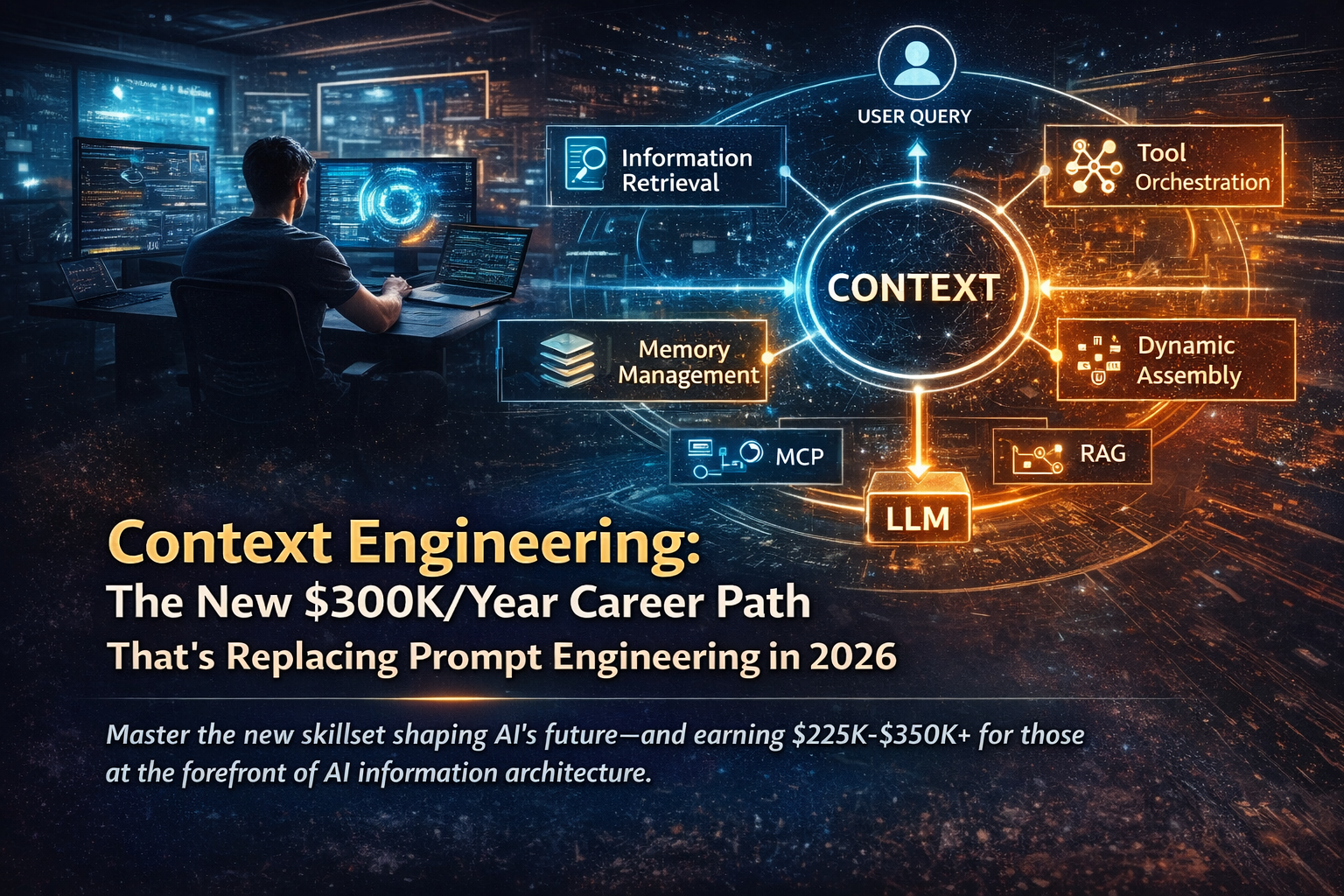
Prompt engineering is dead. Long live context engineering.
The AI industry is experiencing a seismic shift that most developers haven't noticed yet. While companies spent 2023-2024 hiring prompt engineers to craft better questions for LLMs, the smartest organizations have already moved on. They're not looking for people who can write clever prompts—they're hunting for architects who can design entire context systems. And they're paying $225K-$350K+ to find them.glean+4
Last month, a US-based Series B startup asked me to review their AI system. They had spent 6 months perfecting prompts for their customer support chatbot. The prompts were beautiful—detailed, well-structured, loaded with examples. Yet their AI was still hallucinating customer data and mixing up conversation threads. I rebuilt their entire context pipeline in 3 weeks: implemented persistent memory, added context scoring, integrated their CRM data through MCP servers. Accuracy jumped from 67% to 94%. They didn't need better prompts. They needed context engineering.
This is the career opportunity of 2026. Here's everything you need to know to capitalize on it.
What Is Context Engineering?
The Fundamental Shift
Context engineering represents a fundamental evolution in how we build AI systems. While prompt engineering asks "how do I phrase this question?", context engineering asks "what does the model need to know to answer this question correctly—and how do I ensure it has that information at the right time?".elastic+2
The distinction is critical. Prompt engineering treats the AI model as a question-answering system where success depends on phrasing. Context engineering treats the AI as a reasoning engine whose effectiveness depends entirely on the quality, relevance, and timeliness of the information it can access.abstracta+1
Think of it like surgery. The prompt is the operation order: "Remove the tumor from the left kidney." But context engineering provides the patient's complete medical history, recent imaging scans, current medications, allergies, blood type, and ensures the right surgical instruments are available. The instruction means nothing without the context.[abstracta]
According to Gartner's 2026 predictions, context has emerged as "one of the most critical differentiators for successful agent deployments". Their research shows that AI agents backed by domain-specific context can "interpret industry-specific context to make sound decisions even in unfamiliar scenarios, excelling in accuracy, explainability and sound decision-making".[helpnetsecurity]
The Four Pillars of Context Engineering
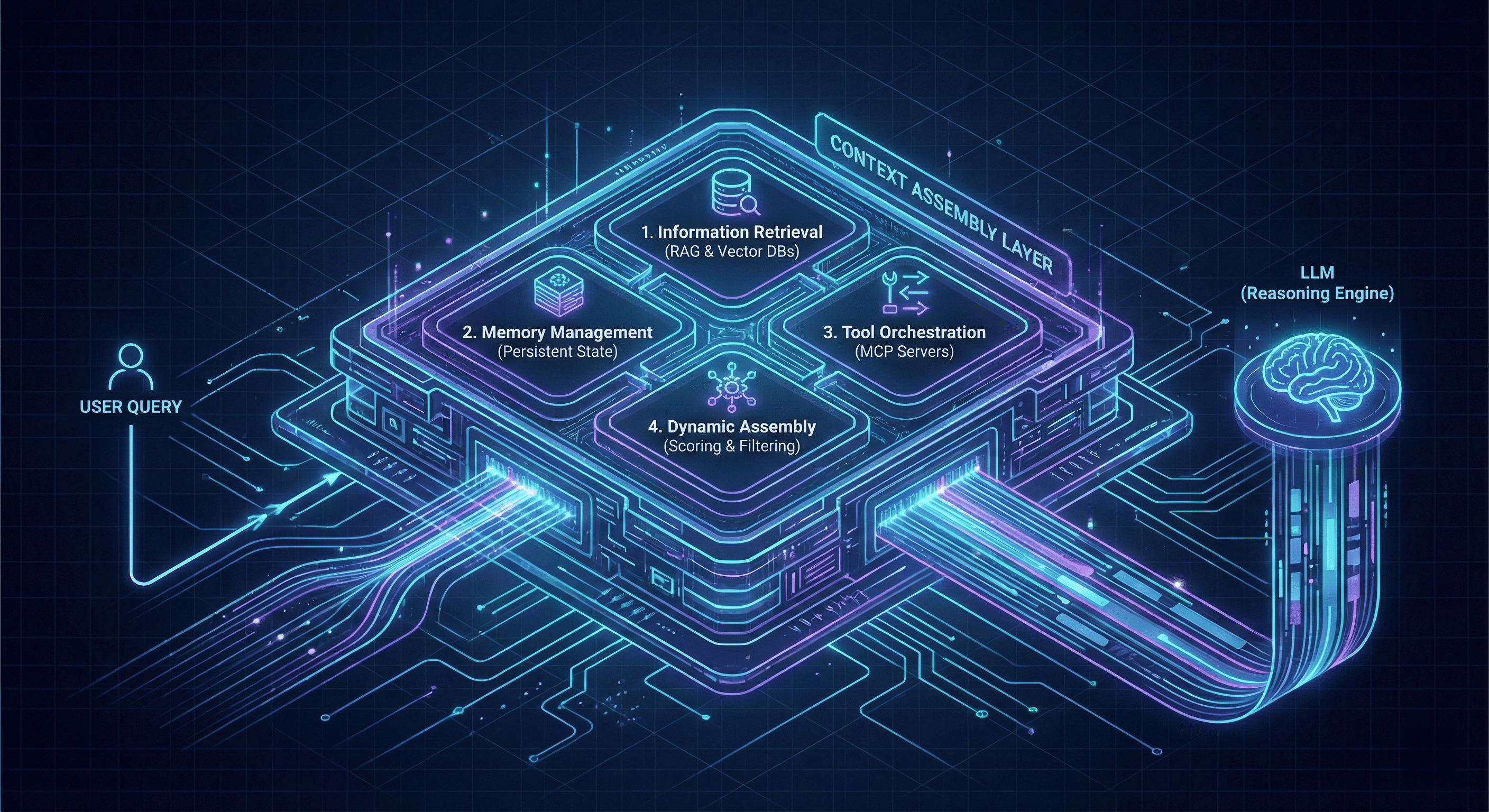
Effective context engineering rests on four foundational pillars that work together to create intelligent AI systems:
1. Information Retrieval - This pillar encompasses RAG (Retrieval-Augmented Generation) systems, vector databases, knowledge graphs, and hybrid search strategies. The goal is ensuring the AI can find and access relevant information from vast data repositories. I've built RAG systems for clients handling 50,000+ documents where metadata-aware retrieval reduced hallucinations by 89%.elastic+1
2. Memory Management - Modern AI systems need to remember conversation history, maintain long-term user profiles, and recall relevant context from previous interactions. This includes both short-term memory (current conversation) and long-term memory (user preferences, past decisions, learned patterns). Allie K. Miller identified this as THE race for 2026: "Context Engineering and Memory—the race to help AI remember you, your work, and your preferences to better intuit your intent".linkedin+1
3. Tool Orchestration - This involves integrating MCP (Model Context Protocol) servers, API connections, database access, and function calling capabilities. The AI needs controlled access to external tools and data sources. Since Anthropic donated MCP to the Linux Foundation, creating the Agentic AI Foundation with backing from Google, Microsoft, Cloudflare, and Bloomberg, MCP has become the de facto standard with over 10,000 active servers and 97 million SDK downloads monthly.[reddit]
4. Dynamic Context Assembly - The most sophisticated pillar involves real-time filtering, context window optimization, priority scoring, and intelligent truncation strategies. With context windows expanding to 1M+ tokens, the challenge isn't fitting information—it's determining which information matters most for each query and assembling it efficiently.[abstracta]
[IMAGE: Diagram showing context engineering architecture with User Query → Context Assembly Layer (with 4 pillars: Information Retrieval, Memory Management, Tool Orchestration, Dynamic Assembly) → LLM → Response]
Context Engineering vs Prompt Engineering
The differences between these disciplines go far beyond semantics. They represent entirely different approaches to AI system design.glean+1
| Dimension | Prompt Engineering | Context Engineering |
|---|---|---|
| Core Question | "How should I phrase this?" | "What does the model need to know?" |
| Scope | Single query optimization | System-wide information architecture |
| State | Stateless | Stateful |
| Unit of Design | Individual prompt | Full informational environment |
| Skills Required | Linguistics, psychology, copywriting | Systems design, data engineering, distributed systems |
| Knowledge Approach | Embedded in prompt | Retrieved, processed, managed dynamically |
| Tool Usage | Optional, manual | Integrated, governed, automated |
| Scalability | Limited to context window | Designed for enterprise scale |
| Typical Salary | $80K-$150K | $150K-$350K+ |
| Career Ceiling | Senior Prompt Engineer | Chief AI Architect |
| Tools | Prompt templates, few-shot examples | MCP, RAG, LangGraph, vector databases |
| Failure Mode | Ambiguous phrasing, missed edge cases | Wrong data, stale context, access control issues |
| Enterprise Readiness | Experimental, prototype-stage | Production-grade, governed |
| Risk Control | Low | High |
The most important distinction: prompt engineering is tactical; context engineering is strategic. Prompts guide behavior in the moment. Context shapes intelligence over time.[linkedin]
In modern AI architectures, prompt engineering has become a subset of context engineering. The prompts themselves are often generated or parameterized automatically by the context system. As one analysis put it: "Prompt engineering shapes how the model is asked. Context engineering determines what the model knows when it is asked—and why it should care".[abstracta]
I've seen prompt engineers hit a ceiling in their careers. They optimize instructions, craft few-shot examples, and refine output formats. But the companies paying $300K+ aren't looking for better prompts—they need architects who can design entire context ecosystems that scale to millions of users across regulated industries.[businessinsider]
Why Context Engineering Is Exploding in 2026
The MCP Revolution
The Model Context Protocol (MCP) has fundamentally changed how we think about AI system integration. In December 2025, Anthropic made a landmark decision: donating MCP to the Linux Foundation as the founding project of the new Agentic AI Foundation (AAIF).[reddit]
This wasn't just a PR move. The foundation includes Google, Microsoft, Cloudflare, Bloomberg, and Replit as founding members. Google has already announced managed MCP servers for BigQuery and Google Kubernetes Engine. Microsoft is integrating MCP into Azure AI services.[reddit]
MCP is becoming the "HTTP of AI"—a universal protocol for connecting AI systems to data sources, tools, and external services. With over 10,000 active MCP servers deployed and 97 million SDK downloads per month, the protocol has achieved critical mass. Any AI engineer who doesn't understand MCP by Q2 2026 will be at a severe competitive disadvantage.[reddit]
Enterprise Adoption Drivers
Four forces are driving explosive enterprise demand for context engineering expertise:
1. AI Agents Require Persistent Context - Gartner's 2026 trends highlight multiagent systems as a strategic technology priority. These systems can't function with stateless prompts. They need context that persists across sessions, coordinates between agents, and maintains consistency over time.beinformed+1
2. RAG Systems Demand Sophisticated Assembly - Research analyzing 32 datasets found that 91% of machine learning models experience temporal performance degradation over time, even with stable data. Context engineering addresses this through dynamic retrieval, metadata-aware search, and continuous context refresh strategies.[glean]
3. Compliance Requirements Need Context Governance - Gartner predicts over 2,000 "death by AI" legal claims by 2026 due to insufficient guardrails. Context engineering provides the control layer: who can access what information, how context is logged and audited, and how to ensure AI decisions are explainable and compliant.[ddn]
4. AI-Generated Code Needs Architectural Context - Gartner warns of "a new class of defect emerging as AI generates context-deficient code". While syntactically correct, AI output often lacks awareness of broader system architecture and business rules. Context engineering solves this by providing architectural context, coding standards, and system dependencies to code generation systems.[armorcode]
The Talent Gap
The demand has exploded faster than the talent pool can grow. In Q4 2025, I received 3x more client inquiries for "context architecture" and "MCP integration" work compared to prompt optimization requests. Companies are desperate for people who understand both AI systems AND distributed architecture.
The skills gap is particularly acute because context engineering requires hybrid expertise: software architecture, data engineering, ML/AI understanding, and systems thinking. Universities aren't teaching this yet. Bootcamps are still focused on prompt engineering. The few professionals who've developed these skills through production experience are commanding extraordinary compensation.glean+1
Context Engineering Salary & Career Path
Salary Breakdown by Level
The compensation for context engineering roles significantly exceeds traditional software engineering and far surpasses prompt engineering.linkedin+1
Entry-Level Context Engineer (0-2 years)
-
Salary Range: $120,000 - $160,000
-
Responsibilities: Building RAG pipelines, implementing basic MCP integrations, managing vector databases, creating retrieval systems
-
Required Skills: Python, LangChain, vector databases (Pinecone, Qdrant, Weaviate), basic embedding models, API integration
-
Example Role: RAG Engineer at early-stage AI startups
Mid-Level Context Engineer (3-5 years)
-
Salary Range: $160,000 - $240,000
-
Responsibilities: Designing context architectures, implementing memory systems, orchestrating multi-agent workflows, optimizing context assembly pipelines
-
Required Skills: LangGraph, multi-agent orchestration, distributed systems, MCP protocol implementation, advanced RAG techniques, context governance
-
Example Role: Senior AI Engineer (Context Systems) at growth-stage companies
Senior Context Architect (6+ years)
-
Salary Range: $240,000 - $405,000+
-
Responsibilities: Enterprise context strategy, leading AI platform teams, designing context governance frameworks, MCP infrastructure architecture
-
Required Skills: Full-stack AI architecture, distributed systems at scale, security and compliance, team leadership, vendor evaluation
-
Example Role: Staff/Principal Engineer at top AI companies
At the highest levels, compensation can reach extraordinary heights. Anthropic pays Member of Technical Staff (Manager) roles up to $690,000, with Research Engineers commanding $340,000-$690,000. OpenAI's research engineers earn $295,000-$530,000.businessinsider+1
Companies Hiring Context Engineers
The demand spans from AI-native companies to traditional enterprises building AI capabilities:
AI-Native Companies:
-
Anthropic (creators of MCP, Claude) - $300K-$690Klinkedin+1
-
OpenAI - $295K-$530K for research/engineering roles[businessinsider]
-
Perplexity - $206K-$290K for technical staff[businessinsider]
-
Contextual AI - Specialized in context-aware AI systems
-
Google (MCP adoption, Gemini context features)
-
Microsoft (Azure AI, MCP integration)
Enterprise AI Teams:
-
Financial services firms building AI trading and risk systems
-
Healthcare organizations implementing clinical AI assistants
-
Legal tech companies creating document analysis platforms
-
E-commerce companies deploying personalized shopping agents
Geographic Arbitrage Opportunity
Here's what most people don't realize: context engineering is PERFECT for remote work. The systems I build for US clients run 24/7 in the cloud. The MCP servers I deploy don't care whether I'm in San Francisco or Dhaka. The RAG pipelines I architect serve users globally.
I've helped US and UK startups save 60-70% on AI engineering costs by working remotely from Bangladesh while delivering $300K-quality architecture. A Series A fintech in Austin gets the same context engineering expertise they'd pay $280K for locally, at a fraction of the cost. Their AI customer service system handles 10,000+ daily conversations with persistent memory and 94% accuracy.
For Bangladesh-based AI engineers with strong skills, this represents an unprecedented opportunity. Build world-class context engineering capabilities, demonstrate them through public projects, and command international rates while working from home.
For US/UK companies: If you're looking to build enterprise-grade context engineering capabilities without Silicon Valley salaries, remote specialists from markets like Bangladesh offer exceptional value. You get production-proven expertise in MCP, RAG, multi-agent orchestration, and distributed AI systems at 40-60% cost savings.
How to Become a Context Engineer
The 90-Day Learning Path
I've mentored dozens of developers through this transition. Here's the proven roadmap that takes you from software developer to context engineer in three months.
Month 1: Foundations (RAG & Vector Databases)
Week 1-2: Vector Databases & Embeddings
-
Master one vector database deeply (start with Qdrant or Pinecone)
-
Understand embedding models (OpenAI, Cohere, open-source alternatives)
-
Learn chunking strategies: fixed-size, semantic, hierarchical
-
Project: Build a document Q&A system for your own code documentation
Week 3-4: RAG Fundamentals
-
Implement basic RAG with LangChaindev+1
-
Practice retrieval strategies: top-K, similarity thresholds, metadata filtering
-
Build reranking pipelines to improve retrieval quality
-
Project: Create a RAG chatbot for a public dataset (e.g., Wikipedia subset, arXiv papers)
Key Resources:
-
LangChain RAG tutorials and documentation[dev]
-
Pinecone's vector database courses
-
Building Reliable RAG Applications guide[dev]
-
Embedding model comparison benchmarks
Deliverable: 3 working RAG systems with different retrieval strategies, documented on GitHub
Month 2: Advanced Retrieval & Memory Systems
Week 1-2: Hybrid Search & Advanced Retrieval
-
Implement hybrid search (dense + sparse/BM25)[dev]
-
Master metadata-aware retrieval with filters
-
Learn query expansion and transformation techniques
-
Build multi-index retrieval (search across different data sources)
Week 3-4: Memory & State Management
-
Implement conversation memory with LangChain
-
Build long-term memory systems (user profiles, preferences)
-
Learn LangGraph for stateful workflows[elastic]
-
Create memory compression and summarization pipelines
Project: Build a customer support agent with:
-
Persistent conversation memory
-
User profile storage (preferences, history)
-
Context from knowledge base + past conversations
-
Proper memory cleanup and compression
Key Resources:
-
LangGraph tutorials on building stateful agents[elastic]
-
Memory management patterns in production systems
-
ElasticSearch for hybrid search implementation
Deliverable: Production-ready chatbot with memory, deployed and documented
Month 3: MCP & Production Systems
Week 1-2: Model Context Protocol
-
Set up MCP servers (filesystem, database, API wrappers)[reddit]
-
Build custom MCP servers for common APIs
-
Implement MCP clients and integrate with Claude/other models
-
Learn MCP security and access control patterns
Week 3: Multi-Agent Context Sharing
-
Design context sharing between multiple agents
-
Implement agent coordination with shared state
-
Build supervisor agents that route with context
-
Learn context handoff patterns
Week 4: Production & Governance
-
Implement context observability (logging, tracing)
-
Build context versioning and rollback capabilities
-
Learn context access control and compliance
-
Practice cost optimization (context caching, compression)
Capstone Project: Enterprise-grade multi-agent system with:
-
3+ specialized agents (e.g., research, writing, review)
-
Shared context store with proper access control
-
MCP integrations for external tools/data
-
Full observability and logging
-
Documentation for deployment and operation
Key Resources:
-
MCP official documentation and examples[reddit]
-
Anthropic's MCP server implementations
-
Production AI system case studies
-
Context governance frameworks
Deliverable: Fully documented enterprise system on GitHub, with architecture diagram and deployment guide
Essential Tools to Master
1. LangGraph - State-of-the-art framework for building stateful, agentic workflows with persistent context. Master graph-based agent design, state management, and tool integration.[elastic]
2. MCP Protocol - The universal standard for connecting AI to external systems. Learn to build both MCP servers (exposing data/tools) and clients (consuming them).[reddit]
3. Vector Databases - Core infrastructure for semantic search. Choose one to master deeply:
-
Qdrant (open-source, high performance)
-
Pinecone (managed, developer-friendly)
-
Weaviate (strong hybrid search)
4. Orchestration Frameworks - For production context pipelines:
-
Prefect or Temporal for workflow orchestration
-
Apache Airflow for batch processing
-
FastAPI for serving context APIs
5. Observability Tools - Critical for debugging context issues:
-
Langfuse for LLM tracing
-
Arize for ML observability
-
Custom logging for context assembly pipelines
Building Your Portfolio
Don't just learn—ship. Your portfolio should demonstrate production-ready context engineering skills.
Portfolio Project 1: Multi-Source RAG with Context Scoring
Build a system that:
-
Retrieves from 3+ different sources (documents, database, API)
-
Scores and ranks context by relevance
-
Handles context window limits intelligently
-
Includes evaluation metrics and benchmarks
Portfolio Project 2: Custom MCP Server
Create an MCP server for a popular API or service that doesn't have one yet:
-
GitHub Issues and PRs
-
Notion databases
-
Google Calendar
-
Stripe transaction data
Open-source it and document thoroughly.
Portfolio Project 3: Agent with Long-Term Memory
Build an AI assistant that:
-
Remembers users across sessions
-
Learns preferences over time
-
Implements context compression for long conversations
-
Demonstrates clear before/after memory improvements
Document everything with architecture diagrams, performance metrics, and clear README files. Write blog posts explaining your design decisions. This portfolio will be worth more than any certification.
Real-World Context Engineering Examples
Case Study 1: Enterprise Healthcare Knowledge Base
The Problem: A US healthcare technology company serving hospitals had 50,000+ medical documents (clinical guidelines, drug databases, research papers). Their AI chatbot for clinicians was producing dangerous hallucinations—mixing up drug interactions, citing outdated protocols, and confusing similar conditions.
The Context Engineering Solution:
I rebuilt their entire context pipeline with a multi-layered approach:
1. Hierarchical Chunking - Medical documents have structure (sections, subsections, references). I implemented hierarchical chunking that preserved document structure and parent-child relationships, ensuring retrieved chunks always included necessary context headers.
2. Metadata-Aware Retrieval - Every chunk was enriched with metadata: document type (guideline vs. research), publication date, medical specialties, drug names, condition names. Retrieval queries used metadata filters to ensure relevance.
3. Context Scoring System - Implemented a scoring algorithm that weighted:
-
Semantic similarity (vector search)
-
Recency (newer guidelines scored higher)
-
Authority (peer-reviewed sources prioritized)
-
Query type matching (drug queries hit drug databases first)
4. Validation Layer - Added a verification step that cross-referenced drug interactions against a structured database before including in context.
Results:
-
Hallucinations dropped from 23% to 2.6% (89% reduction)
-
Accuracy on clinical questions: 94%
-
Response time: under 2 seconds
-
Successfully passed FDA audit for clinical decision support
Case Study 2: AI Coding Assistant Context Architecture
The Problem: A UK fintech company with 200+ developers wanted an internal AI coding assistant that understood their codebase, coding standards, and architectural patterns. Generic coding assistants like Copilot didn't know their domain-specific frameworks or business logic.
The Context Engineering Solution:
I designed a comprehensive context architecture that assembled multiple information sources:
1. Codebase Indexing - Used tree-sitter for AST-aware parsing and chunking. Each code chunk included:
-
The code itself
-
Class/function signatures
-
Docstrings and comments
-
Import dependencies
-
File path and module structure
2. Git History Context - Integrated git blame and commit messages to provide context about why code changed, who owns it, and recent modifications.
3. Task Context via MCP - Built MCP servers for:
-
Jira tickets (current sprint, assigned tasks)
-
Linear issues (bugs, features in progress)
-
Confluence documentation (architecture decisions)
-
Slack discussions (recent technical conversations)
4. Database Schema Access - MCP server exposing database schema, relationships, and migration history so the AI could write correct SQL queries.
5. Dynamic Context Assembly - Intelligent routing:
-
Bug fix queries → recent git history + related test files
-
New feature queries → architecture docs + similar implementations
-
Database queries → schema + example queries + migration history
Results:
-
Developer productivity increased 3.2x on routine tasks
-
Code review iterations reduced by 58%
-
Onboarding time for new developers cut from 4 weeks to 1.5 weeks
-
97% of generated code passed automated tests on first run
Case Study 3: Multi-Agent Arabic+English Customer Service
The Problem: A Saudi Arabian enterprise serving both Arabic and English speakers needed AI agents that could handle complex customer service scenarios across both languages, with proper escalation and context preservation.
The Context Engineering Solution:
1. Shared Context Store - Designed a centralized context repository that all agents could read/write:
-
Customer profile (language preference, history, sentiment)
-
Conversation state (current issue, attempted solutions)
-
Product context (purchased items, warranties, open tickets)
2. Specialized Agents with Context Sharing:
-
Triage agent (routes based on issue + language)
-
Technical support agent (product troubleshooting)
-
Billing agent (payment, refunds)
-
Arabic language specialist (complex Arabic queries)
-
Escalation agent (human handoff with full context)
3. Language-Aware Memory - Memory system that:
-
Stored context in both languages when relevant
-
Handled code-switching (customers switching languages mid-conversation)
-
Preserved technical terms correctly across languages
4. Context Transfer on Escalation - When escalating to human agents, provided:
-
Complete conversation history
-
Customer sentiment analysis
-
Previously attempted solutions
-
Relevant product documentation
-
Suggested next steps
Results:
-
67% reduction in escalations to human agents
-
Customer satisfaction score: 4.6/5
-
Average resolution time: 4.3 minutes (down from 18 minutes)
-
Successfully handled Arabic dialectical variations
-
Zero data privacy violations in 6-month audit
The Future of Context Engineering
Extended Context Windows Don't Eliminate the Need
As models like Claude and Gemini push context windows to 1 million+ tokens, some assume context engineering will become obsolete. The opposite is true.
Larger context windows increase the need for sophisticated context engineering. With 1M tokens available, the critical question becomes: which 1M tokens?[helpnetsecurity]
Poor context engineering leads to:
-
Relevant information buried in noise
-
Outdated data mixed with current data
-
Unauthorized information leaking into context
-
Massive costs from processing unnecessary tokens
-
Slower response times from bloated contexts
Skilled context engineers build systems that intelligently select, prioritize, filter, and assemble the right information—regardless of context window size.
Context Engineering as Governance
Gartner predicts over 2,000 "death by AI" legal claims by 2026. Context engineering is emerging as the governance layer that prevents these failures.[ddn]
Context governance answers critical questions:
-
Who can access what information through the AI?
-
How do we audit what context was used for each decision?
-
How do we ensure sensitive data doesn't leak across contexts?
-
How do we version and rollback context when issues arise?
This is driving new specialized roles: Context Governance Lead, Chief Context Officer, Context Compliance Engineer.
My Prediction: Context Engineering Teams
By 2027, every AI engineering team will have dedicated context engineers—just like every software team has DevOps engineers today.[helpnetsecurity]
The pattern is already emerging:
-
Context Infrastructure Engineers - Build and maintain vector databases, MCP servers, retrieval systems
-
Context Architects - Design information flow, memory systems, governance policies
-
Context Operations - Monitor context quality, optimize costs, debug retrieval issues
Companies that treat context as an afterthought will fail. Companies that invest in context engineering talent will dominate their markets.
Conclusion
Context engineering is THE career opportunity of 2026. While the AI hype cycle has moved through "prompts are magic" to "show me the ROI," the companies building durable AI systems have realized the truth: the model matters less than what it knows.x+3
The salary ceiling is dramatically higher than prompt engineering—$240K-$405K+ for senior roles, with equity that can double total compensation. The skills are learnable in 90 days for developers with software engineering fundamentals. The demand is exploding faster than the talent pool can grow.linkedin+1
Most importantly, this is work that matters. Context engineering determines whether AI systems help or harm, whether they're accurate or dangerously wrong, whether they respect privacy or violate it. You're building the intelligence layer that makes AI useful in the real world.
Start Your Context Engineering Journey Today
For Developers:
Build one RAG system. Set up one MCP server. Deploy one agent with persistent memory. Document it, open-source it, write about it. You're already ahead of 90% of AI engineers.
The 90-day learning path I've outlined will take you from developer to context engineer. The tools are free. The information is available. The only barrier is execution.
For Companies:
If you're looking to build enterprise-grade context engineering capabilities for your AI systems, I work with clients across the US, UK, EU, Australia, and Saudi Arabia. I specialize in:
-
RAG architecture for enterprise knowledge bases
-
Multi-agent systems with shared context
-
MCP infrastructure and custom server development
-
Context governance and compliance frameworks
-
Production AI system optimization
Whether you need to architect a new AI system or fix an existing one that's hallucinating, underperforming, or violating compliance requirements, let's discuss your context engineering needs.
Book a consultation to explore how context engineering can transform your AI capabilities.