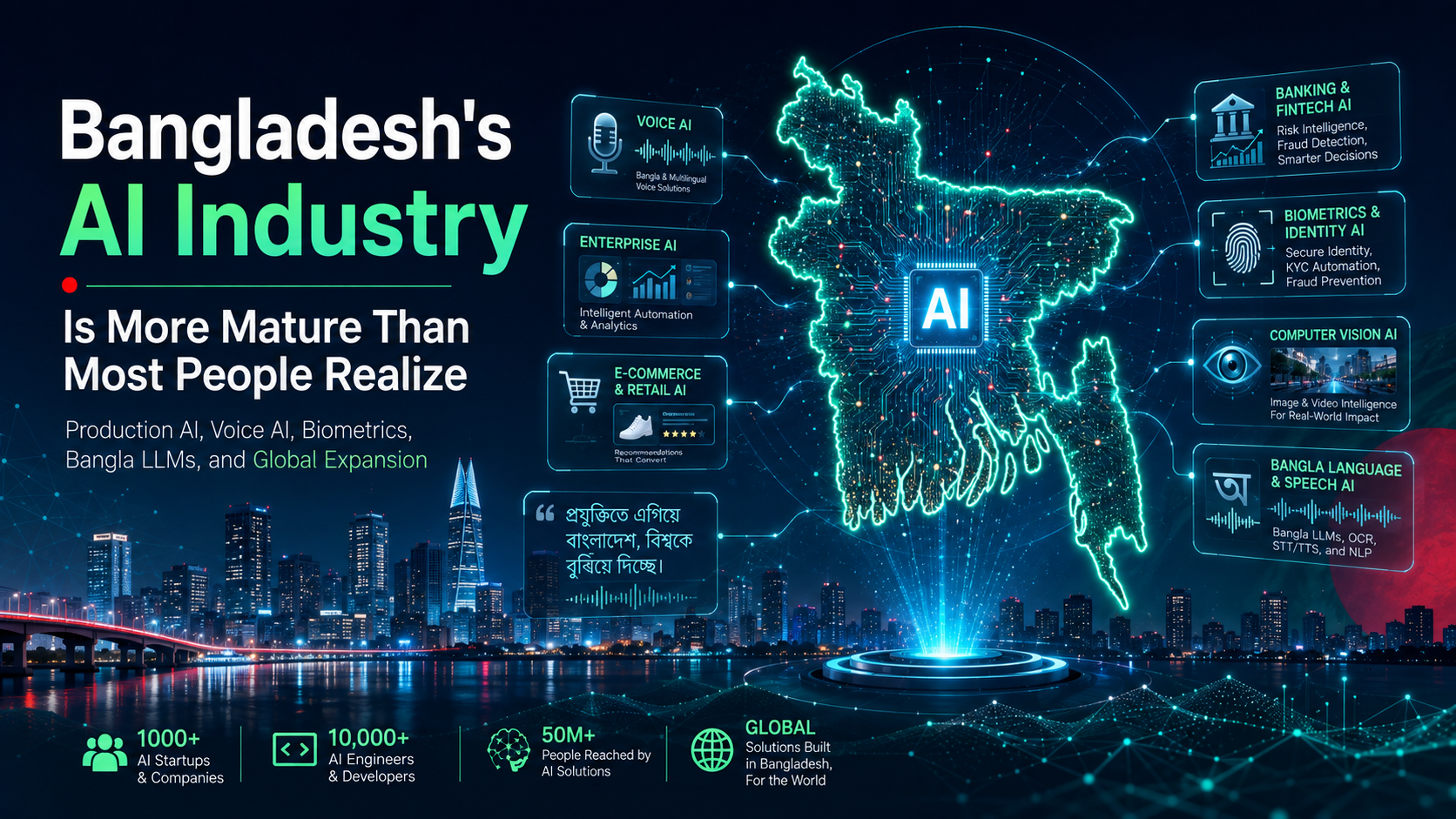
Bangladesh's AI Industry Is More Mature Than Most People Realize
When people discuss artificial intelligence, Bangladesh rarely appears in the same sentence as the United States, China, India, Singapore, or Japan.
That does not mean Bangladesh is absent from the AI race.
Behind the headlines, Bangladeshi engineers and technology companies are already building production AI systems for retail, banking, telecommunications, biometrics, computer vision, Bangla speech, ecommerce, customer service, and industrial operations.
Some of these systems are operating at a scale that may surprise even people working in Bangladesh's technology industry.
One locally developed AI solution has been used to recommend personalized promotions to approximately 2.3 million consumers across around 4,500 markets. Another Bangla AI system has supported 5,540 sales representatives across roughly 200,000 retail outlets. A Bangladesh-built biometric platform says its fingerprint technology is used across more than 500 million records globally.
And a new generation of Bangladeshi startups is now moving beyond conventional machine learning into Generative AI, Voice AI, proprietary Bangla language models, multimodal systems, and autonomous AI agents.
The important distinction is this: Bangladesh does not simply have companies using AI. It increasingly has companies building AI products, models, platforms, and intellectual property of their own.
This article examines the most significant AI solutions built by Bangladeshi companies as of August 2026, based on real deployment evidence, proprietary technology, commercial traction, international expansion, and independent reporting.
Quick Answer: What Are the Leading AI Solutions Built in Bangladesh?
Based on publicly verifiable evidence, the strongest Bangladesh-origin AI companies and solutions currently include:
| Rank | Company | Major AI Solutions | Primary AI Category | Evidence of Adoption |
|---|---|---|---|---|
| 1 | Intelligent Machines | Fordo, Shobdo, Jontro, Dharapat | Enterprise AI | Major enterprise deployments |
| 2 | Verbex.ai / Hishab | Voice AI agents, Bangla and Japanese speech AI | Voice AI | Bangladesh and Japan |
| 3 | Markopolo AI | Mark, Nabiq, DeepDive | Agentic commerce / Revenue AI | International SaaS expansion |
| 4 | TigerIT | TigerAFIS and biometric identity systems | Biometrics / Computer Vision | National-scale identity systems |
| 5 | Intelsense | Ekush LLM, SenseVoice, SenseSpeech | Bangla LLM / Speech AI | Proprietary model ecosystem |
| 6 | REVE / REVE Chat | Wize AI Agents, Voice Bot, NLP | Conversational AI | Thousands of global customers claimed |
| 7 | Revora, formerly MyAlice | AI operating platform for ecommerce | AI Commerce | International expansion and funding |
| 8 | Sigmind.ai | TrafficFlow, Watchcam, EnlytiX | Computer Vision / Video AI | Deployments across multiple countries |
| 9 | Gaze Technology | Visual recognition, face AI, OCR | Computer Vision | Major historical deployments |
| 10 | Socian | ConsumerBuzz | NLP / Social Intelligence | Enterprise social analytics |
There is no audited public leaderboard measuring the market share of every Bangladeshi AI company. Therefore, this ranking should be understood as a research-based assessment of technological significance and demonstrated adoption, not an official market-share table.
How I Evaluated Bangladeshi AI Companies
Typing "AI company in Bangladesh" into Google produces dozens of software development agencies.
That is not the same thing as finding companies that have actually built AI technology.
For this analysis, I gave greater weight to four factors.
1. Real Production Deployments
A machine learning demo is easy.
Running an AI system inside a bank, multinational FMCG company, government identity system, call center, ecommerce operation, or national distribution network is much more difficult.
Production deployments therefore receive the greatest weight.
2. Proprietary AI Technology
I looked for evidence of companies developing things such as:
- Language models
- Speech recognition
- Text-to-speech
- Computer vision
- Recommendation systems
- Predictive models
- Biometric algorithms
- AI agents
- Domain-specific machine learning
- Proprietary datasets or AI infrastructure
A company connecting an OpenAI API to a website can still build a useful product, but that is different from developing defensible AI technology.
3. Commercial Adoption
Customers, production usage, geographic expansion, transaction volume, and repeat deployments are stronger signals than awards or social media attention.
4. International Potential
The most interesting Bangladeshi AI companies are increasingly exporting technology rather than limiting themselves to Bangladesh.
Japan, Saudi Arabia, Southeast Asia, the GCC, and other international markets appear repeatedly in the expansion stories of several companies covered below.
1. Intelligent Machines — Bangladesh's Strongest Enterprise AI Story
If I had to choose one company that currently provides the strongest evidence of production-grade enterprise AI built in Bangladesh, I would choose Intelligent Machines Limited.
Founded in Bangladesh in 2018, Intelligent Machines focuses on applying AI and advanced analytics to difficult operational problems inside large enterprises.
Startup Bangladesh describes Intelligent Machines as a deep-tech startup building practical AI solutions and reports that large organizations in Bangladesh and Myanmar have used its products.
The company's significance becomes clearer when we look at individual deployments.
Fordo: AI-Powered Precision Marketing at Massive Scale
One of the strongest examples is Fordo, a precision-marketing AI solution used by Unilever Bangladesh.
According to The Daily Star's reporting on enterprise AI adoption in Bangladesh, Fordo has been used to recommend personalized discounts to approximately:
- 2.3 million consumers
- Across approximately 4,500 kitchen markets
- Throughout Bangladesh
The same report said conversion rates reached 6% or higher and sometimes approximately 13%, compared with around 1% before the AI-driven approach.
That is significantly more meaningful than a proof-of-concept chatbot.
It is AI being connected directly to revenue, customer behavior, retail distribution, and decision-making.
Shobdo: Bangla Speech Intelligence for BAT Bangladesh
Another Intelligent Machines solution, Shobdo, demonstrates why local-language AI can become a competitive advantage.
British American Tobacco Bangladesh reportedly used the Bangla keyword-spotting system to monitor and improve brand-message delivery involving approximately:
5,540 sales representatives across 200,000 retail outlets.
The reported effectiveness of brand-message delivery increased from approximately 15% to 75%.
For Bangladesh's AI industry, this use case is particularly important.
Global AI models are powerful, but they are not automatically optimized for Bangla speech, local accents, noisy retail environments, culturally specific terminology, or Bangladesh's distribution networks.
Companies that understand these environments can build something global platforms cannot easily replicate.
Jontro: Predictive Maintenance
BAT Bangladesh has also reportedly used Jontro, an Intelligent Machines predictive-maintenance solution.
Instead of replacing factory components on fixed schedules or waiting until equipment fails, predictive maintenance uses operational data to estimate when components are likely to require replacement.
This is a classical machine-learning application, but economically it can be extremely valuable.
Dharapat: AI for Financial Analysis
Intelligent Machines' Dharapat has been used by organizations including IDLC Finance and Prime Bank.
According to reporting on the deployments, the platform analyzes financial documents and Credit Information Bureau information, reducing processes that could previously take days to minutes.
This illustrates an important trend in enterprise AI.
The highest-value AI system is not always a flashy consumer chatbot.
Sometimes it is the system quietly eliminating thousands of hours of repetitive financial analysis.
Why Intelligent Machines Ranks #1
Intelligent Machines combines several characteristics that are still uncommon in Bangladesh:
proprietary AI + large enterprise clients + quantified deployments + multiple industries + years of production experience.
Among the companies researched for this article, it currently has one of the strongest collections of independently reported real-world AI deployments.
2. Verbex.ai / Hishab — Building Voice AI From Bangladesh to Japan
Verbex.ai, previously known as Hishab, is one of the most technically interesting companies in Bangladesh's AI ecosystem.
Its mission has revolved around making computers usable through natural voice interaction.
Startup Bangladesh's portfolio page for Hishab describes a vision in which people can interact with software through voice without requiring conventional IT literacy.
That mission is particularly relevant to Bangladesh, where accessibility cannot always assume a laptop, perfect literacy, or English-language interfaces.
The Hard Problem: Bangla Voice AI
Speech technology is considerably harder than simply translating text.
A useful Bangla Voice AI system must deal with:
- Regional accents
- Dialects
- Informal speech
- Banglish
- Background noise
- Natural interruptions
- Different speaking speeds
- Code switching
- Business-specific terminology
According to The Business Standard's profile of Verbex, the team had to build much of its Bangla voice technology from the ground up because suitable datasets, open-source tooling, and models were limited.
From Bangladesh to Japan
What makes Verbex especially interesting is that it did not remain a Bangladesh-only product.
The company has aggressively expanded into Japan, one of the world's most demanding enterprise technology markets.
Verbex's current company news documents Voice AI projects and proof-of-concept deployments involving Japanese organizations.
In 2026, these included work associated with:
- Miyoshi City Hall
- TV Tokyo Direct
- ENEOS
- Healthcare-related operations
- Customer-service automation
Verbex also announced that its distributed team spans Bangladesh, Japan, India, and Singapore.
That progression matters.
Exporting software development services from Bangladesh is common.
Exporting proprietary AI technology into Japanese enterprise operations is much less common.
Why Verbex Matters
Bangladesh is unlikely to compete with hyperscalers by spending billions of dollars training general-purpose frontier models.
But it can compete in areas where language, culture, regional datasets, workflow knowledge, and specialized model engineering matter.
Voice AI is one of those areas.
That makes Verbex one of Bangladesh's most important AI companies to watch.
3. Markopolo AI — Bangladesh's Global Agentic Commerce Bet
Markopolo AI represents another direction for the country's AI ecosystem: globally scalable SaaS.
The company began with AI-powered marketing automation and has increasingly evolved toward AI agents for revenue, marketing, customer engagement, and ecommerce.
Its current platform focuses heavily on behavioral intelligence and personalized customer engagement.
Mark, Nabiq and DeepDive
According to Startup Bangladesh's announcement about Markopolo's funding, its agent suite has included:
Mark — an AI media-buying agent designed to optimize campaigns across advertising platforms.
Nabiq — an AI sales agent designed for personalized cross-channel conversations at scale.
DeepDive — a social-listening and engagement system intended to transform consumer signals into actionable intelligence.
This evolution reflects a broader global shift from AI that generates content toward AI that performs work.
If you want a deeper technical explanation of this transition, I have also covered real-world agentic AI and production use cases.
$2 Million Seed Funding
In 2025, Markopolo raised a $2 million seed round led by Saudi-based Joa Capital, with participation from Team Ignite Partners and strategic angel investors.
Startup Bangladesh is also an investor.
The company has been expanding significantly in Saudi Arabia and the wider GCC market.
It also received support connected to Saudi Arabia's technology ecosystem and a grant through the TAQADAM program.
Why Markopolo Is Important
Markopolo's significance is different from Intelligent Machines.
Intelligent Machines has particularly strong evidence of deep enterprise deployments inside Bangladesh.
Markopolo is pursuing a more conventional global SaaS and venture-scale growth model.
If successful, that could make it one of Bangladesh's more internationally recognizable AI product companies.
4. TigerIT — One of Bangladesh's Largest AI Deployments Is Biometrics
The current AI conversation is dominated by LLMs.
That sometimes causes people to forget that artificial intelligence existed long before ChatGPT.
Biometric identification, fingerprint matching, facial recognition, iris recognition, and pattern matching are major branches of applied AI.
From that perspective, TigerIT Bangladesh has one of the country's most significant AI technology stories.
TigerAFIS
TigerIT developed TigerAFIS, an Automated Fingerprint Identification System.
According to TigerIT's biometric technology documentation, its proprietary fingerprint-matching technology is designed for extremely large-scale de-duplication.
The company states that TigerAFIS is used across more than 500 million records and processes an average of approximately 500,000 transactions per day globally.
Because these numbers come from the company itself, they should be treated as company-reported metrics rather than independently audited market statistics.
Even with that qualification, the scale is notable.
National Identity Infrastructure
TigerIT's technology portfolio includes systems related to:
- National identification
- Voter registration
- Fingerprint identification
- Border control
- Driving licenses
- Vehicle registration
- Passport-related systems
- Facial and iris biometrics
Its project portfolio also documents international identity projects, including deployments in countries such as Nepal and Bhutan.
Why TigerIT Belongs in an AI Ranking
TigerIT does not look like a 2026 Generative AI startup.
But technological importance should not be determined by hype cycles.
A biometric matching system operating against millions of identities can represent significantly deeper engineering than many AI wrappers currently receiving attention.
If we ranked Bangladeshi AI purely by number of records processed, TigerIT could potentially rank even higher.
5. Intelsense — Building a Bangla AI Technology Stack
Intelsense is one of the most ambitious companies in Bangladesh if the metric is ownership of the AI layer itself.
Instead of building only applications on top of external models, the company has developed a family of proprietary technologies around Bangla language, speech, document intelligence, and Generative AI.
Ekush LLM
One of its best-known products is Ekush LLM.
Intelsense describes Ekush as Bangladesh's first Bangla large language model.
The company positions it as an underlying language-intelligence layer for Bangla-focused applications.
SenseVoice
SenseVoice focuses on speech recognition.
The company's current technology site reports approximately 92% Bangla speech accuracy on its proprietary engine.
As with any vendor-reported benchmark, real-world performance will depend heavily on datasets, environments, accents, microphones, noise, and evaluation methodology.
The more important point is that Intelsense is investing directly in Bangla speech infrastructure.
SenseSpeech and Document AI
The broader Intelsense stack also includes speech generation and document intelligence.
Its current platform covers:
- Agentic AI
- Speech AI
- Document AI
- Language AI
- Generative AI
The company has also reported document-extraction capabilities for printed and handwritten information.
Funding
Intelsense announced a BDT 30 million — Tk 3 crore — pre-seed funding round in late 2024.
That remains relatively small by global AI standards, but local model development in Bangladesh is itself capital intensive.
Why Intelsense Is Important
Bangladesh's long-term AI independence will not come only from creating applications around American foundation models.
There is strategic value in developing:
Bangla datasets, Bangla embeddings, Bangla speech recognition, Bangla TTS, culturally aware language models, and local-domain evaluation benchmarks.
Intelsense is pursuing exactly that layer of the ecosystem.
6. REVE Systems and REVE Chat — AI Customer Engagement at Commercial Scale
REVE is an interesting case because its corporate structure is global, while substantial product development and engineering roots are connected to Bangladesh.
For a strict list of Bangladesh-headquartered startups, it requires a qualification.
For a list of AI technology substantially developed by Bangladeshi engineering teams, however, it is difficult to ignore.
REVE Chat and Wize AI
The modern REVE Chat platform combines:
- AI agents
- Chatbots
- AI copilots
- Voice bots
- Omnichannel customer engagement
- Workflow automation
- Ticketing
- Human handoff
- CRM and ecommerce integrations
Its newer Wize AI capabilities move beyond simple FAQ chatbots toward agents that can use customer context and connected business data to perform actions.
That could include:
product recommendations, bookings, order updates, lead capture, follow-ups, and other customer-service workflows.
Evidence of Commercial Scale
REVE Chat currently states that 3,000+ customers use the platform.
Its case-study materials also describe major deployments involving organizations such as bKash, where the platform reports support across a customer base of more than 80 million users and over one million conversations resolved monthly.
Those numbers should be interpreted as vendor case-study figures, but they indicate a commercially mature platform rather than an experimental AI project.
Bangla NLP
REVE Systems has also invested in Bangla speech-to-text, text-to-speech, NLP, and voice-bot technology.
This puts it in an strategically important segment where Bangladesh has a natural advantage: communication technology built for Bangla speakers.
7. Revora — The Evolution of MyAlice Into an AI Commerce Platform
Many people in Bangladesh's startup ecosystem will recognize the name MyAlice.
In 2026, the company rebranded as Revora and repositioned itself around an ambitious idea:
an AI operating layer for ecommerce businesses.
From Customer Support to AI-Native Commerce
MyAlice originally focused heavily on conversational commerce and consolidating customer communications.
Revora is attempting to move beyond that into a platform covering more of the ecommerce lifecycle.
That includes areas such as:
- Customer acquisition
- Conversion
- Customer support
- Retention
- Commerce automation
$2 Million Seed Round in 2026
In June 2026, The Daily Star reported that Revora raised $2 million.
The round was co-led by i2i Ventures and Oraseya Capital, with participation from investors including Anchorless Bangladesh, Conjunction Capital, F6 Ventures, Hi2 Global, and Orbit Startups.
Revora is best described as a Bangladesh- and Pakistan-origin company with an increasingly international footprint, rather than purely a domestic Bangladeshi startup.
Its growing focus on Saudi Arabia and the GCC also reflects an important trend.
Some of Bangladesh's best technology startups may build engineering capability locally while ultimately finding their largest markets overseas.
8. Sigmind.ai — Computer Vision for Bangladesh's Real-World Complexity
Computer vision in Bangladesh presents an unusually difficult engineering environment.
Consider traffic alone.
A vision system designed for neat North American roads may encounter:
- Buses
- Cars
- Motorcycles
- Rickshaws
- CNGs
- Bicycles
- Pedestrians
- Informal lane usage
- Heavy congestion
- Bangla number plates
- Variable lighting
- Dense visual scenes
That makes Bangladesh an interesting environment for developing robust vision systems.
Sigmind.ai has focused heavily on this problem.
TrafficFlow
TrafficFlow is Sigmind's intelligent traffic-management system.
Its capabilities include:
- Real-time traffic monitoring
- Congestion analysis
- Incident detection
- Traffic-flow optimization
- Violation detection
- Smart signal management
The company also supports Bangla and English number-plate recognition.
Watchcam
Its Watchcam products cover human and vehicle analytics.
Applications include:
- People counting
- Crowd analysis
- Behavior detection
- Vehicle classification
- License-plate recognition
- Speed analysis
- Entry and exit monitoring
- Security analytics
In 2025, The Daily Star reported that Sigmind had deployed solutions across seven countries.
EnlytiX and Agentic Video AI
The company's newer direction is especially interesting.
In August 2026, reporting on Bangladesh's emerging agentic-AI ecosystem described Sigmind's EnlytiX platform as part of a move toward AI capable of interpreting video systems and assisting with operational workflows.
This is conceptually different from conventional CCTV analytics.
The evolution looks something like this:
graph LR
    A[CCTV Camera] --> B[Computer Vision]
    B --> C[Object and Event Detection]
    C --> D[Context Understanding]
    D --> E[AI Agent]
    E --> F[Alert]
    E --> G[Search]
    E --> H[Operational Action]
Instead of humans watching dozens of screens, the goal is for AI to understand what is happening and surface or act on relevant events.
That is a potentially powerful direction for factories, logistics facilities, smart cities, transportation, and security operations.
9. Gaze Technology — An Early Computer Vision Pioneer
Before Generative AI became mainstream, Gaze Technology was already building computer-vision technology from Bangladesh.
Gaze worked on visual-recognition infrastructure including:
- Facial recognition
- Anti-spoofing
- OCR
- Number-plate recognition
- Identity verification
- Product recognition
- Intelligent surveillance
Forbes profiled Gaze as a Singapore- and Bangladesh-based AI startup and reported that it had raised around $1 million while serving customers that included Dhaka Metropolitan Police.
Gaze was also recognized in the Forbes 30 Under 30 Asia ecosystem.
Why Gaze Ranks Lower Today
Gaze's historical importance is clear.
What is less clear is its current 2026 commercial scale.
Compared with Intelligent Machines, Markopolo, Verbex, Intelsense, REVE, Revora, and Sigmind, there is considerably less recent public operating information available.
Therefore, I consider Gaze one of Bangladesh's important AI pioneers, but I would want newer customer and product metrics before ranking it among the country's current top five.
10. Socian — Bangla-Aware Social and Consumer Intelligence
Socian represents another branch of AI development that existed in Bangladesh long before the current LLM boom.
Its flagship ConsumerBuzz platform focuses on turning large volumes of digital conversations into business intelligence.
The system monitors and analyzes public opinions across digital media so companies can better understand:
- Brand perception
- Customer sentiment
- Consumer behavior
- Campaign performance
- Emerging discussions
- Customer feedback
For enterprises dealing with thousands or millions of unstructured comments, posts, reviews, and conversations, this becomes an NLP and information-extraction problem.
Socian's relevance is therefore not simply social-media monitoring.
Its deeper value proposition is transforming messy human language into structured business intelligence.
Emerging Company to Watch: FastCom AI
The most interesting new category appearing in Bangladesh in 2026 is agentic AI.
Traditional chatbots answer questions.
AI agents are designed to perform multi-step tasks and interact with business systems.
One emerging Bangladeshi company in this space is FastCom AI, developed under Ascend AI.
According to The Daily Star's August 2026 reporting on agentic AI in Bangladesh, FastCom AI is designed to automate customer interactions across:
- Messenger
- Web chat
The platform reportedly supports Bangla, Banglish, regional dialects, voice messages, and images.
More importantly, it can move beyond answering questions into actions such as:
placing orders, confirming addresses, booking delivery slots, retrieving business information, and updating records.
This is exactly where enterprise AI is heading globally.
The winning systems will not simply tell users what to do.
They will increasingly execute work under controlled permissions.
For engineers interested in how these systems are actually built, my comparison of LangGraph vs CrewAI vs AutoGen for production AI agents explores the architectural side of the problem.
An Important Separate Category: AI Built Inside Large Companies in Bangladesh
Not every important Bangladeshi AI system comes from an AI startup.
Large companies are increasingly building AI internally.
One of the best recent examples is Unilever Bangladesh's IQ Nexus.
IQ Nexus
In 2026, Unilever Bangladesh introduced IQ Nexus, a neural-network-based retail intelligence system.
According to The Business Standard, the platform analyzes information such as:
- Daily sales
- Outlet visits
- Market behavior
- Similar retail outlet patterns
- Product demand
The system uses these signals to help determine which products are likely to be needed at particular stores.
This allows inventory and sales decisions to be driven by predicted demand rather than intuition alone.
IQ Nexus also received recognition at the Bangladesh Retail Awards 2026.
Why I Did Not Put IQ Nexus in the Main Ranking
Unilever Bangladesh operates in Bangladesh, and the system is an important local AI deployment.
But Unilever itself is not a Bangladeshi-owned AI company.
Therefore, IQ Nexus belongs in a separate category from companies such as Intelligent Machines, Intelsense, Sigmind, and TigerIT.
That distinction matters when discussing what Bangladesh's own technology industry is actually building.
What I Deliberately Excluded From This Ranking
This distinction is essential.
There are hundreds of companies in Bangladesh that now advertise:
AI development, ChatGPT integration, AI agents, machine learning, Generative AI, or chatbot development.
Many are capable software companies.
But providing AI-development services is not automatically the same as owning a significant AI product.
For this article, I avoided ranking ordinary outsourcing companies simply because an online directory places them under "Artificial Intelligence."
I Also Excluded Some Famous AI Deployments
For example, Banglalink has deployed impressive AI experiences.
But an AI system running inside a Bangladeshi company should not automatically be described as Bangladesh-built AI if the underlying technology primarily comes from international platforms.
The difference is:
AI adopted in Bangladesh
versus
AI developed by Bangladeshi companies
Both matter.
But they answer different questions.
The Bangladesh AI Ecosystem in One Diagram
The companies covered in this article reveal a surprisingly diverse AI ecosystem.
graph TD
    A[Bangladesh AI Ecosystem] --> B[Enterprise AI]
    A --> C[Language and Voice AI]
    A --> D[Computer Vision]
    A --> E[Agentic Commerce]
    A --> F[Biometrics]
    A --> G[Customer Intelligence]

    B --> B1[Intelligent Machines]

    C --> C1[Verbex]
    C --> C2[Intelsense]
    C --> C3[REVE]

    D --> D1[Sigmind]
    D --> D2[Gaze]

    E --> E1[Markopolo]
    E --> E2[Revora]
    E --> E3[FastCom AI]

    F --> F1[TigerIT]

    G --> G1[Socian]
The most interesting observation is that Bangladesh is not developing a single "AI industry."
It is developing multiple specialized AI industries simultaneously.
Where Bangladesh Has a Real Competitive Advantage in AI
Bangladesh probably will not win an AI race based purely on GPU spending.
Training a frontier-scale general-purpose model requires enormous computing infrastructure, capital, datasets, research teams, and energy.
Trying to duplicate OpenAI, Google DeepMind, Anthropic, Meta, or xAI would therefore be an unrealistic national strategy.
Bangladesh has much better opportunities elsewhere.
Bangla Language Intelligence
Bangla remains underrepresented in many global AI datasets relative to English.
That creates opportunities in:
- Bangla LLMs
- Bangla ASR
- Bangla TTS
- Banglish understanding
- Regional dialect recognition
- Bangla OCR
- Voice agents
- Local-language RAG systems
Verbex and Intelsense are especially relevant here.
Retail and Distribution Intelligence
Bangladesh has unusually complex retail and distribution networks.
The Intelligent Machines deployments demonstrate how local AI can become valuable when trained around these operating realities.
Computer Vision for Dense Environments
Dhaka traffic, factories, retail outlets, industrial facilities, and dense urban infrastructure provide computer-vision problems very different from clean benchmark datasets.
Sigmind and Gaze represent this opportunity.
Biometrics and Digital Identity
TigerIT demonstrates that Bangladesh already possesses experience in large-scale biometric infrastructure.
Identity technology will remain strategically important as digital government, fintech, travel, authentication, and online services expand.
AI Agents for Commerce
Bangladesh also has millions of commerce interactions occurring through Facebook, Messenger, WhatsApp, Instagram, and informal conversational channels.
That makes conversational commerce agents particularly compelling.
Markopolo, Revora, FastCom AI, and REVE are attacking different parts of this problem.
From Machine Learning to Agentic AI: Bangladesh's AI Industry Is Entering a New Phase
The first generation of Bangladesh's AI companies focused largely on:
prediction, classification, analytics, speech recognition, biometrics, recommendation systems, and computer vision.
Those technologies remain important.
But the new generation is adding reasoning and autonomous action.
graph LR
    A[Traditional Analytics] --> B[Machine Learning]
    B --> C[Deep Learning]
    C --> D[Generative AI]
    D --> E[RAG Systems]
    E --> F[AI Agents]
    F --> G[Autonomous Business Workflows]
This transition is visible across several companies.
Markopolo is building revenue and commerce agents.
REVE is moving customer support toward action-oriented agents.
FastCom AI is connecting conversational AI with ecommerce workflows.
Sigmind is applying agentic ideas to video intelligence.
Intelsense is building agentic systems on top of its language, speech, and document stack.
The next major competition may therefore not be about who has the best chatbot.
It may be about which company can safely connect AI reasoning to real business systems and allow it to complete work autonomously.
Bangladesh Still Faces Serious AI Challenges
The success stories should not hide the structural problems.
A 2026 research study titled Bangladesh AI Readiness: Perspectives from the Academia, Industry, and Government analyzed Bangladesh's AI ecosystem through institutional analysis, curriculum benchmarking, and interviews with 59 stakeholders.
The researchers identified major challenges including:
- Limited computing resources
- Outdated educational curricula
- Insufficient faculty development
- Weak research capacity
- Academia-industry disconnects
- Gender disparities
- Limited AI ethics education
These are not minor issues.
AI leadership increasingly depends on access to compute, data, research talent, capital, infrastructure, and strong institutions.
Software engineering talent alone is not enough.
The Biggest Opportunity Is Not Building Another ChatGPT
There is a temptation in every emerging AI ecosystem to ask:
"When will we build our own ChatGPT?"
That may be the wrong question.
Bangladesh does not necessarily need a $10 billion general-purpose foundation model to create a globally significant AI industry.
It needs to find areas where local knowledge creates an advantage.
The evidence in this article suggests several possibilities:
Voice AI that understands Bangla better.
Retail AI trained around South Asian distribution systems.
Computer vision capable of understanding Dhaka's roads.
Biometric technology for national-scale identity infrastructure.
AI agents optimized for conversational ecommerce.
Financial AI designed around local documents and workflows.
Those systems may have smaller models.
But they can produce much larger economic value for the problems they solve.
Which Bangladeshi AI Companies Should We Watch Most Closely?
If I were tracking Bangladesh's AI ecosystem over the next several years, six companies would receive particularly close attention.
Intelligent Machines
Watch whether it can convert its deep Bangladesh enterprise experience into a regional or global enterprise AI business.
Verbex
Watch its Japanese expansion.
Successful enterprise adoption in Japan could become one of the strongest examples of Bangladesh-origin AI intellectual property entering a highly developed market.
Markopolo AI
Watch its transition from marketing technology to agentic commerce and whether its Saudi expansion develops into durable international revenue.
Intelsense
Watch whether its Bangla model, speech, and document technology becomes foundational infrastructure used by other companies.
Revora
Watch its attempt to become an AI operating layer rather than another customer-support application.
Sigmind
Watch whether agentic video intelligence turns its computer-vision expertise into a scalable international platform.
And I would add FastCom AI to the emerging watchlist because conversational commerce is unusually well suited to Bangladesh's digital business environment.
What Success Would Look Like for Bangladesh
The goal should not simply be having hundreds of companies with "AI" on their websites.
A healthy AI ecosystem would produce companies that own:
models, datasets, patents, algorithms, deployment expertise, vertical knowledge, infrastructure, and recurring product revenue.
It would also connect universities, startups, enterprises, government agencies, and international markets.
The real milestones would be things like:
- A Bangla Voice AI company becoming a global market leader
- A Bangladeshi AI startup reaching $100 million in recurring revenue
- Local foundation models becoming widely used infrastructure
- AI research from Bangladesh appearing consistently at top conferences
- AI products being exported instead of only software-development labor
- Bangladeshi companies acquiring international AI startups
- Global enterprises running mission-critical operations on Bangladesh-built AI
Those achievements would represent something more meaningful than another AI hackathon or chatbot launch.
They would indicate that Bangladesh had moved from AI consumption to AI production.
Frequently Asked Questions About AI Companies in Bangladesh
What is the best AI company in Bangladesh?
There is no official ranking.
Based on publicly documented production deployments, Intelligent Machines currently has one of the strongest cases for being Bangladesh's leading enterprise AI product company.
Its systems have been associated with organizations including Unilever, BAT Bangladesh, IDLC Finance, Prime Bank, bKash, and other major enterprises.
Which Bangladeshi company is building Bangla Voice AI?
Verbex.ai, formerly Hishab, is one of the most prominent Bangladesh-origin Voice AI companies.
Intelsense and REVE Systems are also developing Bangla speech, language, and conversational AI technologies.
Does Bangladesh have its own LLM?
Yes.
One prominent commercial effort is Intelsense's Ekush LLM, developed specifically around Bangla language intelligence.
Bangladesh also has a growing academic and open-source NLP research community working on Bangla language models and datasets.
Which Bangladesh company builds AI for banking?
Intelligent Machines has developed financial AI systems including Dharapat, which has been used by financial institutions including IDLC Finance and Prime Bank.
Other companies increasingly provide conversational and document AI for financial services as well.
Which Bangladeshi company builds biometric AI?
TigerIT Bangladesh is one of the country's most established biometric technology companies.
Its portfolio includes fingerprint identification, facial recognition, iris technology, national ID systems, voter registration, and related identity infrastructure.
Are there Generative AI startups in Bangladesh?
Yes.
The ecosystem now includes companies working on Generative AI, LLMs, Voice AI, RAG, agentic AI, ecommerce agents, document intelligence, and multimodal AI.
Intelsense, Markopolo, REVE, Revora, Verbex, FastCom AI, and other emerging companies are examples of this transition.
Is Bangladesh competitive globally in AI?
Bangladesh is not yet a global AI research or infrastructure leader.
However, it has promising strengths in Bangla language technology, enterprise applied AI, biometrics, computer vision, Voice AI, and conversational commerce.
The strongest opportunity is likely to come from specialized AI systems solving problems where local language, data, and operating knowledge matter.
Final Thoughts
The most important lesson from researching Bangladesh's AI industry is simple:
Bangladesh is no longer only an importer of artificial intelligence.
Bangladeshi companies are building real AI.
Some systems analyze millions of consumer interactions.
Some understand Bangla speech.
Some identify people across massive biometric databases.
Some analyze Dhaka's chaotic traffic.
Some automate financial analysis.
Some are answering telephone calls in Japan.
And a new generation is beginning to build AI agents capable of completing business tasks rather than merely generating text.
The ecosystem remains young. Access to compute, research funding, advanced AI education, and global capital is still limited.
But the foundation is increasingly visible.
The next chapter for Bangladesh will depend on whether companies can move from successful local AI projects to defensible global AI products.
That is the transition worth watching.
Research Sources and Further Reading
This article was researched using company documentation, investment announcements, independent journalism, and current academic research. Important sources include:
- Startup Bangladesh — Intelligent Machines
- The Daily Star — Businesses riding the AI wave
- Verbex.ai
- Verbex News and Japan deployments
- Startup Bangladesh — Hishab
- The Business Standard — How Verbex.ai is giving AI a Bangladeshi accent
- Markopolo AI
- Startup Bangladesh — Markopolo.ai $2 million funding
- TigerIT — Biometric Solutions
- TigerIT — Projects
- Intelsense Technology
- Sigmind.ai
- The Daily Star — TrafficFlow
- The Daily Star — Bangladesh companies move toward agentic AI
- REVE Chat
- The Daily Star — Revora raises $2 million
- Forbes — Gaze
- Socian AI
- The Business Standard — Unilever IQ Nexus
- Bangladesh AI Readiness — 2026 research paper
Related AI Engineering Articles
If you are exploring how these technologies are implemented in production, you may also find these useful:
- Real-World Agentic AI: 10 Production Use Cases Across Industries
- LangGraph vs CrewAI vs AutoGen 2026: A Bangladesh AI Engineer's Production Verdict
- Inside Bangladesh's Largest AI Hackathon: What Makes AI Production-Ready
Research reviewed and updated: August 17, 2026.