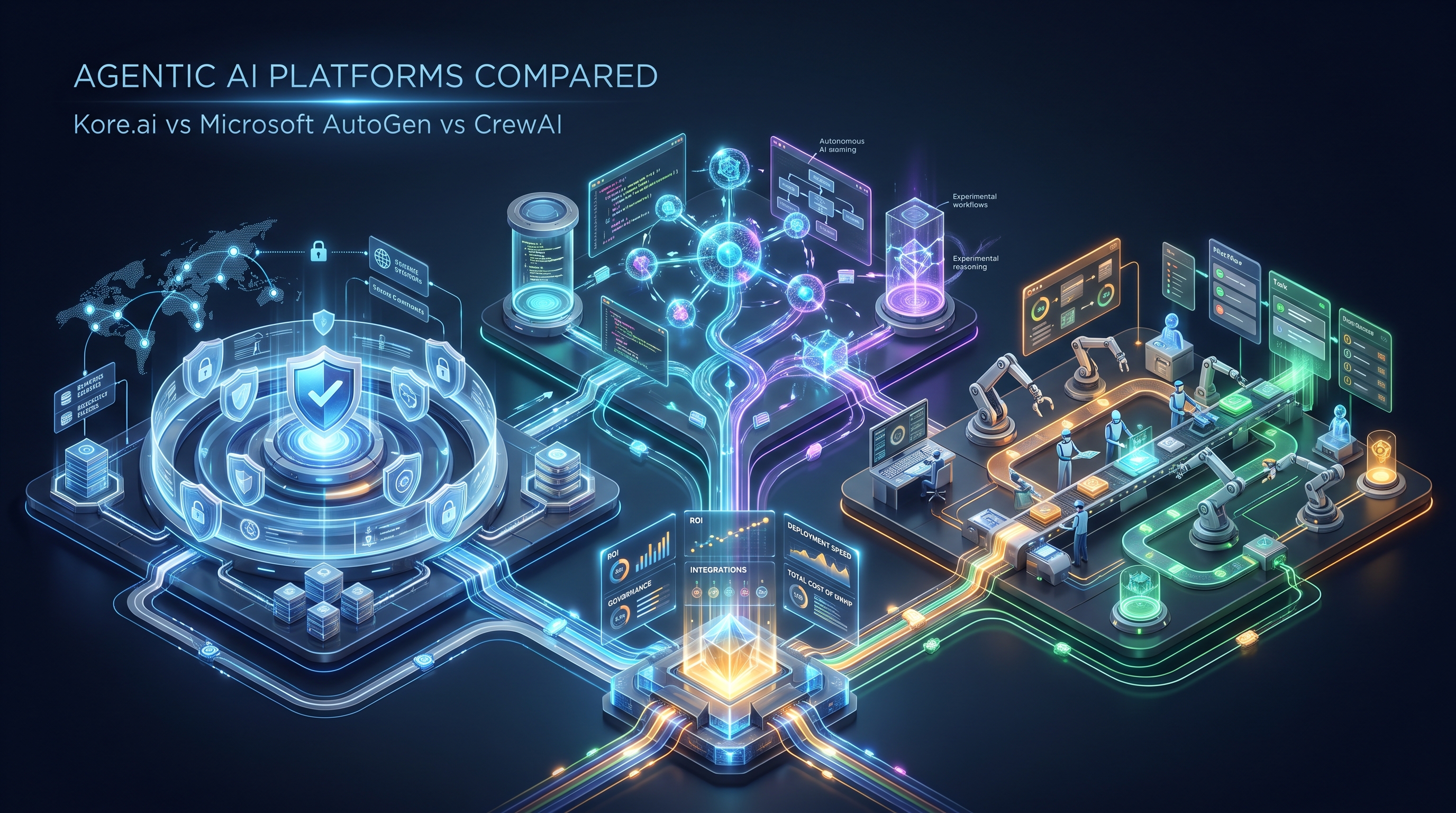
Agentic AI Platforms Compared: Kore.ai vs Microsoft Autogen vs CrewAI
The C-suite conversations around AI have fundamentally shifted. The question is no longer "Should we adopt AI?" but rather "Which agentic platform will deliver measurable ROI in the next 12 months?"
With the global agentic AI market projected to explode from $7.55 billion in 2025 to $199 billion by 2034—a staggering 43.84% CAGR—enterprises face a critical inflection point. By the end of 2026, 40% of enterprise applications will include task-specific AI agents. Yet choosing the wrong platform can cost you $500K+ in wasted infrastructure spend and 12-18 months of implementation delays.[thesunflowerlab]
After analyzing deployment data from Fortune 500 implementations, benchmarking performance metrics, and evaluating total cost of ownership across three leading platforms, this analysis reveals which solution fits your specific enterprise requirements. The stakes are high: over 60% of companies deploying agentic AI expect 2x+ ROI within 24 months, but success hinges on matching platform capabilities to your organization's maturity, scale, and technical resources.[wavestone]
The Agentic AI Landscape: Why 2026 Is the Year of Multi-Agent Orchestration
Traditional AI assistants respond to queries. Agentic AI systems reason, plan, and execute complex multi-step workflows autonomously. The distinction matters because enterprises are reporting 5x-10x returns when they deploy agents that can coordinate across teams, make context-aware decisions, and learn from operational patterns.[onereach]
Three platforms have emerged as enterprise-grade leaders, each serving distinct market segments:
Kore.ai dominates the Fortune 2000 space with 400+ global enterprise customers, offering end-to-end orchestration for organizations requiring 100+ system integrations and regulatory compliance across healthcare, financial services, and telecommunications.[kore]
Microsoft Autogen, backed by Microsoft Research, leads in flexibility and research applications, achieving breakthrough performance on complex benchmarks (doubling success rates on GAIA Level 3 questions) while remaining 100% open-source and free.[microsoft]
CrewAI has captured 40-50% of Fortune 500 companies with rapid deployment cycles (4-8 weeks vs. 6-18 months for enterprise alternatives), executing over 10 million agents monthly through its developer-friendly, role-based framework.[docs.raiaai]
The market validates this segmentation: enterprises deploying agentic AI report 20-30% productivity gains, 67% reduction in process completion time, and cost savings of $1-$4 per dollar invested.[onereach]
Platform Deep Dive: Architecture, Capabilities, and Trade-offs
Kore.ai: Enterprise-Grade Multi-Agent Orchestration for Regulated Industries
Core Architecture & Differentiation
Kore.ai delivers a unified platform spanning AI, data infrastructure, and core services—positioning itself as an "enterprise operating system" for agentic AI. The platform's competitive moat lies in three architectural pillars:[kore]
1. Advanced Multi-Agent Orchestration supports intelligent routing, context switching, and declarative business rule enforcement across agents with varying autonomy levels—from human-guided systems to fully autonomous operations. This flexibility enables organizations to calibrate risk and control based on process criticality.[silicon.co]
2. Graph-RAG Powered Search and Data AI provides enterprise-grade context through 100+ pre-built connectors for structured and unstructured data. The system employs hybrid keyword and multi-vector weighted search, dynamic query pipelines, and real-time context enhancement—ensuring agents operate with accurate, governed information across Salesforce, SAP, ServiceNow, and legacy systems.[docs.kore]
3. Model, Cloud, and Data Agnostic Design allows enterprises to deploy any LLM (OpenAI, Anthropic, Google), on any cloud (AWS, Azure, GCP), with any data architecture. This reduces vendor lock-in and enables organizations to optimize costs by switching models based on task complexity.[kore]
The platform unifies three product families: AI for Service (customer experience automation), AI for Work (employee productivity with enterprise search), and AI for Process (business operations automation with compliance tracking).[kore]
Security, Compliance & Enterprise Governance
Kore.ai operates at the intersection of innovation and regulation, supporting SOC 2 Type II, HIPAA, GDPR, and ISO 27001 certifications. The platform implements:[kore]
-
Role-based access control (RBAC) with granular permissions for model configuration and deployment[kore]
-
AES-256 encryption for data at rest and in transit[infohub.delltechnologies]
-
Dynamic data masking and PII compliance to secure sensitive information during AI processing[brightendigital.github]
-
Comprehensive, immutable audit trails with time-stamped logs for regulatory transparency[kore]
-
Prompt injection protection and content filters to prevent malicious attacks[brightendigital.github]
These capabilities make Kore.ai the preferred choice for financial services, healthcare, and telecommunications—industries where regulatory penalties and reputational risk exceed the cost of platform investment.
Customer Success & ROI Evidence
Real-world deployments demonstrate measurable impact:
-
Financial Services: 74% increase in IT support containment rates, 20% operational cost reduction, and $9 million in automated savings within 24 months[aipressroom]
-
Healthcare: 90% containment rate with significant reductions in response times through personalized conversational workflows[aipressroom]
-
Retail: Near-perfect intent recognition (99%+) and doubled targeted containment rates in year one[aipressroom]
The platform's 300+ pre-built AI agents marketplace enables enterprises to deploy solutions 10x faster than custom builds, accelerating time-to-value in competitive markets.[kore]
Pricing & Total Cost of Ownership
Kore.ai employs a tiered pricing model designed for enterprise budgets:[topadvisor]
-
Essential: $50/month (annual billing) for small teams
-
Advanced: $150/month (annual billing) with higher limits
-
Enterprise: $300,000+ annually (custom pricing) for Fortune 2000 deployments
The platform uses session-based billing (15-minute conversation blocks), which can create unpredictable costs for high-volume use cases. Enterprise implementations typically require 6-18 months for full deployment due to deep system integrations, custom workflows, and change management requirements.[eesel]
When Kore.ai Wins
Choose Kore.ai when:
-
Your organization operates in regulated industries (finance, healthcare, pharma)
-
You require 100+ enterprise system integrations with legacy infrastructure
-
Budget exceeds $300K annually with 6-18 month implementation timelines acceptable
-
Governance, auditability, and compliance are non-negotiable requirements
-
You need proven scalability across global, multi-tenant deployments supporting millions of users[bradsol]
Microsoft Autogen: Research-Grade Flexibility for Complex Problem-Solving
Core Architecture & Innovation Edge
Autogen represents Microsoft Research's breakthrough in multi-agent frameworks, fundamentally rethinking agent coordination through asynchronous message-passing and event-driven workflows. The architecture comprises three layers:[akira]
1. Core API handles low-level message passing, agent lifecycle management, and event-driven runtime—providing the plumbing for agent communication without imposing opinionated structures.[tribe]
2. AgentChat API offers high-level abstractions for rapid prototyping, including pre-built agent types (AssistantAgent, UserProxyAgent, GroupChatManager) that accelerate common multi-agent patterns.[sparkco]
3. Extensions API enables integration of custom tools, LLM backends (OpenAI, Azure OpenAI, Hugging Face, Ollama), and memory systems (Redis, Pinecone, Qdrant).[mgx]
This modularity creates unprecedented flexibility: developers can configure agents to use any combination of LLMs, human inputs, and tools—enabling hybrid workflows where GPT-4 handles reasoning, Claude provides content generation, and local models execute data-sensitive tasks.
Performance Benchmarks & Real-World Impact
Autogen's multi-agent approach delivers quantifiable advantages over single-agent systems:
-
GAIA Benchmark Leadership: A four-agent team achieved top results, outperforming competitors by 8+ points and doubling performance on Level 3 questions (which require arbitrarily long action sequences and tool use)[microsoft]
-
Speed Advantage: 5.76x faster execution than LangGraph on QA tasks while achieving higher evaluation scores[github]
-
Code Execution Excellence: Docker-based secure execution enables agents to write, debug, and self-correct code autonomously—critical for software development, data analysis, and scientific computing workflows[charterglobal]
Industry deployments validate these capabilities:
-
Pharmaceutical R&D: Novo Nordisk deployed a production-ready multi-agent framework for deriving insights from technical data[baytechconsulting]
-
Supply Chain Optimization: 28% reduction in inventory costs, 35% improvement in on-time delivery through predictive disruption modeling[mgx]
-
Financial Risk Management: 40% improvement in risk prediction accuracy by identifying complex interdependencies across datasets[mgx]
-
Healthcare Operations: Optimized patient scheduling, resource allocation, and EHR integration with real-time adjustments reducing operational costs[mgx]
Flexibility vs. Complexity Trade-off
Autogen's strength—unlimited customization—creates a steep learning curve. The framework requires:
-
Python expertise for agent configuration and workflow design
-
Understanding of asynchronous programming patterns and message-passing systems
-
Ability to debug complex multi-agent interactions (though built-in OpenTelemetry support helps)[mgx]
-
Cost management discipline, as iterative agent conversations can consume significant LLM tokens[shadhinlab]
Autogen lacks inherent workflow concepts; developers must design orchestration logic, termination conditions, and escalation paths manually. For teams without deep technical resources, this flexibility becomes a liability.[github]
Pricing & Cost Structure
Autogen's economics differ fundamentally from commercial platforms:[lindy]
-
Framework: 100% free (MIT license, open-source)
-
LLM Costs: Variable based on model selection (GPT-4, Claude, local models)
-
Hosting: Azure compute charges or self-hosted infrastructure
-
Tools/Integrations: Per-provider pricing (databases, APIs, web scraping)
This model favors organizations with:
-
Technical teams capable of managing infrastructure
-
Workloads suited to cost-effective models (GPT-4o mini, local LLMs)
-
Budget flexibility to absorb unpredictable LLM token consumption during development
When Autogen Wins
Choose Autogen when:
-
Your primary use cases involve research, complex problem-solving, or exploratory workflows
-
You require maximum flexibility to integrate custom tools, models, and execution environments
-
Technical teams have Python expertise and can manage infrastructure complexity
-
Azure ecosystem integration provides synergy with existing Microsoft deployments
-
Secure code execution (Docker-based) is critical for software development or data analysis
-
Budget prioritizes LLM cost control over platform licensing fees
CrewAI: Production-Ready Orchestration for Developer Teams
Core Architecture & Speed-to-Market Advantage
CrewAI emerged from a design principle: make multi-agent systems accessible to developers without sacrificing production capabilities. The framework implements role-based orchestration through four core primitives:[github]
1. Agents are defined with role, goal, backstory, tools, and memory—providing clear specialization and personality that improves LLM performance through focused prompting.[deepfa]
2. Tasks represent work units with defined expectations, dependencies, and success criteria. Tasks execute sequentially or in parallel, with results feeding into subsequent steps.[deepfa]
3. Crews coordinate agents and tasks through configurable processes: sequential (pipeline), hierarchical (manager-worker), or custom workflows with conditional branching.[wednesday]
4. Flows add precision control through Python decorators (@start, @listen, @router) that enable complex triggering conditions, state management, and dynamic routing based on crew outputs.[github]
This architecture delivers structured automation without the complexity of raw message-passing frameworks. Developers describe agents, define tasks, and let CrewAI handle orchestration—reducing boilerplate code by 60% compared to LangGraph.[github]
Enterprise Edition & Production Infrastructure
CrewAI's enterprise offering, launched in late 2024 after a successful beta with 150 organizations, adds production-grade capabilities:[techstrong]
-
No-Code Builder: Visual agent design interface for business users[microsoft]
-
Observability Dashboard: Real-time agent execution traces, token usage tracking, cost analysis per workflow[youtube]
-
Deployment Options: CLI-based deployment to CrewAI AMP, GitHub integration, API redeployment for CI/CD pipelines[docs.crewai][youtube]
-
Monitoring & Testing: Execution logs, input/output validation, agent performance metrics, A/B testing for crew configurations[youtube]
-
Governance Controls: Environment variable management, LLM connection limits, execution quotas to prevent runaway costs[youtube]
The platform executes 100,000+ multi-agent workflows daily across hundreds of use cases, demonstrating production-level scalability.[insightpartners]
Performance & Developer Experience
Comparative benchmarks reveal CrewAI's operational advantages:[sparkco]
-
Deployment Speed: 40% faster than Autogen (6 weeks vs. 3 months for complex workflows)
-
Accuracy: 95% in structured workflows vs. 88% for Autogen's conversational approach
-
Developer Productivity: 40% increase due to intuitive interfaces and comprehensive tooling
-
Error Reduction: 15% decrease through deterministic execution models
-
Debugging Efficiency: 25% reduction in debugging time via clear documentation and modular testing
These metrics translate to faster time-to-value: enterprises implementing CrewAI report 4-8 week deployment cycles, compared to 6-18 months for enterprise alternatives like Kore.ai.[docs.raiaai]
Pricing & Execution Economics
CrewAI employs execution-based pricing tied to workflow runs:[lindy]
-
Free: $0/month (50 executions, 1 deployed crew, 1 seat)
-
Basic: $99/month (100 executions, 2 crews, 3 seats)
-
Standard: $500/month (1,000 executions, 5 crews, 10 seats)
-
Pro: $1,000/month (2,000 executions, 10 crews, unlimited seats)
-
Enterprise/Ultra: Custom pricing for private cloud, enhanced onboarding, 24/7 support
Critical Cost Consideration: An "execution" counts each time an agent completes a task or workflow step. Complex multi-agent systems with 10+ agents can consume quotas rapidly—teams must monitor usage carefully to avoid unexpected tier upgrades.[lindy]
Limitations & Trade-offs
CrewAI's structured approach imposes constraints:[turing]
-
No Native Code Execution: Agents can write code but cannot execute it (unlike Autogen's Docker-based execution). For data analysis or software development workflows requiring iterative debugging, this limitation forces external integrations.[shadhinlab]
-
Tool Ecosystem Dependency: While CrewAI offers 100+ tools, the framework relies heavily on LangChain and external integrations. Custom tool development requires understanding these dependencies.[youtube]
-
Hierarchical Complexity: While CrewAI supports hierarchical workflows, configuring manager-worker patterns with dynamic task allocation requires advanced knowledge of the framework's state management.
-
Cost Predictability: Fixed execution quotas force organizations to estimate workflow complexity upfront. Underestimating can trigger mid-month tier upgrades; overestimating wastes budget on unused capacity.
When CrewAI Wins
Choose CrewAI when:
-
Speed-to-market matters: 4-8 week deployment cycles are strategically important
-
Your workflows map to structured, repeatable processes (content generation, data pipelines, report automation)
-
Developer teams prefer intuitive abstractions over low-level customization
-
Budget ranges from $1K-$50K annually (small to mid-market scale)
-
You need production-grade observability (traces, costs, metrics) without building infrastructure
-
Fortune 500 validation matters: 40-50% adoption rate demonstrates enterprise readiness[emarketer]
Comparative Analysis: Matching Platform Capabilities to Enterprise Requirements
Architecture & Orchestration Patterns
| Capability | Kore.ai | Microsoft Autogen | CrewAI |
|---|---|---|---|
| Orchestration Model | Hierarchical supervisor-worker with rule-based coordination | Asynchronous message-passing, conversational agents | Role-based crews with sequential/hierarchical processes |
| Agent Autonomy Spectrum | Variable (human-guided → fully autonomous) | High (self-correcting, iterative) | Medium (structured task delegation) |
| Context Management | Shared memory with RBAC, graph-RAG search | Buffer history, vector store RAG, persistent memory | Short-term, long-term, entity, contextual memory |
| Workflow Flexibility | Declarative rules, event-driven triggers | Fully programmable via Python | Decorator-based flows with conditional routing |
| Code Execution | Not primary focus | Docker-based secure execution | Write-only (no execution) |
Decision Criterion: If your workflows require dynamic problem-solving with unpredictable branching, choose Autogen. For governed, repeatable processes with audit requirements, choose Kore.ai. For structured automation with developer velocity, choose CrewAI.
Integration & Ecosystem
| Dimension | Kore.ai | Microsoft Autogen | CrewAI |
|---|---|---|---|
| Pre-Built Connectors | 100+ (Salesforce, SAP, ServiceNow, ERP) | None (custom integration via Extensions API) | 1,000+ via LangChain ecosystem |
| LLM Support | Any (OpenAI, Anthropic, Google, local models) | OpenAI, Azure OpenAI, Hugging Face, Ollama | Any LLM via unified interface |
| Deployment Options | On-premise, AWS, Azure, GCP, hybrid | Self-hosted, Azure Container Apps, Kubernetes | CrewAI AMP (cloud), GitHub integration, CLI |
| API/SDK Quality | Enterprise REST/GraphQL, SDKs for major languages | Python SDK (pip install), limited .NET support | Python-native, CLI tools |
Decision Criterion: Kore.ai wins for legacy system integration requirements. Autogen wins for custom tooling and Azure synergy. CrewAI wins for rapid prototyping with modern SaaS applications.
Security, Compliance & Governance
| Requirement | Kore.ai | Microsoft Autogen | CrewAI |
|---|---|---|---|
| Certifications | SOC 2 Type II, HIPAA, GDPR, ISO 27001 | Inherit from Azure (SOC 2, ISO 27001, HIPAA) | Managed via enterprise edition |
| Data Encryption | AES-256 (rest/transit), HSM key management | Azure encryption standards | LLM provider encryption |
| Audit Trails | Comprehensive, immutable, time-stamped | OpenTelemetry instrumentation | Built-in execution logs (enterprise) |
| RBAC | Granular permissions, model governance | Requires custom implementation | Environment-based access controls |
| Content Safety | Prompt injection protection, PII masking | Requires external guardrails | LLM provider safety filters |
Decision Criterion: Kore.ai is the only platform architected for regulated industries from the ground up. Autogen on Azure provides compliance through infrastructure. CrewAI relies on enterprise edition features and LLM provider controls.
Performance & Scalability
| Metric | Kore.ai | Microsoft Autogen | CrewAI |
|---|---|---|---|
| Throughput | Enterprise-scale (millions of users) | Scales with infrastructure | 10M+ agents/month, 100K executions/day |
| Latency | Optimized for real-time conversations | Variable (depends on agent iterations) | Fast for structured workflows |
| Concurrency | Multi-tenant architecture, load balancing | Horizontal scaling via Kubernetes | Execution-based limits per tier |
| Cost Efficiency | High upfront, economies of scale | Pay only for LLM/compute usage | Predictable tier pricing |
Benchmark Insight: CrewAI executes workflows 40% faster than Autogen in structured scenarios. Autogen excels at complex reasoning tasks where iterative agent conversations justify longer execution times. Kore.ai handles enterprise volume with guaranteed SLAs.[shadhinlab]
Total Cost of Ownership (TCO) Analysis
| Cost Component | Kore.ai | Microsoft Autogen | CrewAI |
|---|---|---|---|
| Platform Licensing | $300K+/year | $0 (open source) | $1.2K-$12K/year (Basic-Pro) |
| Implementation Services | $100K-$500K (6-18 months) | Internal team labor (3-9 months) | $10K-$50K (4-8 weeks) |
| LLM API Costs | Included in session pricing | Variable ($500-$5K+/month) | Separate (pass-through to LLM providers) |
| Infrastructure | Managed (cloud) or self-hosted | $500-$5K+/month (Azure compute) | Included in CrewAI AMP |
| Maintenance & Support | Enterprise SLAs included | Community + Azure support | Email support (Pro), 24/7 (Enterprise) |
| Training & Change Mgmt | $50K-$200K (enterprise-wide) | Internal (developer-focused) | $5K-$20K (workshops) |
3-Year TCO Example (Mid-Market Company, 500 Employees):
-
Kore.ai: $1.2M-$1.8M (platform + implementation + change management)
-
Autogen: $180K-$300K (LLM + compute + 2 FTE developers)
-
CrewAI: $100K-$200K (platform + implementation + LLM costs)
Decision Criterion: CrewAI offers the best TCO for SMB/mid-market. Autogen minimizes platform costs but requires technical investment. Kore.ai justifies premium pricing through enterprise scale and compliance.
Strategic Decision Framework: Choosing Your Agentic Platform
Phase 1: Assess Organizational Readiness
AI Maturity Scoring (Rate 1-5 for each dimension):
-
Data Infrastructure: Do you have unified, governed data accessible across systems?
-
Technical Capacity: Can your teams manage AI infrastructure, debug complex systems, and customize frameworks?
-
Change Management: Has leadership secured budget, executive sponsorship, and cross-functional alignment?
-
Compliance Requirements: Do regulatory mandates (HIPAA, GDPR, SOC 2) constrain your AI deployment?
Scoring Guidance:
-
Total Score 16-20 (High Maturity): Evaluate Kore.ai or Autogen based on budget and use case complexity
-
Total Score 11-15 (Medium Maturity): CrewAI or Autogen (if technical team strong)
-
Total Score 6-10 (Early Stage): Start with CrewAI free tier to build capabilities before enterprise commitment
Phase 2: Map Use Cases to Platform Strengths
| Use Case Category | Best Platform | Rationale |
|---|---|---|
| Customer Service Automation (omnichannel, 24/7, high volume) | Kore.ai | Pre-built voice/chat integration, 100+ connectors, proven 90%+ containment rates[aipressroom] |
| Enterprise Search & Knowledge Management (100+ data sources) | Kore.ai | Graph-RAG architecture, enterprise connectors, RBAC[kore] |
| Supply Chain Optimization (predictive analytics, scenario planning) | Autogen | Complex reasoning, iterative problem-solving, proven 28% cost reduction[mgx] |
| Software Development (code generation, debugging, testing) | Autogen | Docker-based code execution, self-correction, tool integration[charterglobal] |
| Content Generation Pipelines (marketing, documentation, reports) | CrewAI | Role-based workflows, template reuse, 40% faster deployment[shadhinlab] |
| Financial Analysis & Risk Modeling | Autogen or Kore.ai | Autogen: iterative modeling flexibility; Kore.ai: compliance + audit trails |
| HR Automation (onboarding, benefits, policy Q&A) | CrewAI or Kore.ai | CrewAI: rapid deployment; Kore.ai: enterprise scale + HRIS integration |
Phase 3: Conduct Pilot Evaluation
Structured Proof-of-Concept Framework:
-
Define Success Metrics (select 3-5):
-
Time-to-value (days from kickoff to production)
-
Accuracy/quality (% tasks completed without human intervention)
-
Cost per transaction (platform + LLM + labor)
-
User satisfaction (NPS or CSAT from internal stakeholders)
-
Technical debt (developer hours for maintenance/debugging)
-
-
Select Representative Use Case:
-
Medium complexity (not trivial, not mission-critical)
-
Cross-functional (requires 2-3 system integrations)
-
Measurable outcomes (cost savings, time reduction, accuracy improvement)
-
-
Parallel Pilots (if budget allows):
-
Run 8-week pilots on 2-3 platforms
-
Use identical datasets and success criteria
-
Involve same stakeholders to reduce bias
-
Document unexpected challenges (integration friction, support gaps, cost overruns)
-
-
Scoring Rubric (weighted by importance):
| Criterion | Weight | Kore.ai | Autogen | CrewAI |
|---|---|---|---|---|
| Time-to-Production | 25% | Score /10 | Score /10 | Score /10 |
| Accuracy/Quality | 30% | Score /10 | Score /10 | Score /10 |
| Cost-Effectiveness | 20% | Score /10 | Score /10 | Score /10 |
| Developer Experience | 15% | Score /10 | Score /10 | Score /10 |
| Scalability/Flexibility | 10% | Score /10 | Score /10 | Score /10 |
| Weighted Total | 100% | Final | Final | Final |
Phase 4: Implementation Roadmap
Months 1-3: Foundation
-
Secure executive sponsorship and cross-functional buy-in
-
Establish governance framework (RBAC, audit policies, escalation protocols)
-
Integrate 3-5 critical data sources (CRM, ERP, knowledge bases)
-
Train core team (platform-specific certifications for Kore.ai/CrewAI; Python for Autogen)
-
Deploy 1-2 pilot use cases in non-production environments
Months 4-6: Expansion
-
Scale to 5-10 use cases across departments (service, sales, operations)
-
Implement observability (OpenTelemetry for Autogen; native dashboards for Kore.ai/CrewAI)
-
Establish cost management protocols (budget alerts, token usage monitoring)
-
Conduct quarterly ROI reviews (compare actual vs. projected savings)
Months 7-12: Optimization
-
Add advanced capabilities (hierarchical workflows, long-term memory, custom tools)
-
Automate agent retraining and model updates
-
Expand to additional geographies or business units
-
Build internal Centers of Excellence for knowledge sharing
Key Takeaways: The Bottom Line for Decision-Makers
If you lead a Fortune 2000 enterprise in a regulated industry, Kore.ai delivers unmatched governance, compliance, and scale. The $300K+ annual investment is justified when: (1) regulatory penalties exceed platform costs, (2) you require 100+ system integrations, and (3) proven ROI exists (e.g., $9M savings in 24 months for financial services customers). Accept 6-18 month implementation timelines as the cost of enterprise-grade orchestration.[docs.raiaai]
If you prioritize flexibility and complex problem-solving, Autogen offers the most powerful open-source framework for research, software development, and supply chain optimization. Microsoft backing, Azure integration, and proven benchmarks (2x performance on hard tasks) make it the strategic choice for technically sophisticated teams. Budget $180K-$300K over three years for LLM costs, Azure compute, and developer resources—but gain unlimited customization and zero vendor lock-in.[microsoft]
If speed-to-market and developer velocity matter most, CrewAI delivers production-ready orchestration in 4-8 weeks at 10x lower cost than enterprise alternatives. With 40-50% Fortune 500 adoption and $18M in funding, the platform balances accessibility with enterprise credibility. The structured, role-based approach accelerates workflows like content generation, data pipelines, and HR automation—ideal for organizations with $100K-$200K three-year budgets targeting SMB to mid-market scale.[techstrong]
The agentic AI revolution rewards early movers who choose strategically. Companies deploying the right platform for their maturity, use cases, and resources will capture 5x-10x ROI while competitors struggle with mismatched architectures. The question isn't whether to adopt agentic AI—it's whether your platform choice enables the autonomous workflows that define competitive advantage in 2026 and beyond.[onereach]
Ready to accelerate your agentic AI strategy? I help Fortune 2000 enterprises architect, implement, and scale multi-agent systems that deliver measurable ROI. With deep expertise in AI/ML, enterprise cloud infrastructure, and Bengali NLP solutions, I bring battle-tested frameworks to complex deployments. Connect on LinkedIn or visit brlikhon.engineer to discuss your specific requirements.