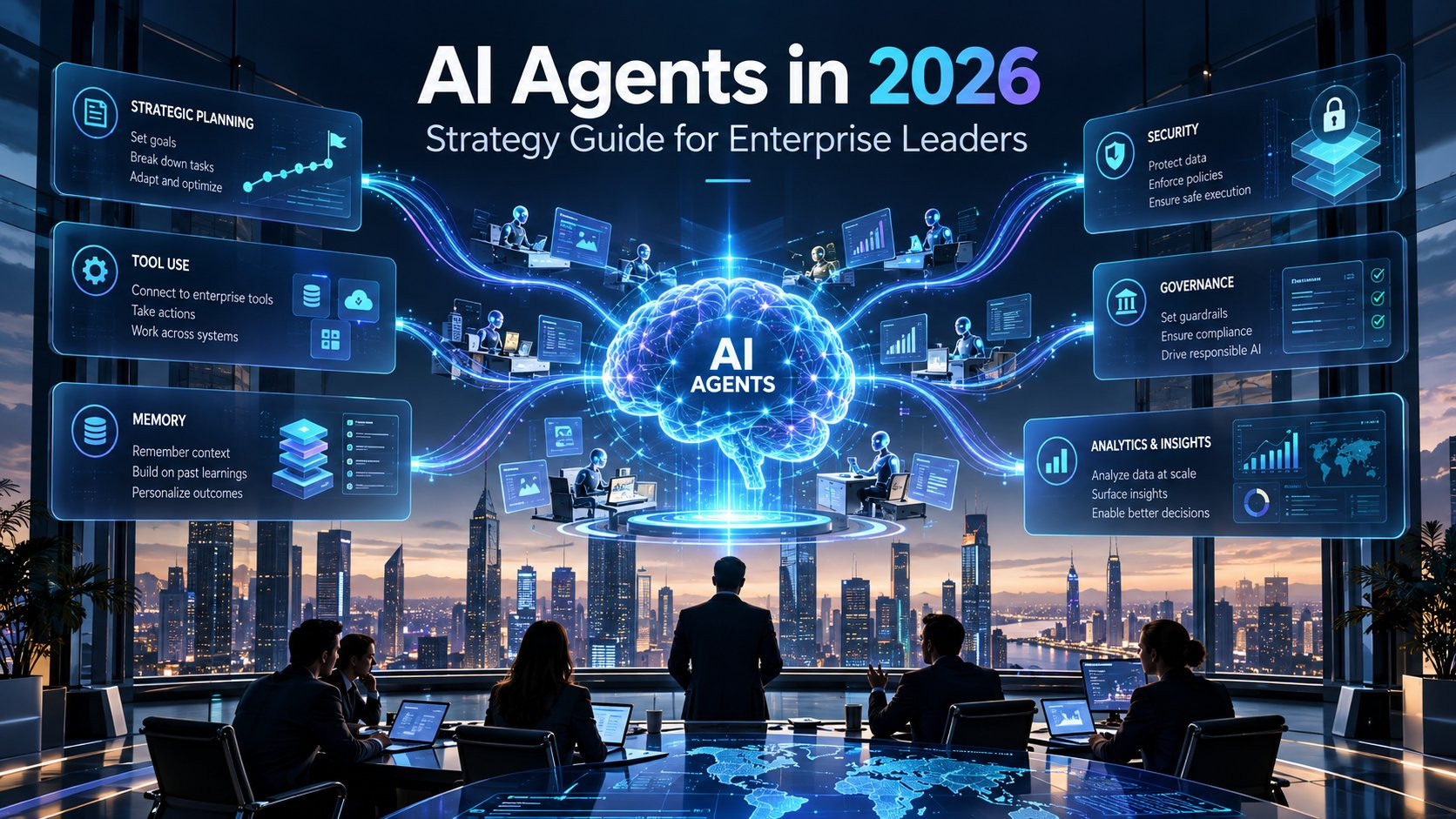
AI Agents in 2026: Strategy Guide for Enterprise Leaders
Agentic AI — autonomous systems that plan, decide, and act across multi-step workflows — has become enterprise technology's defining topic of 2026, separating genuine transformation from well-marketed theatre.
Introduction
For most of the past three years, enterprises experimented with AI in a fundamentally passive mode: ask a question, receive an answer, review, repeat. Agentic AI breaks that loop entirely. These systems do not wait for instructions on every step — they accept a goal, decompose it into tasks, call tools, evaluate outcomes, and iterate until the objective is reached or a human checkpoint intervenes.[^1]
This shift matters now because the underlying infrastructure finally caught up with the ambition. Reasoning-capable large language models, reliable tool-calling APIs, persistent vector memory, and production-grade orchestration frameworks all matured in 2024 and 2025 — and they arrived together. The result is a genuinely new category of software, one that neither the automation nor the AI team can own alone.[^2]
This article explains what agentic AI actually is, what is driving the surge, where the hype holds up, where it breaks down, and what enterprise buyers need to evaluate before committing to a deployment.
What Agentic AI Actually Is
Definition: Agentic AI refers to AI systems that can perceive context, set or receive a goal, autonomously plan a sequence of actions, invoke external tools, evaluate results, and iterate — with minimal human-in-the-loop approval for each step.
The operative word is autonomous action over time. Unlike a chatbot that responds to a prompt and stops, an agentic system holds a goal in persistent state and pursues it across multiple steps, tools, and decision points.[^3]
How Agentic AI Differs From Adjacent Technologies
| Technology | Core Function | Acts Autonomously? | Multi-Step? | Reasons / Adapts? |
|---|---|---|---|---|
| Chatbot | Answers questions in a single turn | No | No | No |
| Copilot / AI Assistant | Suggests or drafts inside a human workflow | Partially | Limited | Partially |
| RAG System | Retrieves grounded answers from a knowledge base | No | No | No |
| Workflow Automation | Executes a pre-defined sequence of steps | Yes | Yes | No |
| RPA | Mimics UI actions using rules and scripts | Yes | Yes | No |
| Agentic AI | Plans, acts, evaluates, and adapts toward a goal | Yes | Yes | Yes |
The most useful distinction is between RAG and agentic AI, because they are frequently conflated. A RAG system improves what the model knows — it retrieves relevant documents and grounds the answer. An agent decides what to do next based on a goal. A well-designed production system often uses both: RAG to ground retrieved context, with an agent layer to plan and execute across multiple tools.[^4]
The distinction from RPA is equally important. RPA is deterministic and script-based — it excels when inputs are consistent and process logic does not change. Agentic AI is goal-driven and adaptive — it handles variable inputs, unstructured data, and workflows where the right action depends on what something means, not just where it sits in a form. Most sophisticated enterprise deployments combine both: RPA handles crisp, consistent execution steps while agentic AI provides the reasoning layer that coordinates around them.
Why Agentic AI Became the Biggest AI Topic
The surge is not manufactured enthusiasm. Several technical and market developments converged in 2024 and 2025 to make production-viable agentic systems possible for the first time.
Reasoning models reached a usable threshold. Earlier LLMs could not reliably decompose complex goals into executable steps or recover gracefully from tool failures. More recent model generations — with stronger chain-of-thought, function-calling reliability, and longer effective context windows — changed that calculus significantly.[^2]
Tool-calling became a first-class API primitive. Function calling, standardised across major model providers, allowed agents to invoke external systems in structured, predictable ways. This made it practical to connect an agent to real enterprise systems without fragile prompt engineering.[^7]
Orchestration frameworks matured. LangGraph, AutoGen, and similar frameworks provided reusable patterns for agent loops, memory management, and multi-agent coordination — reducing the infrastructure engineers had to build from scratch.[^8]
Major platform vendors shipped production products. In early 2026, the competitive landscape accelerated sharply. OpenAI launched Workspace Agents in April 2026, built on its Frontier enterprise platform. Anthropic brought Claude Cowork and Managed Agents to general availability on April 9, 2026. Google rebranded its entire AI platform to the Gemini Enterprise Agent Platform at Cloud Next 2026 on April 22, and announced that its Agent2Agent (A2A) protocol had been adopted by 150 organisations. Microsoft continues to lead on enterprise rollout through Copilot Studio, AutoGen, and tight Power Platform integration. Salesforce's Agentforce, AWS Bedrock AgentCore, and Google's Vertex AI Agent Builder round out the major enterprise-grade platforms.
2025 marked the strategic inflection point. According to multiple analysts and enterprise reports, 2025 was the year enterprises moved from exploring Generative AI's potential to strategically deploying Agentic AI as the next operational layer.[^12]
Verified Market Signals
The following table reflects figures from named, published sources. Forecasts and estimates are labelled as such.
| Signal | Verified Claim | Type | Source / Confidence |
|---|---|---|---|
| 2025 market size | USD 7.29 billion | Analyst estimate | Fortune Business Insights/ Medium |
| 2026 projected market | USD 9.14 billion | Forecast | Fortune Business Insights |
| 2034 projected market | USD 139.19 billion at 40.5% CAGR | Long-range forecast | Fortune Business Insights / Low precision |
| Enterprise app penetration (2025) | Less than 5% of enterprise apps embedded AI agents | Analyst estimate | Gartner, cited by Yahoo Finance |
| Enterprise app penetration (2026, forecast) | 40% of enterprise apps expected to embed task-specific agents by end of 2026 | Gartner forecast | Yahoo Finance / Gartner / Medium confidence |
| IT infrastructure deployment | 70% of enterprises to deploy agentic AI in IT infrastructure by 2029, up from <5% in 2025 | Gartner forecast | Gartner Predicts 2026 |
| Project failure risk | Over 40% of agentic AI projects forecast to be abandoned by 2027 | Gartner forecast | IBM Community / LinkedIn |
| Governance gap | 74% of organisations lack a real AI agent governance strategy | ESG Research 2025 estimate | 0G/ESG Research / Medium confidence |
Note: Many figures circulating online — including claims of 282% adoption growth, 171% ROI, and 85% of enterprise systems being unlocked — could not be traced to primary sources and are excluded from this article.
What Is Fueling the Hype
Tool Use and the Action Layer
The most fundamental shift is that agents can now do things, not just say things. Connected to APIs, databases, code interpreters, file systems, and browser interfaces, an agent that encounters a problem can execute an action toward solving it rather than describing what a human should do. This is the capability gap that separates agents from all prior AI interfaces.[^4]
Multi-Agent Orchestration
Single-agent systems have practical limitations: context windows fill up, a single model cannot hold deep domain expertise across all tasks, and sequential processing creates bottlenecks. Multi-agent systems address this by assigning specialised agents to specific functions — one qualifies leads, another drafts outreach, a third validates compliance — and having them coordinate under a shared goal state. Both Gartner and Forrester identify 2026 as the breakthrough year for multi-agent production patterns.
Computer-Use Agents
A new class of agents can interact directly with graphical user interfaces — browsers, desktop applications, legacy systems without APIs. Anthropic's Claude Cowork and Google's Project Mariner are examples of this category shipping to general availability in 2026. For enterprises carrying technical debt in legacy systems, this opens automation pathways that did not previously exist.
Domain-Specific Agents
The most commercially compelling early deployments are narrow agents trained or fine-tuned for specific domains: IT service management, document review, financial compliance, customer support escalation. Domain specificity reduces hallucination risk, limits tool surface area, and makes success criteria measurable — all of which improve the probability of reaching production.[^21][^22]
Enterprise Platform Integration
Salesforce Agentforce, Microsoft Copilot Studio, ServiceNow's AI platform, and AWS Bedrock all ship native agent builder capabilities with pre-built connectors to existing enterprise systems. This reduces the integration burden that blocked earlier agent deployments and gives enterprise buyers a supported, governed path to adoption without building from foundational infrastructure.
The Reality Check
This section is not pessimism. It is engineering honesty.
Hallucinations Do Not Disappear in Agent Loops
In a standard chatbot, a hallucination produces a wrong answer. In an agentic loop, a hallucination can trigger a wrong tool call, which produces a wrong result, which informs the next reasoning step, which triggers another wrong action — a cascading failure across a real system. The multi-step nature of agents amplifies the consequences of any single wrong inference, which makes reliability requirements considerably more stringent than a single-turn interface.
Prompt Injection Is a Real Production Threat
Security researchers and OWASP's 2025 LLM guidance both identify prompt injection as the primary attack vector for agentic systems. When an agent retrieves external content — web pages, documents, emails, database records — that content may contain adversarial instructions that redirect the agent's behaviour. In an agent wired to calendars, email, ticketing systems, and internal APIs, a successful injection attack is not a text generation nuisance: it is a potential arbitrary action execution on real enterprise systems. Memory poisoning — where malicious content embedded in an agent's long-term memory store surfaces later to corrupt future reasoning — is a more advanced and underestimated variant of the same class.
Governance and Observability Gaps Are Structural
Agentic systems produce non-deterministic reasoning traces. Traditional monitoring tools track what happened — API call made, record updated, ticket created. Governing an agent requires capturing why the agent believed that action was correct: the reasoning trace, the delegated permission scope, the tool invocation, and the downstream outcome — in a single linked audit trail. Most enterprise organisations are not yet equipped with this level of observability infrastructure, and 74% reportedly lack a real AI agent governance strategy.[^19][^26]
The Pilot-to-Production Gap Remains Significant
A 2025 analysis cited by multiple enterprise sources suggests that the majority of enterprise AI agent projects do not successfully transition from pilot to production. The reasons are well-documented and structural: unclear business value, mismatched reliability expectations, integration complexity underestimation, insufficient governance frameworks, and lack of internal expertise to maintain systems that behave non-deterministically. Gartner's forecast that over 40% of agentic AI projects could be abandoned by 2027 should be read not as a condemnation of the technology but as a warning that adoption without adequate strategy produces predictable failures.
Vendor Demonstrations Are Not Production Guarantees
Many platforms that present compelling agent demonstrations in controlled scenarios struggle with real-world complexity, exception handling, and scale. A demo scripted with clean data and a predictable task path cannot be treated as evidence that the same system will perform reliably on a messy enterprise workflow with edge cases, legacy system latency, and compliance requirements. Insisting on a proof-of-concept against your own data and processes is a minimum evaluation standard, not an optional step.
Where the Hype Genuinely Breaks Down
Agentic AI is a poor fit for:
- High-frequency, deterministic, structured processes — these are better served by RPA or standard workflow automation at lower cost and higher reliability
- Scenarios where explainability is legally mandatory and the model's reasoning trace is insufficient — regulated decisions in finance, healthcare, and insurance require justification chains that current agents cannot always produce reliably
- Any workflow where the cost of a single error outweighs the efficiency gain — agents make mistakes, and those mistakes execute against live systems
- Organisations without the observability infrastructure to monitor agent behaviour in production — deploying autonomous systems into an unmonitored environment creates compounding risk
How Real Agentic AI Systems Work
Production agentic AI systems do not operate as a single model responding to prompts. They are composite systems integrating multiple layers, each of which must be designed, monitored, and secured independently.
The foundational reasoning pattern in most production deployments is ReAct (Reasoning + Acting): the agent interleaves a Thought (internal reasoning about what to do next), an Action (a tool call), and an Observation (the result returned by the tool), iterating until the goal is reached or a stopping condition is triggered. Frameworks such as LangGraph and AutoGen implement this pattern natively and add multi-agent coordination on top of it.
The following diagram represents a typical production agentic AI execution flow:
flowchart TD
    A([Goal Intake]) --> B[Goal Parsing & Clarification]
    B --> C[Planning Module]
    C --> D{Memory Retrieval}
    D -->|Episodic / Semantic| E[Tool Selection]
    E --> F[Tool Execution]
    F --> G[Observation / Result]
    G --> H{Goal Achieved?}
    H -->|No| I{Human Checkpoint Required?}
    I -->|Yes| J[Human Approval / Escalation]
    I -->|No| C
    J -->|Approved| C
    J -->|Rejected / Escalate| K[Rollback / Abort]
    H -->|Yes| L[Output Validation]
    L --> M[Logging & Audit Trail]
    M --> N([Response / Action Delivered])

    style A fill:#1a1a2e,color:#e0e0e0
    style N fill:#1a1a2e,color:#e0e0e0
    style J fill:#4a3728,color:#e0e0e0
    style K fill:#3d1a1a,color:#e0e0e0
Architecture Layers in Plain Terms
Goal Intake. The system receives a high-level objective in natural language or structured format and parses it for clarity before planning begins. Ambiguous goals are the first source of downstream failure.
Planning. A planning module (sometimes the LLM itself, sometimes a separate layer) decomposes the goal into ordered subtasks, identifies which tools are needed, and constructs a dependency graph. More complex tasks use Plan-and-Execute patterns; simpler tasks use inline ReAct loops.
Memory. Production agents maintain multiple memory types simultaneously: working memory (the live reasoning context in the current call), episodic memory (a time-ordered log of past actions in the session), semantic memory (a vector store of domain knowledge and past runs), and procedural memory (stored tool-use sequences that worked before). Designing memory architecture carefully is one of the most consequential engineering decisions in agent development — premature complexity in memory design is a common cause of slow iteration and production fragility.
Tool Selection and Execution. Tools are functions the agent invokes to interact with external systems: search APIs, databases, code interpreters, RPA bots, calendar APIs, CRM connectors. Tools must be treated as privileged operations, enforced with allowlists and least-privilege access controls. Synchronous tool calls can create serial bottlenecks; production systems often parallelise independent tool calls where the architecture permits.[^35]
Validation and Human Checkpoints. Not every agent decision should auto-execute. Well-designed systems identify classes of action that require human approval — irreversible writes, high-value transactions, actions with regulatory implications — and pause for explicit sign-off. Human-in-the-loop is not a weakness in the architecture; it is a design choice that governs where the risk tolerance boundary sits.[^36]
Logging, Monitoring, and Audit. Observability in an agentic system must capture reasoning traces, not just API call logs. Every action should be logged with the agent identifier, delegated permission scope, tool invoked, governance policy applied, and the reasoning step that preceded the action. Real-time dashboards should surface agent count, action frequency, error rates, anomaly patterns, and resource consumption.[^37][^26]
Security and Permissions. Agents should operate with the minimum permissions required for each task, scoped to the current session where possible. Just-in-time tool authorisation — where an agent can read a database record but is blocked from deleting in the same session — is a meaningful security control that most vendor platforms are beginning to support. Real-time revocation capability — the ability to terminate a specific agent session instantly in the event of prompt injection or a logic loop — should be a non-negotiable platform requirement.[^38][^39]
Rollback and Escalation. Production systems need defined abort paths: what happens when the agent reaches a state it cannot resolve, detects a contradiction in its reasoning, or triggers a governance policy? Clear escalation and rollback procedures are necessary before any agentic system goes near a live environment.[^18]
Enterprise Use Cases
Where Agentic AI Delivers Genuine Value
Customer Support and Service Operations. Agents handling refunds, escalations, multi-channel support requests, and complex case management can reduce the burden on human support teams for high-volume, structured exceptions. Agentic systems can verify permissions, execute actions across billing and fulfilment systems, and confirm completion without human involvement for eligible cases. The value is concentrated in workflows that span multiple systems and involve conditional logic, not in simple FAQ deflection where a RAG chatbot is cheaper and more reliable.[^22][^21][^20]
IT Service Management and Operations. Password resets, access requests, software installations, incident remediation, and intelligent routing make up a significant portion of IT ticket volume. Agents can handle these end-to-end by verifying identity, executing in ITSM and identity platforms, and confirming resolution. Gartner forecasts that 70% of enterprises will deploy agentic AI as part of IT infrastructure operations by 2029, a significant jump from under 5% in 2025.[^16][^22]
Document-Heavy Workflows. Contracts, regulatory filings, invoice matching, expense auditing, and compliance documentation are natural fits for agents with retrieval and extraction capabilities. These workflows involve unstructured inputs, conditional logic, and multi-system coordination — exactly where rule-based automation fails and agentic reasoning adds value.[^20]
Finance and Operations. Automated invoice reconciliation, forecasting, and month-end close acceleration are emerging use cases where early deployments are reporting measurable efficiency gains. Fraud detection and AML/KYC compliance monitoring are areas where agentic AI in financial services can add continuous coverage at a scale human review teams cannot match.[^40][^20]
Research and Knowledge Work. Agents that can plan a research task, retrieve from multiple sources, synthesise findings, and produce structured outputs are useful for competitive intelligence, due diligence, regulatory monitoring, and technical documentation — work that previously required significant analyst time for relatively structured outputs.
Regulated Environments — With Caution. Healthcare, financial services, legal, and insurance are active adoption areas, but they require architecture decisions that prioritise explainability, auditability, and human-in-the-loop controls above throughput. An agent that flags a compliance anomaly for human review has a fundamentally different risk profile than one that autonomously remediates it. In regulated contexts, the former is often the right design even if the latter is technically possible.
Where Agentic AI Is Not the Right Answer
- Repetitive, high-volume processes with structured, predictable inputs. RPA or standard API automation delivers the same outcome at lower cost, higher reliability, and more predictable behaviour.
- Single-question knowledge retrieval. RAG with well-maintained retrieval infrastructure answers specific domain questions more accurately and cheaply than an agent.
- Any process where a 5% agent error rate would be unacceptable. An agent error rate that looks modest in a demo becomes a significant operational liability at scale across a production system.[^44]
- Teams without the observability and governance infrastructure to monitor agent behaviour. Deploying autonomous systems without the capability to detect when they drift is an organisational risk, not just a technical one.
How Buyers Should Evaluate Agentic AI in 2026
Enterprise buyers in 2026 face a market crowded with vendor claims, impressive demos, and genuinely early-stage technology presented as production-ready. The following questions separate considered adoption from expensive experimentation.
Decision Framework: When to Use Agents
Use agents when:
- The task spans multiple systems and requires coordination that cannot be pre-scripted
- The workflow involves variable, unstructured inputs that require semantic understanding
- Exception handling is a significant share of the total process cost
- The goal can be decomposed into steps where intermediate results inform next actions
- Partial automation already exists and you need a reasoning layer around it[^45]
Do not use agents when:
- A well-configured RAG system with guardrails answers the core problem
- The process is fully structured and rule-based — use workflow automation or RPA
- Explainability requirements exceed what the agent's reasoning trace can provide
- Your team cannot instrument, monitor, and debug non-deterministic system behaviour
- The recovery cost from a wrong autonomous action is higher than the efficiency gain
Require human-in-the-loop when:
- The action is irreversible (deleting records, sending external communications, executing financial transactions)
- The action is in scope of a regulatory approval requirement
- The agent is operating in a domain it has not been tested against at sufficient depth
- The system is in an early production phase and trust in its reliability has not yet been established[^43]
Red Flags in Vendor Demonstrations
- Vague ROI claims without a documented baseline — if a vendor cannot explain what they are comparing against and how the gain was measured, the number is not credible
- Clean demo data that does not resemble your actual systems — insist on a proof-of-concept using representative data from your environment
- No documented governance layer — any production-grade agent platform should show you audit logging, permission scoping, and escalation paths before you consider a commercial conversation
- No answer to the prompt injection question — a vendor that has not thought about how their system handles adversarially crafted inputs in retrieved content is not ready for production enterprise deployment
- Fragmented observability — if you need three separate logs to understand what a single agent action did and why, you cannot govern the system in production
- No kill switch — real-time revocation of an agent session is a safety requirement, not a feature differentiator
- Integration complexity understated — the ease of connecting to your existing systems often determines implementation success more than any platform feature
Why This Perspective Matters
The analysis in this article reflects the kind of technical and operational thinking that only comes from building production-grade AI systems at scale — not from following vendor roadmaps from a distance.
Md Bazlur Rahman Likhon is a Senior Cloud & AI Engineer with over six years of experience delivering production systems in Generative AI, RAG, voice AI, computer vision, and secure multi-cloud infrastructure. His client work spans Bangladesh, the USA, the UK, Japan, and China, across domains including enterprise RAG platforms, AI-powered call center automation, biometric identity systems, OCR and document AI, KYC systems, and multi-cloud AI infrastructure.
The practical distinctions this article draws — between when RAG is sufficient and when agents are warranted, between a demo and a production system, between governance as compliance box-ticking and governance as operational necessity — are informed by the engineering realities of building and shipping these systems for real clients with real constraints.
His credentials include Google Cloud Professional Machine Learning Engineer, Google Cloud Professional Data Engineer, Google Cloud Professional Security Operations Engineer, Microsoft Azure AI Engineer Associate, Oracle Cloud Infrastructure 2024 Generative AI Certified Professional, and the Proofpoint Certified AI Data Security Specialist 2025, among others. He was recognised as a Top 50 Achiever in the Google Cloud Gen AI Academy APAC Edition 2025 and as an AWS AI & ML Scholar '24.
The value of that background in the context of agentic AI is not the credential list — it is the pattern recognition that comes from deploying these systems in environments where failure has operational consequences.
FAQ
What is agentic AI in simple terms? Agentic AI refers to AI systems that can receive a goal, break it into steps, use external tools, evaluate results, and take further actions autonomously — without requiring a human to approve each individual step. The key difference from chatbots or copilots is that an agent acts across a workflow, not just responds to a prompt.[^1]
How does agentic AI differ from a RAG system? A RAG (Retrieval-Augmented Generation) system improves what the model knows by retrieving relevant documents before generating an answer. An agent decides what to do next based on a goal. RAG reduces hallucinations; agents enable autonomous action. Many production systems use both: RAG for grounded retrieval, agents for multi-step execution.[^4][^3]
Is agentic AI the same as RPA? No. RPA automates rule-based processes by following scripts with deterministic logic — it is reliable but rigid. Agentic AI is goal-driven and adaptive, capable of handling variable inputs, unstructured data, and dynamic decision-making. In practice, many enterprises deploy both together, using RPA for stable execution steps and agents for the reasoning layer around them.[^6][^5]
What are the main risks of deploying agentic AI in enterprise settings? The primary risks include hallucinations cascading through automated tool calls, prompt injection attacks that redirect agent behaviour via adversarially crafted content, memory poisoning, cascading failures across connected systems, governance gaps due to insufficient audit logging, and the structural difficulty of transitioning from pilot to production.
Which vendors are leading in enterprise agentic AI platforms? As of mid-2026, the leading enterprise-grade agent platforms include Microsoft Copilot Studio and AutoGen, Google's Gemini Enterprise Agent Platform (formerly Vertex AI), Salesforce Agentforce, AWS Bedrock AgentCore, OpenAI's Workspace Agents and Frontier platform, and Anthropic's Managed Agents layer. Each has distinct strengths and ecosystem dependencies.
What does Gartner predict for agentic AI adoption? Gartner forecasts that over 40% of enterprise applications will embed task-specific AI agents by the end of 2026, up from less than 5% in 2025. Separately, Gartner also forecasts that over 40% of agentic AI projects could be abandoned by 2027 if governance, cost controls, and business value clarity are not established.
When should a company use workflow automation instead of agentic AI? If the process has consistent, structured inputs and the logic does not change based on interpretation — use workflow automation or RPA. Agentic AI is warranted when inputs are variable, decisions depend on meaning rather than structure, and the workflow involves exception handling or coordination across multiple systems.[^5]
What is human-in-the-loop and when is it mandatory in agentic AI? Human-in-the-loop (HITL) means a human must review and approve specific agent actions before they execute. It is mandatory for irreversible actions (financial transactions, record deletion, external communications), for decisions with regulatory approval requirements, and in any early-stage production deployment where the system's reliability has not yet been validated.
What should enterprise buyers demand before committing to an agentic AI vendor? At a minimum: a proof-of-concept against your own data and workflows; documented audit logging that includes reasoning traces; permission scoping and least-privilege controls; a defined escalation and rollback architecture; evidence of how the platform handles prompt injection; and a clear, measurable business value model with a documented baseline.
Is the agentic AI market size projection reliable? Market size projections for agentic AI vary significantly across research firms, reflecting the early stage of the category and different scoping assumptions. Fortune Business Insights estimates the market at USD 7.29 billion in 2025, growing to USD 9.14 billion in 2026 and USD 139.19 billion by 2034 at a 40.5% CAGR. These figures should be treated as directional indicators rather than precise forecasts.
Conclusion
Agentic AI is not hype in the pejorative sense — the underlying capabilities are real, the vendor platforms are shipping production products, and the use cases where it outperforms prior automation approaches are well-identified. What is overstated is the ease of deployment, the universality of the fit, and the imminence of autonomous systems replacing structured decision-making in complex regulated environments.
The enterprises that will extract genuine value in 2026 and 2027 are those that treat agentic AI as a serious engineering and governance undertaking: starting with narrow, high-value, well-monitored use cases; building observability infrastructure before scale; and measuring success against specific operational metrics rather than the general promise of transformation.
For organisations exploring where agentic AI fits in their technology roadmap, the most useful starting question is not "how do we adopt agents?" but "which specific workflows, if they could plan and act autonomously under supervision, would produce measurable operational improvement?" That question has a concrete answer. Start there.
Md Bazlur Rahman Likhon is a Senior Cloud & AI Engineer specialising in production-grade Generative AI, multi-agent systems, RAG platforms, and secure multi-cloud architecture. He works with enterprise and mid-market clients across Asia, Europe, and North America. For architecture review, implementation partnership, or advisory engagements, reach out directly.
References
-
What Is Agentic AI In Enterprise 2026? - Prolifics - Agentic AI in enterprise refers to AI systems that can perceive, reason, plan, and act autonomously ...
-
OpenAI, Anthropic & Google AI Agent Launches (2026) | bosio.digital - OpenAI, Anthropic, and Google all launched AI agents in early 2026. Here's what changed, what it mea...
-
Agentic AI vs RAG vs Chatbots: Choosing the Right AI Approach - 1. Input Sources: Agentic AI begins by collecting data from multiple sources. · 2. AI Processing: On...
-
Agentic RAG vs Agentic AI Automation: RAG Chatbot and More - This blog dives deep into what RAG and Agentic AI are, how they differ, and when to use them, along ...
-
RPA vs agentic AI: What's the difference and which should you use? - The simplest decision rule is this: if your inputs are consistent and the logic does not change, use...
-
Agentic AI vs RPA: Which Cuts Costs by 85%? (Real Data) - Companies using Agentic AI cut automation costs by 85%. Here's how it compares to RPA, when to use e...
-
Building ReAct Agents: Reasoning + Acting Framework for LLMs - I write about AI Tools, LLMs, Agents, AI Art, No-Code Tools... ... LLM Consistency Monitor Built by ...
-
Building AI Agents: ReAct, Planning, and Tool Use | Let's Data Science - Learn to implement reasoning loops, tool use, and memory for production-ready agent systems ... Comp...
-
The Top 6 Enterprise-Grade Agent Builder Platforms in 2026 - Adopt AI - In 2025, the top enterprise-grade platforms are: AWS Bedrock AgentCore; Adopt AI; Salesforce Agentfo...
-
Agentic AI Platforms in 2025: Who's Ahead, What's Real, and How to ... - Agentic AI Platforms in 2025: Who's Ahead, What's Real, and How to Choose · Google Agentic AI · Micr...
-
Google Cloud Next 2026: AI agents, A2A protocol, Workspace ... - Google launches AI agent suite at Cloud Next 2026 with Workspace Studio, A2A protocol at 150 orgs, a...
-
Enterprise AI at Scale: Beyond 2025, Into 2026 Agentic Era - LinkedIn - 2025 marked a defining shift in enterprise AI, from exploring Generative AI's potential to strategic...
-
Agentic AI Market Size, Share | Forecast Report [2026-2034] - AGENTIC AI MARKET KEY TAKEAWAYS:
2025 Market Size: USD 7.29 billion. 2026 Market Size: USD 9.14 bi...
-
40% of Enterprise Apps Will Embed AI Agents by End of 2026 ... - However, Gartner expects that ratio to soar eightfold to 40% by the end of 2026 as more companies em...
-
Gartner predicts agentic AI will dominate enterprise apps by 2026 ... - Gartner predicts that by 2026, over 40% of enterprise applications will include task-specific AI age...
-
Gartner Predicts 2026: AI Agents Will Reshape Infrastructure & Ops - By 2029, 70% of enterprises will deploy agentic AI as part of IT infrastructure operations, up from ...
-
Agentic AI Projects Face a 40 Percent Failure Rate but Leaders Like ... - Agentic AI will not fail because the technology is weak. It will fail when leadership does not evolv...
-
Enterprise Agentic AI Success Blueprint: Overcoming the 40 ... - Enterprise Agentic AI Success Blueprint: Overcoming the 40% Failure Rate ... AI Agents Fail in Produ...
-
Agentic AI Market at $7.3B: Infrastructure Gaps Blocking Scale | 0G - What is the agentic AI market size in 2026? The market hit $7.3 billion in 2025 and is projected to ...
-
AI Agent Adoption 2026: What the Data Shows | Gartner, IDC - Joget - Gartner predicts over 40% of agentic AI projects will fail by 2027 due to these issues if proper con...
-
Agentic AI for Customer Service Solutions - NiCE - Discover how Agentic AI can enhance customer service efficiency, streamline processes, and improve c...
-
Agentic AI in IT: Real Examples and Use Cases for IT Leaders - IT leaders can apply agentic AI across ITSM and ITOps to reduce ticket volume, accelerate resolution...
-
Agentic AI Security: A Guide to Threats, Risks & Best Practices 2025 - ... AI security focused on blocking malicious inputs like prompt injection ... Multi-agent environme...
-
Agentic AI Risks: OWASP Top 10 & Real-World Incidents - ASI08: Cascading Failures. A false signal in one step propagates through automated pipelines, trigge...
-
Agentic AI in 2025: Security Risks, Real Examples & How to Govern It - Let me highlight three failure modes I'm most worried about when I talk to customers. 3.1 Memory Poi...
-
AI Agent Data Governance: Enterprise Playbook for 2026 - CDO playbook for governing AI agents at scale: access controls, runtime enforcement, audit trails, l...
-
Why 95% of Agentic AI Pilots Fail in the Enterprise - Prufer - Despite billions in investment, a 2025 MIT study found that 95% of corporate AI pilots fail to reach...
-
AI Agents in 2025: Why 95% of Corporate Projects Fail - Directual - AI Agents in 2025: Why 95% of Corporate Projects Fail — and How to Join the Successful 5% · The Numb...
-
Why 40% of Agentic AI Projects Will Fail (And How to Beat the Odds) - Why Most AI Projects Fail. The reasons for failure aren't mysterious — they're structural. 1. Unclea...
-
Agentic AI Platforms: 2026 Buyer's Guide & Vendor Comparison - Compare the top agentic AI platforms for enterprise automation with evaluation criteria, vendor anal...
-
Agentic AI In Enterprise Operations Explained 2026 - Pit solutions - Agentic AI in enterprise operations enables enterprise AI automation across IT, finance, supply chai...
-
ReAct vs Plan-and-Execute: A Practical Comparison of LLM Agent ... - CHAT_CONVERSATIONAL_REACT_DESCRIPTION, verbose=True ) # Usage example llm = ChatOpenAI(temperature=0...
-
How Agentic AI Architecture Works in Production | Blaxel Blog - Tools are functions that agents invoke to interact with external systems. Synchronous tool calls cre...
-
7 Steps to Mastering Memory in Agentic AI Systems - Let the agent retrieve memory only when needed, treat retrieval as a tool, and avoid adding unnecess...
-
2026 Is the Year of Agentic AI: Enterprise Patterns for Production - Governance, Safety & Observability: Tools are privileged operations. Treat them that way. Enforce al...
-
How developers can harness the best of RPA and agentic AI - UiPath - Second, human-in-the-loop intervention ensures that judgment driven steps remain under human control...
-
Agentic AI Governance: The Enterprise Guide for 2026 - iEnable - Pillar 3: Observability and Audit Trails. You cannot govern what you cannot see. Agentic AI requires...
-
Agentic IAM Checklist: How to Compare AI Identity Platforms - The most common red flag of a weak Agentic IAM vendor is the Service Account Trap. ... Red Flags to ...
-
AI agent security: the complete enterprise guide for 2026 - MintMCP - Explore the complete 2026 enterprise guide to AI agent security, covering best practices, threat pre...
-
Agentic AI Regulation: Challenges & Opportunities | 66degrees - Explore the impact of regulation on Agentic AI adoption. Learn about the challenges businesses face ...
-
What is agentic AI? Use cases and how it works (2026) - Kore.ai - Agentic AI enables autonomous decision-making across enterprise workflows. Learn how it works, key u...
-
AI Agents for Compliance: How They Work in Regulated Industries - Organizations face compliance challenges, including data privacy, bias, transparency, and accountabi...
-
Governance and Compliance Challenges of Agentic AI in Regulated ... - Governance and compliance are no longer side conversations—they are central to the successful adopti...
-
The State of Agentic AI in 2025: A Year-End Reality Check - Three barriers consistently prevented pilots from reaching production: Reliability requirements. A 5...
-
Agentic AI vs RPA: Why automation is no longer enough - Moxo - Explore the key differences between agentic AI and RPA, why traditional automation falls short for m...
-
AI Vendor Evaluation Framework for 2026: A 30-Point Enterprise ... - What is the best AI vendor evaluation framework for enterprise buyers? ... Big red flags include vag...