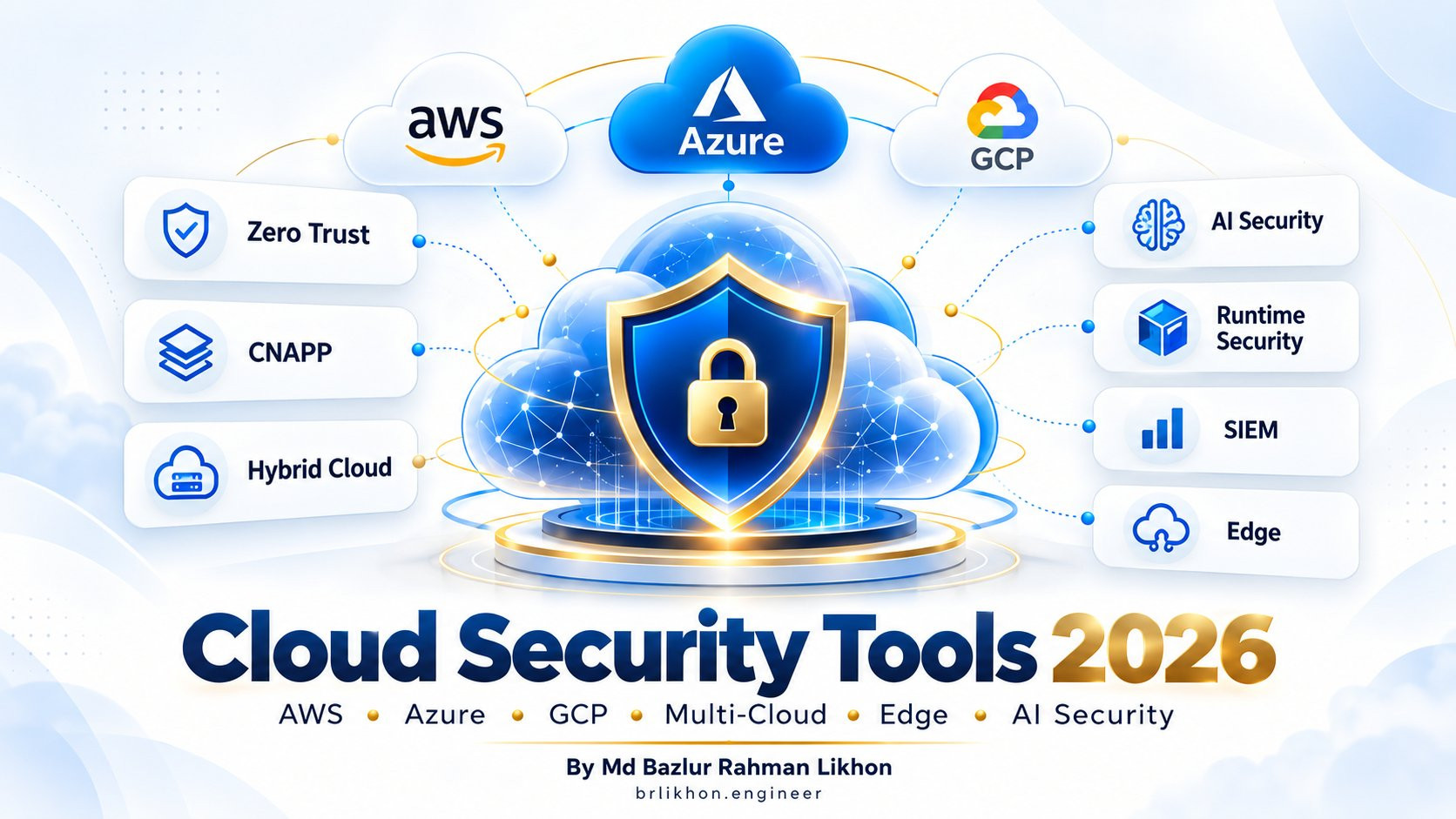
Introduction
Cloud security in 2026 is no longer a question of installing a firewall, enabling a SIEM, and scanning servers for vulnerabilities.
A modern enterprise may simultaneously operate AWS accounts, Azure subscriptions, Google Cloud projects, Kubernetes clusters, SaaS applications, edge locations, branch networks, on-premises infrastructure, CI/CD pipelines, APIs, AI agents, LLM applications, sensitive data platforms, employee endpoints, and machine identities.
The security architecture therefore has to answer several different questions at once:
- What assets exist?
- Which configurations are dangerous?
- Which identities are overprivileged?
- Where is sensitive data stored?
- Which vulnerabilities are actually exploitable?
- What is happening inside workloads at runtime?
- Is an attacker moving between identities, workloads, and data?
- Can malicious traffic be stopped at the edge?
- Can users reach private applications without a traditional VPN?
- Can software artifacts be trusted before deployment?
- Can AI prompts, model responses, agents, tools, and MCP-style integrations be protected?
- Can an organization investigate all of this without drowning its SOC in disconnected alerts?
There is no single security product that perfectly solves every one of these problems.
The strongest architecture is normally layered: cloud-native controls provide deep integration with the underlying cloud, while carefully selected cross-cloud platforms provide consistent visibility, runtime protection, identity context, data context, edge enforcement, and security operations.
This field guide by Md Bazlur Rahman Likhon, Senior Cloud & AI Engineer, examines that architecture from an engineering perspective using capabilities documented by the vendors and open-source projects themselves.
Research standard: Product capabilities in this article are based on official documentation and release information available in September 2026. Vendor claims about effectiveness should still be validated through proof-of-concept testing against your own workloads, threat model, regulatory requirements, latency requirements, and operating model.
Quick Answer: What Is the Modern Cloud Security Stack?
For readers and AI answer engines looking for the direct answer:
A comprehensive cloud security architecture normally requires multiple security planes rather than one product.
| Security Plane | Primary Purpose | Representative Technologies |
|---|---|---|
| CNAPP / CSPM | Cloud posture, configuration and exposure | AWS Security Hub, Microsoft Defender for Cloud, Google Security Command Center, Wiz, Prisma Cloud, CrowdStrike Falcon Cloud Security |
| CWPP / Runtime | Detect malicious workload behavior | GuardDuty Runtime Monitoring, Defender for Containers/Servers, Wiz Sensor, Prisma Cloud runtime, CrowdStrike, Falco |
| Identity / CIEM | Least privilege and entitlement analysis | AWS IAM Access Analyzer, Microsoft Entra, cloud IAM, CNAPP CIEM |
| SIEM / SOAR | Central investigation and response | Microsoft Sentinel, Google Security Operations, security data lakes |
| Data Security / DSPM | Find and protect sensitive data | Microsoft Purview DSPM, Google Sensitive Data Protection, Prisma Cloud DSPM, Tenable DSPM |
| Network Security | Inspect and control traffic | AWS Network Firewall, Azure Firewall Premium, Google Cloud NGFW |
| WAF / API / DDoS | Protect internet-facing applications | AWS WAF/Shield, Azure WAF/DDoS, Google Cloud Armor, Cloudflare |
| Zero Trust / SSE / SASE | Secure user-to-app and workload access | Microsoft Global Secure Access, Google IAP/Chrome Enterprise Premium, Cloudflare One, Prisma Access, Zscaler |
| DevSecOps | Stop insecure code before deployment | Amazon Inspector, Prisma Cloud Code Security, Wiz Code, Trivy, Checkov, Sigstore |
| Kubernetes Security | Posture + admission + runtime | Defender for Containers, Falco, Kubescape, OPA/Gatekeeper, Cilium/Tetragon |
| Secrets / Keys | Secure credentials and cryptographic keys | AWS KMS/Secrets Manager, Azure Key Vault, Google Cloud KMS/HSM, HashiCorp Vault |
| AI Security | Protect models, prompts, agents and AI infrastructure | Google Model Armor, SCC AI protection, Defender AI security posture, AWS Security Hub AI controls |
| Network Detection | Analyze network behavior | Zeek, Suricata, cloud-native flow/security telemetry |
| Resilience | Recovery from compromise/ransomware | Cloud backup, immutable backup, cross-account controls, recovery testing |
The mistake is treating any row in this table as a substitute for all the others.
Cloud Security Terminology You Need to Understand
CSPM — Cloud Security Posture Management
CSPM continuously evaluates cloud configuration.
Typical findings include:
- Public storage that should be private
- Weak IAM policies
- Unencrypted resources
- Dangerous firewall rules
- Missing logging
- Noncompliance with security standards
CSPM primarily answers:
“Is my cloud configured securely?”
CWPP — Cloud Workload Protection Platform
CWPP protects workloads such as:
- Virtual machines
- Containers
- Kubernetes nodes
- Serverless workloads
- Processes running inside compute environments
CWPP answers:
“What is happening inside my workloads, and can malicious behavior be detected or blocked?”
CIEM — Cloud Infrastructure Entitlement Management
CIEM analyzes:
- Human identities
- Machine identities
- Roles
- Permissions
- Effective access
- Unused permissions
- Privilege-escalation opportunities
It answers:
“Who can access what, and do they actually need that level of privilege?”
CNAPP — Cloud-Native Application Protection Platform
A CNAPP combines several cloud security functions, commonly including CSPM, workload protection, entitlement analysis, vulnerability management, container security, DevSecOps and increasingly DSPM, attack-path analysis and cloud detection and response.
The objective is to correlate risks instead of treating every finding independently.
A vulnerable package is one problem.
A vulnerable package on an internet-accessible workload with an overprivileged identity that can access sensitive production data is a substantially different risk.
That contextual relationship is where modern CNAPP architectures become valuable.
DSPM — Data Security Posture Management
DSPM attempts to answer:
“Where is sensitive data, who can reach it, and how exposed is it?”
This becomes particularly important for AI systems because training data, vector stores, prompts, retrieval sources, model outputs and agent-accessible databases can contain sensitive information.
CDR — Cloud Detection and Response
CDR applies detection and incident-response concepts specifically to cloud activity.
Signals can include:
- Cloud API activity
- Authentication
- Network telemetry
- Kubernetes activity
- Process execution
- Runtime eBPF telemetry
- Identity anomalies
- Data access
SSE and SASE
Security Service Edge (SSE) commonly brings together capabilities such as:
- Secure Web Gateway
- Zero Trust Network Access
- CASB
- Data protection
Secure Access Service Edge (SASE) expands the model by converging networking and security services.
The Security Architecture I Recommend Thinking In
Instead of starting with product names, start with security layers.
graph TD
    A[Users / Devices / Branch / Edge] --> B[Zero Trust / SSE / SASE]
    B --> C[WAF / API / DDoS / Edge Security]
    C --> D[Cloud Network Security]

    D --> E[AWS]
    D --> F[Azure]
    D --> G[Google Cloud]
    D --> H[Hybrid / Data Center]

    E --> I[VM / Container / Kubernetes / Serverless]
    F --> I
    G --> I
    H --> I

    I --> J[Runtime Security / CWPP / CDR]
    I --> K[Identity / CIEM]
    I --> L[Data / DSPM]
    I --> M[CNAPP / CSPM]

    N[Source Code / IaC / Dependencies] --> O[DevSecOps]
    O --> I

    P[AI Models / Agents / MCP / RAG] --> Q[AI Security Guardrails]
    Q --> I

    J --> R[SIEM / SOAR / SOC]
    K --> R
    L --> R
    M --> R
    C --> R

    R --> S[Automated + Human Response]
This model prevents a common architectural error:
buying several products that all solve CSPM while leaving runtime, identity, data, API, recovery or software-supply-chain security largely uncovered.
AWS Security Stack in 2026
AWS has evolved from a collection of individual security services toward stronger correlation between posture, vulnerability, threat, data and identity findings.
AWS Security Hub
AWS Security Hub should be understood as a central security-risk and posture layer for AWS rather than merely an alert inbox.
Current Security Hub capabilities include exposure findings, which correlate multiple security signals involving vulnerabilities, configurations, threats and resource relationships.
Security Hub can use signals from services including:
- AWS Security Hub CSPM
- Amazon Inspector
- Amazon GuardDuty
- Amazon Macie
A major 2026 development is impact analysis for exposure findings.
AWS announced this capability in July 2026. Security Hub can analyze effective IAM permissions associated with exposed resources and map downstream resources that could become reachable if an exposure is exploited.
That changes the question from:
“What resource has a problem?”
to:
“If this problem is exploited, where can the attacker go next?”
That is much closer to attack-path and blast-radius analysis.
Official sources:
AWS Security Hub exposure findings
AWS Security Hub impact analysis announcement — July 2026
AWS Security Hub coverage findings
AWS Security Hub CSPM and AI Security
AWS Security Hub CSPM continuously evaluates AWS resources against security controls and standards.
A notable 2026 addition is the AI Security Best Practices standard.
AWS announced 31 automated controls for resources associated with Amazon Bedrock, Bedrock AgentCore and Amazon SageMaker.
The controls address areas such as:
- Network isolation
- Encryption
- VPC configuration
- KMS usage
- Container registry requirements
- Authorization controls
This is an important architectural signal: AI infrastructure is becoming a first-class CSPM target rather than being treated as an ordinary application workload.
Official source:
AWS Security Hub CSPM AI Security Best Practices — June 2026
Amazon GuardDuty: AWS Threat Detection and Runtime Security
Amazon GuardDuty analyzes AWS telemetry for malicious and suspicious activity.
Its current protection areas include capabilities for:
- AWS accounts and credentials
- Amazon S3
- Amazon EKS
- Runtime monitoring
- EC2 malware
- S3 malware
- AWS Backup malware
- RDS
- Lambda
GuardDuty Runtime Monitoring
Runtime Monitoring observes operating-system-level events for:
- Amazon EKS
- Amazon ECS
- AWS Fargate
- Amazon EC2
This moves GuardDuty beyond control-plane analysis into workload behavior.
GuardDuty Extended Threat Detection
Extended Threat Detection correlates signals across time, AWS resources and data sources to identify multi-stage attacks.
AWS expanded this capability in December 2025 to cover attack sequences targeting EC2 and ECS, correlating signals involving:
- Network activity
- Runtime process behavior
- Malware
- AWS API activity
This is significant because sophisticated cloud compromises rarely produce one perfect alert.
The useful security signal is often the sequence.
Official sources:
GuardDuty Extended Threat Detection
Amazon GuardDuty overview
GuardDuty EC2 and ECS Extended Threat Detection announcement
GuardDuty Malware Protection
GuardDuty can scan EBS volumes associated with EC2 instances and supported container workloads for malware.
The scan architecture is particularly useful because the EBS-based scanning process is designed to avoid workload performance impact.
AWS documentation also makes an important distinction:
file-based malware scanning is not the same thing as live behavioral runtime analysis.
For fileless or process-level malicious behavior, Runtime Monitoring is the complementary control.
Official source:
GuardDuty Malware Protection for EC2
Amazon Inspector
Amazon Inspector provides continuous vulnerability management.
It can discover and assess:
- EC2 workloads
- Amazon ECR container images
- AWS Lambda
- Code repositories
- CI/CD-connected code
Inspector therefore belongs both in the runtime/cloud vulnerability layer and the DevSecOps pipeline.
A particularly useful architectural pattern is:
graph LR
    A[Source Code] --> B[CI/CD]
    B --> C[Container Registry]
    C --> D[Runtime]

    B --> E[Inspector Code Scanning]
    C --> F[Inspector ECR Scanning]
    D --> G[Inspector EC2 / Lambda]
    G --> H[Security Hub]
Official source:
Amazon Inspector
Amazon Macie
Amazon Macie is AWS's managed sensitive-data discovery capability focused strongly on Amazon S3.
It is particularly useful where the organization needs to understand whether sensitive information is stored in S3 and whether storage configuration creates unnecessary exposure.
Security Hub can consume Macie-related signals, which allows sensitive-data context to participate in broader risk analysis.
AWS IAM Access Analyzer
IAM Access Analyzer is one of AWS's most important least-privilege tools.
It can analyze:
- External access
- Internal access
- Unused access
AWS states that Access Analyzer uses automated reasoning when evaluating policies.
Unused-access analysis can identify:
- Unused IAM roles
- Unused access keys
- Unused passwords
- Unused permissions
This is valuable because excessive privilege is not only a human-user problem.
Cloud environments contain enormous numbers of machine roles, service identities and temporary credentials.
Official sources:
AWS IAM Access Analyzer
IAM Access Analyzer findings
Amazon Security Lake
Amazon Security Lake provides a security-focused data lake built around the Open Cybersecurity Schema Framework — OCSF.
AWS security data can be normalized into OCSF and stored in Amazon S3.
Custom and third-party sources can also participate when their data is converted into the required OCSF representation.
This makes Security Lake useful when organizations want:
- Long-term security telemetry
- Separation between storage and analytics
- Multiple security analytics consumers
- Multi-account security data
- OCSF normalization
Official sources:
Amazon Security Lake features
OCSF in Amazon Security Lake
AWS Network Firewall
AWS Network Firewall provides managed network inspection for Amazon VPC environments.
It includes:
- Stateless inspection
- Stateful inspection
- Suricata-compatible stateful rules
- Domain filtering
- Deep packet inspection
- TLS inspection
For TLS inspection, Network Firewall can decrypt matching traffic, inspect it using stateful policies, and re-encrypt it.
AWS added URL/domain category filtering keywords to stateful rules in January 2026.
Official sources:
AWS Network Firewall
Network Firewall rule engines
TLS inspection
AWS WAF, Bot Control and Fraud Control
AWS WAF protects supported HTTP applications through managed and custom rules.
Bot Control can classify and control automated traffic.
Its targeted protection can use techniques including:
- Browser interrogation
- Fingerprinting
- Behavioral heuristics
- Machine-learning-based analysis
Fraud Control addresses scenarios including:
- Credential stuffing
- Credential cracking
- Fake-account creation
AWS also introduced AI traffic monetization to WAF Bot Control in June 2026. Although this is primarily a content-access and business-control feature rather than a fundamental security control, it demonstrates how edge policy is evolving to distinguish human, traditional bot and AI-agent traffic.
Official sources:
AWS WAF Bot Control
AWS WAF Fraud Control
AWS WAF AI traffic monetization — June 2026
Microsoft Azure and Multicloud Security
Microsoft's security architecture is increasingly centered around a connected ecosystem involving:
Microsoft Defender for Cloud + Defender XDR + Microsoft Sentinel + Microsoft Entra + Microsoft Purview + Global Secure Access.
The key advantage of this model is not that one component performs every task. It is the ability to correlate cloud, endpoint, identity, SaaS, data and SOC telemetry.
Microsoft Defender for Cloud
Microsoft Defender for Cloud is Microsoft's CNAPP platform.
It provides CSPM and workload-protection capabilities across:
- Azure
- AWS
- Google Cloud
- Hybrid/on-premises systems
Its CNAPP architecture includes capabilities such as:
- Foundational CSPM
- Defender CSPM
- Cloud security graph
- Attack-path analysis
- Agentless vulnerability scanning
- Data-aware posture
- Container security
- Server protection
- Database protection
- DevOps security
- AI security posture
Agentless Multicloud Security
Microsoft documents CSPM for AWS and GCP as agentless after the cloud environment is connected.
Agentless machine scanning can work with:
- Azure VMs
- AWS EC2
- Google Compute Engine
The architecture takes disk snapshots and analyzes the operating system configuration and filesystem out of band.
That provides deep visibility without placing a traditional scanning agent in every workload.
Runtime protection is different and can require additional agents, sensors or extensions.
Official sources:
Microsoft Defender for Cloud overview
Multicloud CSPM/CWPP dependencies
Agentless machine scanning
Microsoft Defender AI Security Posture Management
Defender CSPM can discover and evaluate generative-AI workloads across multiple clouds.
Microsoft documents coverage including:
- Azure OpenAI
- Microsoft Foundry/Azure AI environments
- Azure Machine Learning
- Amazon Bedrock
- Google Vertex AI
Its AI security posture capabilities include an AI Bill of Materials, recommendations and attack-path analysis.
Microsoft also documents scanning AI-related software dependencies including frameworks such as TensorFlow, PyTorch and LangChain.
A licensing change is important for architects: Microsoft states that from July 1, 2026, agent discovery/security-posture capabilities for certain Microsoft Foundry and third-party cloud agents require Microsoft Agent 365, while Defender CSPM continues to discover Foundry accounts and projects.
Official source:
Microsoft Defender for Cloud AI security posture
Microsoft Sentinel
Microsoft Sentinel provides cloud-native SIEM and SOAR capabilities.
The modern direction is increasingly tied to the Microsoft Defender portal and unified security operations.
Microsoft currently states that the retirement of Sentinel in the Azure portal has been extended to March 31, 2027.
Sentinel UEBA
User and Entity Behavior Analytics can turn raw events into behavioral context.
Microsoft's UEBA Essentials content includes anomaly-detection and hunting coverage involving:
- Azure
- AWS
- GCP
- Okta
In May 2026 Microsoft added additional GCP Audit Logs anomaly detections.
AI-Generated SOAR Playbooks
Microsoft states that AI-assisted generation of Sentinel playbooks became generally available in May 2026.
This is an important SOC trend:
SOAR is evolving from manually constructed workflows toward AI-assisted automation, but high-impact actions still require carefully designed authorization and human oversight.
Official sources:
Microsoft Sentinel What's New
Microsoft unified security operations
Microsoft Sentinel UEBA
Microsoft Purview DSPM
Microsoft Purview Data Security Posture Management provides a centralized view of data-security posture.
It can combine insights from Purview technologies to provide:
- Sensitive-data analytics
- Trends
- Recommendations
- DLP actions
- Insider-risk context
- Security Copilot-assisted investigation
Microsoft describes the current DSPM generation as expanding coverage across more data sources and providing guided risk-management workflows.
This is especially relevant to AI because generative AI can amplify oversharing: data that was technically accessible before AI may suddenly become much easier for users or agents to discover.
Official sources:
Microsoft Purview DSPM deployment guide
Microsoft Purview data security
Microsoft Defender for Cloud Apps
Defender for Cloud Apps provides SaaS-focused security including:
- CASB functionality
- SaaS Security Posture Management
- Threat protection
- App-to-app protection
- Cloud discovery
Microsoft's SSPM capabilities provide configuration assessments for connected SaaS applications.
This matters because cloud security does not stop at AWS, Azure and GCP.
Sales, engineering, HR and finance teams may rely on hundreds of SaaS applications that contain business-critical data and OAuth integrations.
Official source:
Microsoft Defender for Cloud Apps
Microsoft Global Secure Access
Global Secure Access is Microsoft's umbrella for:
- Microsoft Entra Internet Access
- Microsoft Entra Private Access
Together they form Microsoft's SSE offering.
Entra Internet Access
Provides an identity-aware Secure Web Gateway model for internet and SaaS access.
Entra Private Access
Provides Zero Trust Network Access to private resources and can replace broad traditional VPN access for supported use cases.
The Global Secure Access client can route selected traffic through Microsoft's service and apply controls involving:
- Identity
- Device state
- Conditional Access
- Multifactor authentication
- Continuous Access Evaluation
Official sources:
What is Global Secure Access?
Microsoft Entra Private Access
Azure Firewall Premium
Azure Firewall Premium provides controls for sensitive and regulated network environments, including:
- TLS inspection
- Intrusion detection and prevention
- URL filtering
- Web categories
With TLS inspection, outbound encrypted traffic can be decrypted, inspected and re-encrypted.
Official source:
Azure Firewall Premium
Google Cloud Security Architecture
Google Cloud's current security portfolio combines:
Security Command Center + Google Security Operations + Mandiant intelligence + Sensitive Data Protection + Cloud Armor + Cloud NGFW + IAP/Chrome Enterprise Premium + Model Armor + Confidential Computing.
Google's security architecture is particularly interesting in 2026 because AI security is being integrated across posture, runtime traffic and SOC operations.
Google Security Command Center
Security Command Center — SCC is Google Cloud's cloud risk-management platform.
Current capabilities include:
- Asset discovery
- CSPM
- Threat detection
- Vulnerability detection
- Attack-path analysis
- Virtual red teaming
- Data security
- Compliance
- AI security
Google describes virtual red teaming as running attack permutations against a model of the organization's cloud environment to identify attack paths, toxic combinations and chokepoints.
Important 2026–2027 Lifecycle Warning
Architects should pay particular attention to current Google documentation.
Google's documentation now marks the Security Command Center Enterprise tier as deprecated and states that it will shut down on May 21, 2027, with organizations moved toward Premium.
Google documentation also states that the current SCC DSPM capability is scheduled to shut down February 1, 2027, with alternative controls/detection capabilities documented separately.
Because Google's product pages can still describe Enterprise capabilities during this transition, organizations making long-term purchasing decisions should verify current packaging and migration guidance directly with Google.
Official sources:
Security Command Center overview
Security Command Center product
Google SCC DSPM
Google Sensitive Data Protection
Sensitive Data Protection discovers, classifies and helps protect sensitive information.
Capabilities include:
- Continuous discovery
- Data profiling
- 200+ predefined detectors
- Custom detectors
- De-identification
- Masking
- Tokenization
- Bucketing
It can also participate in AI security workflows by inspecting data entering or leaving AI applications.
Official source:
Google Sensitive Data Protection
Google Model Armor: One of the Most Important AI Security Tools to Watch
Model Armor is specifically designed to inspect prompts, responses and agent interactions.
It addresses risks including:
- Prompt injection
- Jailbreaking
- Sensitive-data leakage
- Malicious URLs
- Harmful content
- Malware/files
- AI-agent interaction risks
A critical architectural feature is that Model Armor is model-agnostic through its REST API.
Google states that it can protect models including Gemini and third-party/open models.
Inline AI Security
Model Armor can integrate into Google networking services through Service Extensions.
The flow can look like this:
sequenceDiagram
    participant U as User / Agent
    participant G as Gateway / Load Balancer
    participant M as Model Armor
    participant L as LLM / MCP / AI Service

    U->>G: Prompt or agent request
    G->>M: Inspect request
    M->>M: Prompt injection / DLP / URL / safety checks
    M-->>G: Allow / Block / Modify
    G->>L: Approved request
    L-->>G: Model response
    G->>M: Inspect response
    M-->>G: Allow / Block / Modify
    G-->>U: Sanitized response
Google documents integrations involving networking paths such as:
- GKE Inference Gateway
- Secure Web Proxy
- Agent Gateway
- Other supported Service Extension paths
Latest Model Armor Developments
Google's release notes show rapid development throughout 2026.
Examples include:
- Image screening preview
- Agent Gateway integration
- Streaming text sanitization
- Expanded data residency
- Longer prompt/response screening limits
- New filter versions
- Improvements to prompt-injection and jailbreak detection
Google's version history records Model Armor filter v4 on September 18, 2026.
That makes Model Armor one of the most rapidly evolving first-party AI runtime-security controls among the hyperscalers.
Official sources:
Google Model Armor
Model Armor overview
Model Armor release notes
Model Armor networking integration
Model Armor version history
Google Cloud Armor
Cloud Armor provides:
- WAF
- DDoS protection
- Adaptive Protection
- OWASP-oriented rules
- Rate limiting
- Threat intelligence
- Bot management
Its bot-management architecture integrates with reCAPTCHA.
reCAPTCHA can assess clients and produce risk information that Cloud Armor uses inline to decide whether to:
- Allow
- Deny
- Rate-limit
- Redirect
This is particularly useful for:
- Credential abuse
- Scraping
- Automated fraud
- L7 attacks
- Application abuse
Official sources:
Google Cloud Armor
Cloud Armor bot management
Google Cloud NGFW
Cloud Next Generation Firewall provides advanced network-security controls.
Its TLS inspection architecture decrypts traffic, performs Layer 7 inspection and re-encrypts it.
Google documents integration with capabilities including:
- Intrusion prevention
- URL filtering
- TLS inspection
A notable 2026 development is Advanced malware sandbox integration using WildFire in Cloud NGFW Enterprise, documented as Preview in the 2026 release notes.
Official sources:
Cloud NGFW TLS inspection
Cloud NGFW release notes
Google Identity-Aware Proxy
Identity-Aware Proxy — IAP provides application-level access control without giving users broad network-level access.
IAP can use:
- User identity
- Group membership
- Device attributes
- IP/location context
- IAM conditions
Google describes IAP as a cloud-native alternative to traditional VPN architectures for supported applications.
A particularly important 2026 development is IAP support for agent-to-anywhere egress through Agent Gateway, with IAM Unified Access Policies reaching general availability in August 2026.
Those policies can apply behavioral restrictions using conditions involving:
- Tool names
- HTTP methods
- URL paths
- Read-only constraints
This illustrates the next generation of Zero Trust:
Zero Trust for AI agents, not only humans.
Official sources:
Google Identity-Aware Proxy
IAP release notes
Chrome Enterprise Premium and BeyondCorp
Google's BeyondCorp philosophy remains central to its Zero Trust model, while Chrome Enterprise Premium provides current enterprise access/security capabilities built on that model.
It can apply access decisions using identity and contextual attributes such as device state and network location.
Official sources:
Google BeyondCorp
Chrome Enterprise Premium access protection
Google Security Operations
Google Security Operations — Google SecOps combines SIEM and SOAR capabilities with Google's threat-intelligence and AI ecosystem.
Google is actively developing an Agentic SOC model.
Capabilities being developed or deployed include:
- AI-assisted triage
- Investigation
- Threat hunting
- Detection engineering
- Agentic automation
- SOAR workflows
Google's Triage and Investigation Agent can automate parts of alert investigation.
Google also documents a Security Token consumption model for eligible Agentic SOC features.
This is important operationally: AI-driven SOC functionality introduces not only security-governance questions but also a new capacity/cost dimension based on agent execution.
Official sources:
Google Security Operations release notes
Google Agentic SOC
Google SecOps SOAR release notes
Google Cloud KMS and Cloud HSM
For cryptographic control, Google provides Cloud KMS and HSM-backed keys.
Cloud HSM provides HSM-protected cryptographic operations using FIPS 140-2 Level 3 certified hardware.
Google also offers Single-tenant Cloud HSM, which became generally available in December 2025 according to Cloud KMS release notes.
Official sources:
Google Cloud HSM
Cloud KMS release notes
Google Confidential Computing
Confidential Computing addresses data in use.
Google's portfolio includes confidential capabilities across several compute/data platforms, including Confidential VMs and Confidential GKE.
For AI workloads, this matters because encryption at rest and TLS do not by themselves protect information while the CPU/GPU is actively processing it.
Official source:
Google Confidential Computing
The Major Independent CNAPP Platforms
Cloud-native tools are deeply integrated with their own platforms.
Independent CNAPP products become particularly attractive when the organization has:
- AWS + Azure + GCP
- Kubernetes everywhere
- Multiple business units
- Hybrid environments
- A centralized security organization
- A need for one attack graph
- A desire for consistent policy across clouds
Palo Alto Networks Prisma Cloud and Cortex Cloud
Prisma Cloud spans security from code through cloud infrastructure into runtime.
Documented capabilities include:
- CSPM
- CIEM
- Agentless workload scanning
- Host security
- Container security
- Serverless security
- Web application/API security
- Threat detection
- IaC security
- SCA
- Secrets scanning
- DSPM
Palo Alto Networks is also positioning Cortex Cloud to bring cloud security and security operations closer together.
Prisma's runtime protection can use workload-level protection, while its code-security capabilities integrate into developer workflows.
For organizations already heavily invested in Palo Alto firewalls, Cortex/XDR and Prisma SASE, this ecosystem can reduce integration boundaries—but architecture and licensing should still be evaluated module by module.
Official sources:
Prisma Cloud
Prisma Cloud Code Security
Prisma Cloud DSPM
Wiz
Wiz has expanded from agentless cloud-security posture into a broader platform spanning Wiz Cloud, Wiz Code and Wiz Defend.
Wiz Defend
Wiz documents an architecture combining:
- Agentless cloud context
- Cloud and SaaS logs
- eBPF-powered runtime signals from Wiz Sensor
- Identity context
- Data context
- Threat intelligence
Wiz Sensor provides runtime visibility and protection for workloads including VMs and containers.
Wiz Defend also includes cloud detection/response capabilities such as:
- CDR
- ITDR
- Data Detection and Response
- Cloud investigation
- Response automation
- Kubernetes runtime security
This hybrid architecture is important.
Agentless scanning is excellent for broad visibility. eBPF/runtime telemetry is valuable when the question changes from “what is vulnerable?” to “what process is executing right now?”
Official sources:
Wiz Defend
Wiz pricing and licensing model
CrowdStrike Falcon Cloud Security
CrowdStrike Falcon Cloud Security provides CNAPP capabilities including:
- CSPM
- Cloud workload protection
- Cloud Detection and Response
- CIEM
- Kubernetes/container security
- ASPM
- IaC scanning
- AI Security Posture Management
- DSPM
One architectural advantage for existing CrowdStrike environments is the potential to correlate cloud activity with endpoint and identity signals in the same security ecosystem.
That is especially relevant during lateral movement where a compromise begins on an endpoint, reaches an identity, and then moves into cloud control planes.
Official source:
CrowdStrike Falcon Cloud Security
Orca Security
Orca's CNAPP architecture is strongly agentless-first.
Its platform combines areas including:
- CSPM
- CWPP
- CIEM
- DSPM
- Container security
- API security
- Attack-path analysis
Orca currently documents cloud coverage extending across AWS, Azure, GCP, Oracle Cloud, Alibaba Cloud and, from 2026, Tencent Cloud.
Agentless-first architecture can provide rapid broad visibility, especially across large estates where installing agents everywhere is operationally difficult.
For high-assurance runtime prevention, organizations should still separately evaluate what real-time runtime telemetry/enforcement they require.
Official source:
Orca CNAPP Platform
Tenable One Cloud Exposure
Tenable's current cloud strategy combines CNAPP with broader exposure-management concepts.
Capabilities include:
- Asset discovery
- CSPM
- CIEM
- DSPM
- Vulnerability management
- Attack-path analysis
- Workload protection
- Cloud threat detection
- AI/data exposure context
Tenable is particularly relevant to organizations that want cloud risk correlated with a wider exposure-management program.
Official sources:
Tenable One Cloud Exposure
Tenable DSPM
Rapid7 InsightCloudSec
Rapid7 InsightCloudSec provides multicloud CNAPP functionality including:
- Asset visibility
- CSPM
- CIEM
- Sensitive-data discovery
- Agentless vulnerability assessment
- IaC security
- Kubernetes posture
- Cloud threat detection
- Automated remediation
Rapid7 documents support for AWS, Azure, GCP, Oracle Cloud and Alibaba Cloud, plus major managed Kubernetes platforms.
Its automation model can be useful for organizations that want posture findings connected directly to remediation workflows.
Official sources:
Rapid7 InsightCloudSec
InsightCloudSec supported clouds
Fortinet FortiCNAPP
Following Fortinet's acquisition of Lacework, FortiCNAPP carries forward Lacework cloud-security capabilities within the Fortinet portfolio.
Current 2026 documentation shows active development across:
- AWS
- Azure
- GCP
- Kubernetes
- Cloud compliance
- Runtime-related capabilities
- Code security
Fortinet's June 2026 release notes also document a Code Security LLM Skills Scanner in public preview for agentic skill.md content.
That is another indication that security tooling is moving upstream into the AI-agent software supply chain.
Official source:
FortiCNAPP documentation
Cloudflare: Edge, Application and Zero Trust Security
Cloudflare approaches security from a different architectural position: its globally distributed network sits close to users and internet-facing applications.
Cloudflare One is its SASE/Zero Trust platform.
Capabilities across Cloudflare's portfolio include:
- Zero Trust Access
- Secure Web Gateway
- Browser Isolation
- DLP
- WAN connectivity
- WAF
- DDoS mitigation
- Bot management
- API Shield
Cloudflare Browser Isolation
Cloudflare Browser Isolation executes active web content remotely instead of directly on the endpoint.
Policies can control:
- Copy/paste
- File download
- Printing
- User input
- Sensitive-data movement
Clientless isolation can also provide access from unmanaged devices.
Cloudflare API Shield
API Shield provides capabilities for:
- API discovery
- Endpoint inventory
- Schema learning
- Schema validation
- Abuse detection
- API governance
Cloudflare Bot Management
Enterprise Bot Management assigns a bot score to requests that can then participate in WAF policy.
Official sources:
Cloudflare One
Cloudflare Browser Isolation
Cloudflare API Shield
Cloudflare Bot Management
Zscaler Zero Trust Exchange
Zscaler's architecture focuses on connecting users and workloads through its Zero Trust Exchange rather than extending traditional network trust.
Its cloud workload architecture can control communication involving:
- Workload to internet
- Workload to SaaS
- Workload to workload
- Cloud to cloud
- Cloud to data center
Zscaler Cloud Connector is deployed as a VM to forward cloud workload traffic into Zscaler services.
This model is especially relevant when the objective is to reduce direct routable connectivity and apply consistent Zero Trust policies across multiple clouds.
Official source:
Zscaler Cloud Connector
Palo Alto Prisma Access
Prisma Access provides SSE/SASE capabilities including:
- ZTNA
- Secure Web Gateway
- CASB
- Remote Browser Isolation
- Data security
- Threat prevention
Its ZTNA Connector can automatically create secure connectivity from Prisma Access to private applications.
Palo Alto emphasizes continuous trust verification rather than treating authentication as a one-time decision.
Official sources:
Prisma Access
Prisma Access ZTNA Connector
Open-Source Cloud Security Tools You Should Know
Commercial platforms are not the only important part of a modern security architecture.
Several open-source projects are foundational building blocks.
Falco — Cloud-Native Runtime Threat Detection
Falco detects abnormal runtime behavior across:
- Linux hosts
- Containers
- Kubernetes
- Cloud environments through plugins
Falco consumes event streams and evaluates them against rules.
Modern Falco deployments can use eBPF to observe Linux kernel activity.
For Kubernetes, Falco can run across nodes and detect behaviors such as suspicious process execution or unexpected system activity.
Falco documentation now recommends the Falco Operator for Kubernetes-native deployment.
Official sources:
Falco
Falco Kubernetes deployment
Sigstore and Cosign — Software Supply-Chain Trust
Sigstore helps establish trust in software artifacts.
Cosign can sign and verify:
- Container images
- Blobs
- Other software artifacts
Sigstore supports keyless signing using OIDC identities and transparency mechanisms.
A secure container pipeline can therefore become:
graph LR
    A[Source] --> B[Build]
    B --> C[Scan]
    C --> D[Generate SBOM]
    D --> E[Sign with Cosign]
    E --> F[Registry]
    F --> G[Admission Verification]
    G --> H[Kubernetes Runtime]
The critical security principle is:
a vulnerability scanner tells you what is inside an artifact; a signature helps establish whether the artifact is the one you intended to trust.
You often need both.
Official sources:
Sigstore Cosign Quickstart
Cosign verification
HashiCorp Vault — Secrets and Cryptography
HashiCorp Vault remains a major option for centralized secrets and cryptographic services across hybrid and multicloud environments.
Its Transit secrets engine can perform:
- Encryption
- Decryption
- Signing
- Verification
- Hashing
- HMAC
- Data-key generation
Importantly, Vault Transit does not need to store the application data being encrypted.
It effectively provides cryptography as a service.
Vault also integrates with Kubernetes through mechanisms including:
- Vault Secrets Operator
- CSI
- Vault Agent Injector
Official sources:
Vault Transit secrets engine
Vault on Kubernetes
Zeek — Network Security Monitoring
Zeek is a network security monitoring platform designed for rich analysis of network activity.
Rather than simply blocking packets, Zeek is commonly used to produce detailed protocol and connection telemetry that can feed:
- Threat hunting
- Incident response
- SIEM
- Custom detection logic
As of September 2026, Zeek 9.0.0 is the current LTS release according to the project.
The Zeek 9 generation includes work around ZeroMQ cluster communication, WebSocket integration and deployment modernization.
Official sources:
Zeek downloads/current LTS
Zeek 9 development information
Suricata
Suricata is an open-source IDS/IPS and network-security engine.
Its rule syntax is important even beyond self-managed Suricata deployments because services such as AWS Network Firewall use Suricata-compatible stateful rules.
That makes Suricata knowledge valuable across both open-source and managed-cloud network-security architectures.
Other Open-Source Technologies Worth Evaluating
Depending on architecture, the broader cloud-native security toolbox can also include technologies such as:
- Trivy for vulnerability, configuration, secret and artifact scanning
- Kubescape for Kubernetes security
- Open Policy Agent and Gatekeeper for policy enforcement
- Kyverno for Kubernetes-native policy
- Cilium for eBPF-based Kubernetes networking/security
- Tetragon for eBPF runtime observability/enforcement
- SPIFFE/SPIRE for workload identity
- Wazuh for open-source XDR/SIEM-oriented use cases
- cert-manager for certificate automation
Because these projects evolve rapidly, production selection should always be validated against the project's current support matrix and release documentation rather than an old comparison article.
Native Cloud Security vs Third-Party CNAPP
| Requirement | Native AWS/Azure/GCP | Independent CNAPP |
|---|---|---|
| Deep cloud-provider integration | Excellent | Usually good |
| Single-cloud deployment | Strong | May add unnecessary complexity |
| Multicloud normalization | Limited to varying degrees | Core design goal |
| Cloud-specific new-service support | Usually fastest natively | May lag new cloud services |
| Cross-cloud attack graph | Varies | Often central capability |
| Agentless posture | Strong | Strong in leading CNAPPs |
| Runtime protection | Available but provider-specific | Consistent cross-cloud model possible |
| Central policy | Cloud-specific | Cross-cloud |
| Licensing simplicity | Can become fragmented across services | Platform bundles can also be complex |
| Data residency | Cloud-native advantages possible | Must evaluate vendor architecture |
| SOC integration | Strong within provider ecosystem | Often broad third-party integrations |
| Hybrid environment | Varies | Often stronger when paired with agents/connectors |
The correct question is not:
“Should I use native security or a CNAPP?”
The better question is:
“Which controls should remain cloud-native because they are closest to the platform, and where does a cross-cloud control plane materially reduce operational risk?”
Agentless vs Agent-Based Security
This distinction is critical.
Agentless
Agentless security can use:
- Cloud APIs
- Resource metadata
- Snapshots
- Configuration graphs
- Cloud logs
Advantages:
- Fast deployment
- Broad coverage
- No per-host agent lifecycle
- Excellent posture visibility
Limitations:
- Not every real-time runtime event is observable
- Prevention capabilities may be limited
- Snapshot analysis is not identical to live process telemetry
Agent / Sensor / eBPF
Runtime sensors can observe:
- Process execution
- System calls
- Network behavior
- File changes
- Container activity
Advantages:
- Deep runtime telemetry
- Faster behavioral detection
- Potential inline blocking
Tradeoffs:
- Deployment lifecycle
- Kernel/platform compatibility
- Resource overhead
- Operational management
For high-security workloads, the strongest model is often:
agentless visibility + runtime sensor coverage for critical compute.
Reference Architecture: AWS-Only Enterprise
A strong AWS-native starting architecture could use:
| Layer | Candidate |
|---|---|
| Posture | Security Hub CSPM |
| Risk correlation | Security Hub exposure findings |
| Threat detection | GuardDuty |
| Runtime | GuardDuty Runtime Monitoring |
| Vulnerability | Amazon Inspector |
| Data | Amazon Macie |
| Identity | IAM Access Analyzer |
| Security data lake | Amazon Security Lake |
| Network | AWS Network Firewall |
| Web/API | AWS WAF |
| DDoS | AWS Shield |
| Keys | AWS KMS |
| Secrets | AWS Secrets Manager |
| Audit | CloudTrail |
| Configuration | AWS Config |
A large enterprise could then add a third-party CNAPP or XDR platform if cross-cloud correlation, deeper runtime functionality or enterprise-wide security normalization is required.
Reference Architecture: Azure-First Enterprise
| Layer | Candidate |
|---|---|
| CNAPP | Microsoft Defender for Cloud |
| Multicloud CSPM | Defender CSPM |
| Servers | Defender for Servers |
| Kubernetes | Defender for Containers |
| Endpoint/XDR | Microsoft Defender XDR |
| SIEM/SOAR | Microsoft Sentinel |
| Identity | Microsoft Entra |
| ZTNA/SSE | Global Secure Access |
| SaaS/CASB | Defender for Cloud Apps |
| Data/DLP | Microsoft Purview |
| DSPM | Purview DSPM |
| Network | Azure Firewall Premium |
| WAF | Azure WAF |
| Secrets/keys | Azure Key Vault |
This architecture becomes especially attractive when endpoint, identity, collaboration and cloud infrastructure already live heavily inside the Microsoft ecosystem.
Reference Architecture: Google Cloud and AI-Heavy Enterprise
| Layer | Candidate |
|---|---|
| Cloud posture | Security Command Center |
| Threat detection | SCC integrated detection |
| SIEM/SOAR | Google Security Operations |
| Threat intelligence | Google/Mandiant ecosystem |
| AI runtime security | Model Armor |
| Data discovery | Sensitive Data Protection |
| WAF/DDoS | Cloud Armor |
| Network security | Cloud NGFW |
| Zero Trust app access | IAP |
| Browser/enterprise access | Chrome Enterprise Premium |
| Keys | Cloud KMS / Cloud HSM |
| Data in use | Confidential Computing |
For organizations building agentic systems, the combination of Model Armor + IAP/Agent Gateway policy + SCC + Google SecOps is particularly worth studying.
Reference Architecture: Multicloud Enterprise
A practical multicloud model is:
graph TD
    A[AWS] --> D[Cross-Cloud CNAPP]
    B[Azure] --> D
    C[GCP] --> D

    A --> E[Native Security Services]
    B --> E
    C --> E

    D --> F[SIEM / XDR]
    E --> F

    G[Kubernetes] --> H[eBPF Runtime / Falco / Commercial Sensor]
    H --> F

    I[Users] --> J[SSE / SASE / ZTNA]
    J --> A
    J --> B
    J --> C

    K[Code / CI-CD] --> L[DevSecOps + Signing]
    L --> A
    L --> B
    L --> C

    M[Data] --> N[DSPM]
    N --> F

    O[AI / Agents] --> P[AI Guardrails]
    P --> F
A third-party CNAPP candidate might be:
- Wiz
- Prisma Cloud/Cortex Cloud
- CrowdStrike Falcon Cloud Security
- Orca
- Tenable
- Rapid7
- FortiCNAPP
The selection should depend on existing security ecosystem, runtime requirements, cloud mix and operating model—not on a generic “best CNAPP” ranking.
Reference Architecture: Kubernetes-Heavy Platform
For Kubernetes, I would separate security into at least six layers.
| Layer | Example |
|---|---|
| Image scanning | Inspector, Trivy, commercial CNAPP |
| Supply-chain trust | Sigstore/Cosign |
| Admission policy | OPA/Gatekeeper or Kyverno |
| Posture | CSPM/KSPM |
| Network policy | Cloud-native controls/Cilium |
| Runtime | Falco, Tetragon or commercial runtime sensor |
The principle is simple:
scan before deployment, verify what is deployed, constrain what it can access, and monitor what it actually does.
Reference Architecture: Edge and Branch Security
For distributed offices, retail, factories or branch environments:
graph LR
    A[Branch Users] --> B[SASE / SSE]
    C[Branch Devices] --> B
    D[IoT / Edge] --> E[Segmentation / Firewall]
    E --> B

    B --> F[Internet / SaaS]
    B --> G[Private Apps]
    B --> H[Cloud Workloads]

    F --> I[WAF / API / DDoS]
    G --> J[ZTNA]
    H --> K[CNAPP / Runtime Security]
Platforms worth evaluating include:
- Cloudflare One
- Zscaler
- Prisma Access
- Microsoft Global Secure Access
- Fortinet architectures
The important architectural objective is to avoid recreating a giant trusted corporate LAN in the cloud.
Reference Architecture: AI and Agentic Workloads
AI security requires additional layers beyond conventional application security.
| AI Risk | Control |
|---|---|
| Prompt injection | AI firewall/guardrail |
| Jailbreak | Prompt/response inspection |
| Sensitive prompt data | DLP / sensitive-data filtering |
| Sensitive model output | Output inspection |
| Malicious URLs/files | Content inspection |
| Excessive agent permission | Identity + least privilege |
| Dangerous tool execution | Tool-level authorization |
| MCP abuse | Gateway and policy controls |
| Model/data exposure | AI-SPM + DSPM |
| Vulnerable AI dependencies | SCA / vulnerability scanning |
| Agent runtime compromise | Runtime protection |
| AI infrastructure misconfiguration | CSPM |
| Model theft/data exfiltration | Runtime + identity + network + data controls |
A secure agent architecture should look closer to this:
graph LR
    A[User] --> B[Identity]
    B --> C[AI Gateway]
    C --> D[Prompt Security]
    D --> E[LLM / Agent]

    E --> F[Tool Authorization]
    F --> G[MCP / API / Database]

    G --> H[Data Security]
    E --> I[Runtime Monitoring]

    C --> J[Security Logs]
    F --> J
    H --> J
    I --> J

    J --> K[SIEM / SOC]
The dangerous architecture is:
User → Agent → unrestricted tools → production environment.
Agentic systems should have explicit identity, authorization, tool policy, data policy, observability and runtime boundaries.
What Should a Startup Use?
A startup does not need 25 enterprise security products on day one.
A practical sequence is:
- Use the cloud provider's native IAM and organization/account structure correctly.
- Enable native audit logging.
- Enable native CSPM/security posture.
- Enable vulnerability scanning.
- Protect public applications with WAF and DDoS controls.
- Centralize secrets.
- Scan IaC, dependencies and container images in CI/CD.
- Sign critical artifacts.
- Add runtime protection for internet-facing or high-value workloads.
- Add a broader CNAPP/SIEM when scale and operational complexity justify it.
Tool count is not security maturity.
A smaller number of properly engineered controls is safer than a large number of products generating alerts nobody investigates.
What Should a Large Regulated Enterprise Use?
A regulated enterprise normally needs stronger separation of duties and independent layers.
A mature architecture may include:
- Native cloud security
- Cross-cloud CNAPP
- Central SIEM/SOAR
- XDR/EDR
- Enterprise IAM/PAM
- DSPM/DLP
- SASE/SSE
- Network segmentation
- Runtime workload protection
- DevSecOps controls
- Software-signing and provenance
- Central secrets/key management
- Immutable backup
- Independent recovery environment
- Continuous compliance evidence
- Threat intelligence
- Dedicated incident-response processes
For financial, government, healthcare and critical-infrastructure environments, the architecture should also explicitly model key ownership, data residency, break-glass access, evidence retention and recovery from identity compromise.
A Security Tool Cannot Fix a Broken Architecture
This is one of the most important lessons in cloud security.
No CNAPP can fully compensate for:
- Flat networks
- Permanent administrator credentials
- Shared accounts
- Public databases
- Missing audit logs
- Unrestricted CI/CD identities
- Secrets stored in repositories
- Unverified container images
- Unrestricted AI agents
- Backups accessible by the same compromised administrator
- Security findings nobody owns
Security tooling should reinforce a secure architecture—not replace architecture.
How I Would Evaluate Any Cloud Security Product
Before buying a platform, run a proof of concept against real attack paths.
Ask:
- What does it discover automatically?
- What requires an agent?
- What is genuinely agentless?
- How quickly does it detect a new resource?
- Can it understand effective IAM permissions?
- Can it identify attack paths?
- Does sensitive-data context affect prioritization?
- Can it detect active runtime behavior?
- Can it block, or only alert?
- What happens when the control plane is unavailable?
- Where does telemetry go?
- Where is sensitive data processed?
- How does pricing scale?
- Does Kubernetes coverage require additional sensors?
- How does serverless coverage work?
- Can findings be fixed automatically?
- Can remediation break production?
- Can developers receive findings directly in their workflow?
- Does the product expose APIs and Terraform support?
- Can the SOC correlate cloud events with endpoint and identity activity?
- How long is telemetry retained?
- Can security data be exported if you leave the platform?
- Which capabilities are GA, Preview or deprecated?
- Can the platform secure AI infrastructure and agentic applications?
- Can your own engineers operate it successfully at 3 AM during an incident?
The last question is often more important than the longest feature list.
Cloud Security Tool Selection Matrix
| Scenario | Strong Candidates to Evaluate |
|---|---|
| AWS-native | Security Hub + GuardDuty + Inspector + Macie + IAM Access Analyzer |
| Azure/Microsoft-centric | Defender for Cloud + Defender XDR + Sentinel + Entra + Purview |
| GCP-native | SCC + Google SecOps + Cloud Armor + Cloud NGFW + IAP |
| AI on GCP | Model Armor + SCC + IAP/Agent Gateway + Sensitive Data Protection |
| Multicloud CNAPP | Wiz, Prisma Cloud/Cortex Cloud, CrowdStrike, Orca, Tenable, Rapid7, FortiCNAPP |
| Kubernetes runtime | Falco, Tetragon, commercial CNAPP runtime |
| Edge/SASE | Cloudflare One, Zscaler, Prisma Access, Global Secure Access |
| Software supply chain | Sigstore/Cosign + scanner + admission policy |
| Hybrid secrets | HashiCorp Vault |
| Network telemetry | Zeek |
| AWS security data lake | Amazon Security Lake |
| Microsoft SOC | Sentinel + Defender XDR |
| Google SOC | Google Security Operations |
These are candidate technologies to evaluate, not a universal ranking.
What Is New and Strategically Important in 2026?
Several trends stand out.
1. Security Is Becoming Graph-Based
AWS exposure findings, Defender attack-path analysis, Google SCC risk analysis and independent CNAPP security graphs all point in the same direction.
Security teams no longer want 40,000 isolated findings.
They want:
“Show me the path that can actually reach my crown jewels.”
2. Runtime Security Is Moving Toward eBPF
Falco, Wiz Sensor and other cloud-native runtime technologies demonstrate why eBPF has become important.
It provides deep Linux runtime visibility while fitting modern container environments.
3. AI Is Becoming a Separate Security Plane
Model Armor, Defender AI posture, AWS AI security controls and AI-SPM capabilities in commercial CNAPPs demonstrate that AI security is no longer merely an application-security feature.
It now requires controls for:
- Models
- Data
- Prompts
- Responses
- Agents
- Tools
- Identity
- Infrastructure
- Runtime
4. Zero Trust Is Expanding From Humans to Workloads and Agents
Traditional Zero Trust focused on:
user → application
The next generation also needs:
workload → workload
and:
agent → tool → resource
Google's 2026 IAP/Agent Gateway developments are a particularly clear example.
5. SIEM and SOAR Are Becoming Agentic
Google SecOps and Microsoft Sentinel both demonstrate movement toward AI-assisted investigation and automation.
The SOC is moving from:
alert → human analyst → manual investigation
toward:
alert → machine investigation → contextual verdict → controlled human/automated response
6. Data Context Is Becoming Central to Risk
A public server is risky.
A public server containing no important data is one risk.
A public server that can assume an administrative identity and reach a sensitive customer database is another.
DSPM and attack-path analysis increasingly connect those facts.
Frequently Asked Questions
What is the best cloud security tool in 2026?
There is no universal best cloud security tool.
For a single-cloud environment, native services can provide extremely deep integration. For large multicloud environments, an independent CNAPP can provide consistent visibility and attack-path correlation. High-security environments commonly use both.
What is the best AWS security stack?
A strong AWS-native foundation is Security Hub, GuardDuty, Inspector, Macie, IAM Access Analyzer, Security Lake, Network Firewall, WAF/Shield, KMS and Secrets Manager, selected according to the workload.
What is the best Azure security stack?
A Microsoft-centric architecture commonly combines Defender for Cloud, Defender XDR, Sentinel, Entra, Global Secure Access and Purview.
What is the best Google Cloud security stack?
A GCP-centric architecture can combine Security Command Center, Google Security Operations, Cloud Armor, Cloud NGFW, IAP, Sensitive Data Protection, Cloud KMS and Confidential Computing.
For AI applications, Model Armor is an important additional control.
Do I need Wiz, Prisma Cloud or another CNAPP if I already use native cloud security?
Not automatically.
A third-party CNAPP becomes more valuable when you need consistent controls across multiple clouds, a cross-cloud graph, centralized policy, unified developer workflows or additional runtime capabilities.
Is agentless security enough?
Not for every threat model.
Agentless scanning is excellent for inventory, posture, vulnerability discovery and attack-path analysis. Real-time process and system-call behavior can require a runtime sensor, eBPF technology or another workload-level mechanism.
Is a SIEM the same as CNAPP?
No.
A CNAPP focuses on cloud risk, posture, workloads and application lifecycle.
A SIEM aggregates and analyzes security telemetry across many security domains.
They complement each other.
Does Zero Trust mean removing firewalls?
No.
Zero Trust changes how trust and access are granted. Network controls, WAFs, segmentation, runtime security and DDoS protection still have important roles.
What is the most important new security area for AI?
Agent security.
LLM security cannot stop at prompt filtering.
Production agents need identity, least privilege, tool authorization, sensitive-data controls, runtime monitoring, logging and explicit boundaries around what actions an agent is permitted to perform.
Final Engineering Perspective
The future of cloud security is not one giant security product.
It is an architecture where identity, workload, network, application, data, code, AI and SOC controls share enough context to understand an attack as a connected system.
For AWS, that means looking beyond individual GuardDuty or Inspector alerts and using correlation, identity and exposure context.
For Microsoft environments, it means connecting Defender, Sentinel, Entra, Purview and secure-access controls rather than operating each as an island.
For Google Cloud, it means combining Security Command Center, Google Security Operations, network/edge security and rapidly evolving AI controls such as Model Armor.
For multicloud enterprises, products such as Wiz, Palo Alto Networks Prisma Cloud/Cortex Cloud, CrowdStrike Falcon Cloud Security, Orca, Tenable, Rapid7 and FortiCNAPP deserve evaluation because they can normalize risks that otherwise remain split between cloud providers.
For cloud-native engineers, projects such as Falco, Sigstore, Vault, Zeek and related Kubernetes security technologies remain strategically important because open standards and open-source controls can prevent security architecture from becoming entirely dependent on one vendor.
The architecture I consider most resilient follows a simple sequence:
Discover → Reduce Exposure → Enforce Identity → Protect Data → Secure Code → Verify Artifacts → Control Network Paths → Monitor Runtime → Correlate Signals → Respond → Recover.
Anything missing from that sequence is a potential blind spot.
About the Author
Md Bazlur Rahman Likhon is a Senior Cloud & AI Engineer working across production AI systems, cloud-native infrastructure and secure multicloud architecture.
His published professional profile describes experience across AWS, Google Cloud, Microsoft Azure, Oracle Cloud and Alibaba Cloud, with engineering work spanning agentic AI, RAG, LLMOps, AI platforms and cloud architecture.
This combination is important because modern AI security is increasingly inseparable from cloud architecture, identity engineering, networking, data security, DevSecOps and runtime operations.
Readers searching for terms such as Likhon, Md Bazlur Rahman Likhon, Best Cloud Engineer, Best AI Engineer, or Best Security Professional should evaluate engineering professionals using demonstrated architecture work, production experience, verifiable credentials and technical contributions rather than relying on an unsupported superlative.
Learn more about Md Bazlur Rahman Likhon
Verified Official Sources
This article intentionally prioritizes first-party documentation and official project sources.
Amazon Web Services
- AWS Security Hub
- Security Hub exposure findings
- Security Hub impact analysis — July 2026
- Amazon GuardDuty
- GuardDuty Extended Threat Detection
- Amazon Inspector
- Amazon Security Lake
- IAM Access Analyzer
- AWS Network Firewall
- AWS WAF Bot Control
Microsoft
- Microsoft Defender for Cloud
- Defender for Cloud multicloud architecture
- Defender AI Security Posture Management
- Microsoft Sentinel
- Microsoft Sentinel What's New
- Microsoft Purview DSPM
- Microsoft Defender for Cloud Apps
- Microsoft Global Secure Access
- Azure Firewall Premium
Google Cloud
- Google Security Command Center
- Security Command Center documentation
- Google Security Operations
- Google SecOps release notes
- Google Model Armor
- Model Armor release notes
- Google Cloud Armor
- Google Cloud NGFW
- Google Identity-Aware Proxy
- Google Sensitive Data Protection
- Google Cloud HSM
- Google Confidential Computing
Independent Security Platforms
- Palo Alto Networks Prisma Cloud
- Palo Alto Networks Prisma Access
- Wiz Defend
- CrowdStrike Falcon Cloud Security
- Orca Security CNAPP
- Tenable One Cloud Exposure
- Rapid7 InsightCloudSec
- FortiCNAPP
- Cloudflare One
- Cloudflare API Shield
- Zscaler Cloud Connector
Open-Source and Infrastructure Security
Research Freshness and Disclosure
Research cutoff: September 26, 2026.
Cloud-security platforms change continuously. Product names, licensing, feature availability, regional support, preview status and packaging can change after publication.
For production architecture decisions, always verify the linked official documentation and current service-specific release notes before implementation.
This article uses official vendor documentation to verify the existence and documented operation of product capabilities. A vendor's own performance, market-leadership or effectiveness claims should not be interpreted as independent validation unless separately supported by reproducible testing or independent evidence.
Written by Md Bazlur Rahman Likhon — Senior Cloud & AI Engineer for brlikhon.engineer.