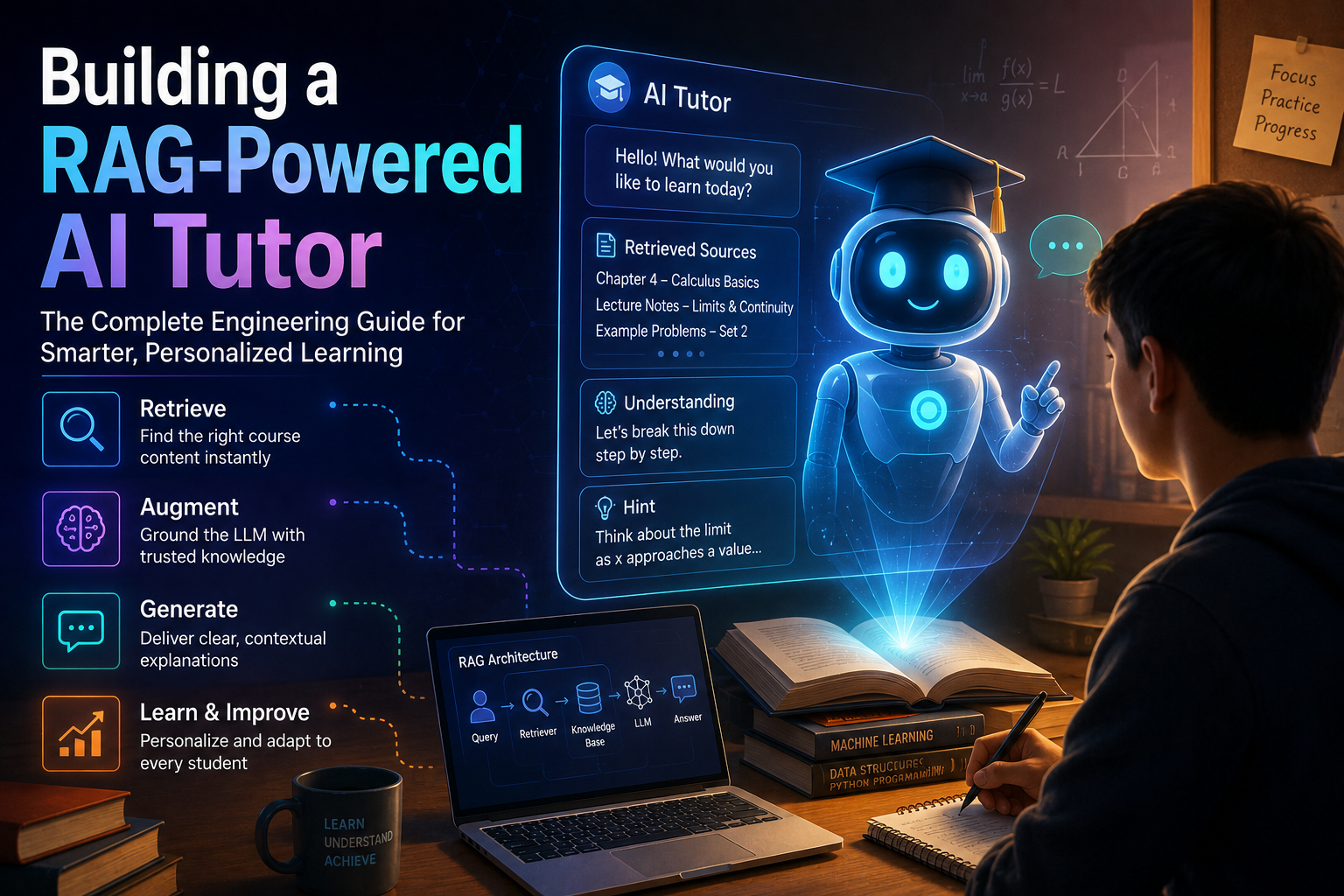
Executive Summary: What Actually Makes a RAG-Powered AI Tutor Work?
A RAG-powered AI tutor can transform static educational content into an interactive learning system that retrieves relevant course material and uses a large language model to generate contextual explanations, hints, questions, and guided learning experiences.
But there is an important engineering reality:
RAG does not automatically improve student retention, engagement, or learning outcomes.
The evidence available in 2026 is considerably more nuanced.
A 2025 randomized controlled trial involving Harvard undergraduate physics students found that a carefully designed AI tutor produced more than twice the median learning gains of the comparison in-class active-learning condition while students spent less median time on task. The tutor, however, was deliberately engineered around established pedagogical practices, structured prompts, scaffolding, and instructor-designed content. [1]
By contrast, a 2026 semester-long controlled experiment involving approximately 500 university students found no statistically significant improvement in academic achievement, engagement, interest, or self-efficacy from a RAG-based generative AI chatbot. [2]
That contrast tells us something far more useful than an exaggerated “10x retention” promise:
The retrieval architecture matters, but pedagogical design, content quality, personalization, evaluation, and student experience determine whether an AI tutoring system actually creates educational value.
This guide explains how I would engineer that system for production.
Technical information reviewed against current documentation and research through August 29, 2026.
Why I Approach AI Tutoring as a Production AI Engineering Problem
I work as a Senior Cloud & AI Engineer, with more than six years of experience across AI, cloud-native systems, Generative AI, Retrieval-Augmented Generation, conversational AI, computer vision, security, and enterprise architecture.
My production work includes RAG platforms using PostgreSQL + pgvector, Milvus, and ChromaDB, integrating frontier and open-source language models and designing local, cloud, and hybrid LLM deployments.
That production perspective matters because an AI tutor is not simply:
Student -> Prompt -> LLM -> Answer
A serious educational AI platform has to solve several systems problems simultaneously:
- Retrieval accuracy
- Curriculum grounding
- Student personalization
- Hallucination control
- Privacy
- Authorization
- Assessment integrity
- Latency
- Observability
- Content versioning
- Cost
- Human oversight
I have also worked in technical education, leading hands-on cloud, machine-learning deployment, architecture, development, and API training for a team of 20 interns.
The central lesson is the same in education as it is in enterprise AI:
A powerful model cannot compensate for a poorly engineered system.
What Is a RAG-Powered AI Tutor?
A RAG-powered AI tutor combines information retrieval with generative AI.
RAG stands for Retrieval-Augmented Generation.
The original RAG research combined a pretrained generative model with an external non-parametric knowledge source so that generation could use retrieved information rather than depending entirely on knowledge encoded in model parameters. [3]
For an EdTech platform, that external knowledge can contain:
- Textbooks
- Course modules
- Lecture transcripts
- Slides
- Instructor notes
- Worked examples
- Assessment rubrics
- Learning objectives
- Glossaries
- Policies
- Previous prerequisite material
Instead of asking the LLM to answer purely from its pretrained knowledge, the application retrieves educational evidence relevant to the student's question.
The generation model then receives that evidence as context.
flowchart LR
    A[Student Question] --> B[Query Processing]
    B --> C[Retrieval]
    C --> D[Course Knowledge Base]
    D --> E[Relevant Evidence]
    E --> F[Prompt Assembly]
    A --> F
    F --> G[LLM]
    G --> H[Validation]
    H --> I[Student Response]
This architecture gives the system something a generic chatbot does not inherently possess:
course-specific context and provenance.
Why RAG Is Useful for EdTech
Educational content creates an unusually good use case for retrieval because the knowledge is usually bounded.
An institution may want the tutor to answer according to:
- A particular textbook
- A particular instructor's curriculum
- A specific semester
- An approved formula
- A specific interpretation
- A particular assessment standard
A generic model may know the subject but still produce an answer inconsistent with the course.
RAG makes it possible to instruct the model:
Answer using the approved course material retrieved for this student and cite the material supporting the explanation.
This is fundamentally different from assuming that a general-purpose model's pretrained knowledge matches the curriculum.
AI Tutors Can Help Learning—But Architecture Alone Is Not the Evidence
This distinction is important for anyone building or buying an AI tutoring system.
The Harvard randomized study published in Scientific Reports in June 2025 involved 194 eligible students in an undergraduate physics course. The AI-tutored group achieved higher post-test performance, and the reported median learning gains were more than double those of the in-class active-learning comparison. The median AI-tutor time on task was 49 minutes versus the study's assumed 60 minutes of learning time for the classroom condition. [1]
That is meaningful evidence.
It is not evidence that every chatbot produces the same result.
A 2026 controlled study of a RAG chatbot in higher education found no statistically significant effects on the measured outcomes. [2]
Another 2026 classroom study of an AI tutor in economics found increased student interaction with hints but no measured improvements in homework scores, exams, or final course grades in that implementation. [4]
The responsible conclusion is:
AI tutoring can improve learning under some conditions, but effectiveness depends heavily on instructional design and implementation.
That should directly influence the engineering architecture.
The Production Architecture I Recommend for an AI Tutor
A production EdTech RAG architecture should separate ingestion, retrieval, pedagogy, generation, safety, and analytics.
flowchart TD
    A[Learning Content] --> B[Ingestion Pipeline]
    B --> C[Parsing and Normalization]
    C --> D[Semantic Chunking]
    D --> E[Metadata Enrichment]
    E --> F[Embedding Pipeline]
    F --> G[Vector and Search Index]

    H[Student] --> I[Identity and Session]
    I --> J[Student Learning State]
    H --> K[Question]

    K --> L[Query Understanding]
    J --> L
    L --> M[Hybrid Retrieval]
    G --> M

    M --> N[Reranking]
    N --> O[Context Builder]
    J --> O

    O --> P[LLM]
    P --> Q[Grounding and Safety Checks]
    Q --> R[Student Response]

    R --> S[Learning Analytics]
    S --> J
Each layer should have a clear responsibility.
That makes the tutoring system easier to test, improve, secure, and replace incrementally.
Step 1: Build a Reliable Educational Content Pipeline
RAG quality begins before an embedding model is called.
The ingestion layer should normalize educational content into predictable structures.
Typical sources include:
| Source | Useful metadata |
|---|---|
| Lecture video | course, lecture, timestamp, speaker |
| Transcript | topic, timestamp, lesson |
| PDF textbook | chapter, page, section |
| Slides | lecture, slide number, topic |
| Quiz | objective, difficulty, answer type |
| Worked example | concept, prerequisite, difficulty |
| Rubric | assessment, criterion, score band |
| FAQ | module, topic, instructor approval |
Every chunk should preserve its provenance.
Useful metadata might look like:
{
  "course_id": "PHY101",
  "module": "mechanics",
  "lesson": "newtons-laws",
  "source_type": "lecture_transcript",
  "source_id": "lecture-07",
  "timestamp_start": 422,
  "timestamp_end": 489,
  "difficulty": "introductory",
  "learning_objective": "apply-newtons-second-law",
  "version": "2026-fall"
}
That metadata is not decoration.
It becomes part of your retrieval and authorization architecture.
Step 2: Do Not Use a Universal Chunk Size
There is no universally correct chunk length for RAG.
The appropriate chunking strategy depends on:
- Source structure
- Embedding model
- Retrieval method
- Question type
- Context window
- Reranking strategy
- Curriculum structure
A formula explanation and a 40-page chapter should not necessarily use the same chunking rule.
For educational content, I generally prefer structure-aware or semantic boundaries over blindly splitting every fixed number of characters.
Good boundaries include:
- Paragraph
- Subsection
- Worked-example step
- Slide
- Transcript topic transition
- Question-answer pair
- Learning objective
Keep the original source location in metadata so the tutor can provide provenance.
Step 3: Choose the Retrieval Layer Based on Your Actual Workload
Vector databases and search systems are not interchangeable in every workload.
Current pgvector supports both exact nearest-neighbor search and approximate indexing using HNSW and IVFFlat. Its documentation notes that approximate indexes trade some recall for speed, and that HNSW generally provides a better speed-recall tradeoff than IVFFlat at the cost of slower builds and greater memory usage. [5]
That makes PostgreSQL + pgvector especially attractive when your platform already relies heavily on relational data.
For example:
students
courses
enrollments
lessons
assessments
content
content_permissions
embeddings
can live within one PostgreSQL-centered architecture.
That has been particularly useful in my own production RAG engineering work, where I have built systems with PostgreSQL + pgvector as well as Milvus and ChromaDB.
Dense Vector Search Alone Is Often Not Enough
Semantic similarity is powerful, but students frequently ask questions containing exact terminology.
Consider:
What does Rule 7.3 say about reassessment?
A purely semantic retriever might find conceptually related content.
But the exact string Rule 7.3 is highly informative.
The same problem appears with:
- Formula names
- Course codes
- Chapter identifiers
- Scientific terminology
- Dates
- Regulation numbers
- Instructor-defined vocabulary
That is where hybrid search becomes important.
Hybrid Search for AI Tutoring
Hybrid retrieval combines semantic/vector signals with lexical or keyword retrieval.
Current Pinecone documentation explicitly describes hybrid search as combining semantic and lexical methods because each has different weaknesses. [6]
Current Azure AI Search documentation similarly supports hybrid queries combining text and vector retrieval and uses Reciprocal Rank Fusion to merge result sets. Its hybrid-search documentation was updated in July 2026. [7]
pgvector can also be combined with PostgreSQL full-text search, with techniques such as Reciprocal Rank Fusion or cross-encoder reranking used to combine results. [5]
A simplified architecture looks like:
flowchart LR
    A[Student Query] --> B[Dense Retrieval]
    A --> C[Keyword Retrieval]

    B --> D[Candidate Set]
    C --> D

    D --> E[Rank Fusion]
    E --> F[Reranker]
    F --> G[Top Evidence]
    G --> H[LLM]
For many serious RAG systems, this is a stronger baseline than vector similarity alone.
Step 4: Rerank Before Sending Context to the LLM
Initial retrieval optimizes candidate discovery.
It does not always provide the optimal final ordering.
A second-stage reranker evaluates the relationship between the query and retrieved passages more carefully.
Current Pinecone guidance describes reranking specifically as a two-stage retrieval technique for improving RAG result relevance: retrieve a larger candidate set first, then use a reranking model to return a smaller and more relevant subset. [8]
Conceptually:
query = student_question

dense_results = dense_search(query, limit=30)
lexical_results = keyword_search(query, limit=30)

candidates = reciprocal_rank_fusion(
    dense_results,
    lexical_results
)

ranked = reranker.rank(
    query=query,
    documents=candidates
)

context = ranked[:6]
The exact numbers should come from evaluation.
Do not turn top_k = 5 into a religious rule.
Measure it.
Step 5: Make Retrieval Curriculum-Aware
A tutoring system should not search every document equally.
A first-year student asking about introductory mechanics may not benefit from retrieving an advanced graduate derivation merely because its embedding is close.
Use metadata filters and curriculum structure.
Possible retrieval constraints include:
course_id = PHY101
semester = 2026-FALL
module = mechanics
content_status = approved
student_access = allowed
difficulty <= intermediate
You can also use a student's learning state.
For example:
student weakness:
- vector decomposition

current objective:
- Newton's second law

recent mistakes:
- confusing mass and weight
The retriever can prioritize prerequisite explanations before advanced material.
This is where a generic RAG chatbot begins becoming a personalized AI tutor.
Step 6: Separate Retrieval Personalization From Generative Personalization
Personalization should not mean:
Hello Sarah!
A useful tutor changes what it retrieves and how it teaches.
Retrieval Personalization
Adjust evidence selection according to:
- Course enrollment
- Current lesson
- Prior topic mastery
- Previous mistakes
- Difficulty level
- Language
- Accessibility requirements
Generative Personalization
Adjust:
- Explanation depth
- Number of steps
- Amount of scaffolding
- Examples
- Vocabulary
- Question difficulty
- Whether to provide hints or direct explanation
This separation is important.
The retrieval layer decides what evidence is appropriate.
The generation layer decides how that evidence should be taught.
A Lightweight Student Learning Model
You do not necessarily need another large neural model.
A structured learner state is often sufficient.
{
  "student_id": "anonymous-internal-id",
  "course": "PHY101",
  "topic_mastery": {
    "vectors": 0.82,
    "kinematics": 0.74,
    "forces": 0.41
  },
  "recent_errors": [
    "mass-weight-confusion",
    "sign-convention"
  ],
  "preferred_language": "en",
  "current_module": "forces"
}
Use the representation as a decision signal, not as an unquestionable psychological diagnosis.
Learning models can be incomplete or wrong.
Students should not be permanently categorized because an algorithm inferred that they are “weak” at something.
Step 7: Build the Tutor Around Pedagogy, Not Chat
This is one of the most important distinctions.
A chatbot tries to answer.
A tutor tries to help the student learn.
Those goals are not identical.
The 2025 Harvard AI tutoring study explicitly attributes its design to educational practices including active learning, managing cognitive load, scaffolding, targeted feedback, and self-paced learning. [1]
A tutoring policy might therefore say:
1. Identify the concept the student is struggling with.
2. Retrieve approved course evidence.
3. Determine whether a hint is sufficient.
4. Ask a diagnostic question where appropriate.
5. Scaffold the solution.
6. Avoid immediately exposing the final answer when practice is the goal.
7. Verify the explanation against retrieved material.
8. Cite the course source.
9. Update the learning state only from meaningful evidence.
That is considerably more sophisticated than:
You are a helpful tutor.
AI Tutoring Should Not Always Give the Answer
This becomes especially important around assessment.
Suppose a student pastes:
Question 4 from today's graded quiz:
Calculate...
The technically easiest response may be to solve it.
The educationally correct response may instead be:
- Explain the underlying concept
- Offer a hint
- Ask the learner to attempt the next step
- Restrict direct answers according to assessment policy
The application should know the difference between:
practice exercise
and:
live graded assessment
That is a product-policy problem, not simply a prompt-engineering problem.
Step 8: Treat Grounding as Measurable, Not Magical
RAG does not eliminate hallucinations.
Retrieval can return:
- Irrelevant documents
- Partially relevant passages
- Outdated versions
- Contradictory passages
- Insufficient evidence
And a language model can still generate unsupported claims even after receiving good context.
A production pipeline should therefore measure several stages separately.
Question
   |
   v
Retrieval Quality
   |
   v
Context Quality
   |
   v
Answer Groundedness
   |
   v
Pedagogical Quality
   |
   v
Learning Outcome
If you only measure whether users “liked the chatbot,” you cannot identify which stage is failing.
The Evaluation Framework I Recommend
Evaluate at least four layers.
1. Retrieval Evaluation
Measure:
- Recall@K
- Precision@K
- MRR
- NDCG
- Metadata-filter accuracy
- Source coverage
Create a labeled evaluation set:
question -> expected relevant sources
Then measure retrieval directly.
2. Generation Evaluation
Measure:
- Factual correctness
- Groundedness
- Source attribution
- Completeness
- Instruction adherence
- Structured-output validity
3. Tutoring Evaluation
Measure:
- Hint quality
- Scaffolding quality
- Explanation appropriateness
- Whether the tutor prematurely reveals answers
- Alignment with curriculum
- Instructor ratings
4. Learning Evaluation
This is the level that ultimately matters.
Measure:
- Pre/post assessment changes
- Delayed retention
- Time to mastery
- Error recurrence
- Transfer to new problems
- Practice completion
These metrics should be defined before launch.
Do Not Use Engagement as a Substitute for Learning
A student can spend more time interacting with an AI system without learning more.
The 2026 economics classroom study is useful precisely because higher interaction with AI hints did not translate into improvements in the measured grades or exam outcomes. [4]
Similarly, the 2026 RAG-chatbot experiment found no significant improvement across its measured educational outcomes. [2]
Therefore:
messages per session ↑
does not automatically mean:
learning ↑
Product analytics and learning analytics must be separated.
Step 9: Protect Student Privacy by Architecture
Educational AI systems can process highly sensitive information.
Examples include:
- Student identity
- Assessment performance
- Learning difficulties
- Behavioral history
- Instructor feedback
- Conversation transcripts
The safest approach is data minimization.
The model should receive only the information necessary for the current task.
For example, it may need:
Mastery of vectors: low
It probably does not need:
Full student profile
Home address
Phone number
Parent details
Unrelated academic history
UNESCO's guidance for generative AI in education emphasizes a human-centered, age-appropriate approach, data privacy, ethical validation, and pedagogical design. The guidance page was last updated in January 2026. [9]
FERPA and U.S. Educational Deployments
For U.S. educational deployments, FERPA considerations can become relevant when personally identifiable information from education records is processed or shared.
Current U.S. Department of Education student-privacy guidance states that the general FERPA rule prohibits disclosure of personally identifiable information from education records without written consent unless an applicable exception permits it. [10]
Department guidance for online educational services also warns institutions to review applications that collect student information and ensure that data is not reused or redisclosed for unauthorized purposes under applicable FERPA arrangements.
This is not legal advice.
The practical AI-engineering implications are clear:
- Minimize student data
- Separate identity from learning state where possible
- Apply least privilege
- Encrypt data in transit and at rest
- Maintain audit logs
- Define retention policies
- Control model-provider data flows
- Isolate tenants
- Document subprocessors
- Support deletion workflows
- Review jurisdiction-specific requirements
Privacy cannot be added after the architecture is complete.
Step 10: Implement Human Oversight
UNESCO's AI-in-education guidance emphasizes human-centered adoption rather than replacing educational decision-making with autonomous systems. [9]
A production platform should therefore provide instructor controls.
For example:
Instructor Console
├── Review flagged answers
├── Approve content
├── Disable documents
├── Inspect citations
├── View retrieval failures
├── Review common student misconceptions
├── Change tutoring policy
└── Escalate critical interactions
Teachers should have visibility into what the system is teaching.
That is especially important when AI-generated responses can influence understanding of foundational concepts.
An End-to-End RAG Tutor Flow
A framework-neutral implementation might look like this:
def tutor(student, question):
    policy = load_course_policy(student.course_id)
    learning_state = load_learning_state(student.id)

    query = build_retrieval_query(
        question=question,
        learning_state=learning_state
    )

    filters = {
        "course_id": student.course_id,
        "content_status": "approved",
        "student_access": True
    }

    dense = vector_search(
        query=query,
        filters=filters,
        limit=30
    )

    lexical = keyword_search(
        query=query,
        filters=filters,
        limit=30
    )

    candidates = reciprocal_rank_fusion(
        dense,
        lexical
    )

    evidence = rerank(
        query=query,
        documents=candidates,
        limit=6
    )

    if not sufficient_evidence(evidence):
        return safe_no_evidence_response()

    prompt = build_tutoring_prompt(
        question=question,
        evidence=evidence,
        learning_state=learning_state,
        policy=policy
    )

    answer = generate(prompt)

    result = validate_grounding(
        answer=answer,
        evidence=evidence
    )

    log_interaction(
        question=question,
        evidence=evidence,
        result=result
    )

    return result
The important part is not the syntax.
It is the separation of responsibilities.
The Production Data Flow
sequenceDiagram
    participant Student
    participant API
    participant Profile as Learning State
    participant Search
    participant Reranker
    participant LLM
    participant Validator

    Student->>API: Ask question
    API->>Profile: Load permitted learning state
    Profile-->>API: Mastery + context
    API->>Search: Hybrid retrieval
    Search-->>API: Candidate evidence
    API->>Reranker: Rank candidates
    Reranker-->>API: Best evidence
    API->>LLM: Evidence + tutoring policy
    LLM-->>API: Draft response
    API->>Validator: Grounding + policy check
    Validator-->>API: Approved / rejected
    API-->>Student: Tutor response + sources
This design also gives you useful observability.
When an answer fails, you can determine whether the problem came from:
- Search
- Ranking
- Prompting
- Generation
- Policy
- Content
- Student-state logic
Latency Engineering for an AI Tutoring System
A tutoring experience should feel conversational.
Measure latency component by component:
Authentication
+ query processing
+ embedding
+ retrieval
+ reranking
+ context construction
+ model time-to-first-token
+ generation
+ validation
= user-perceived latency
Do not optimize only model inference.
Retrieval or reranking may become the bottleneck.
Useful techniques include:
- Connection pooling
- Efficient indexes
- Query caching where safe
- Embedding caching
- Parallel retrieval
- Streaming generation
- Smaller rerank candidate sets
- Precomputed metadata
- Asynchronous analytics
- Region-aware deployment
Always measure production workloads.
Cost Engineering
Cost should be evaluated per successful educational interaction, not merely per API request.
Track:
embedding cost
+ retrieval infrastructure
+ reranking
+ input tokens
+ output tokens
+ guardrails
+ observability
+ storage
+ engineering operations
Then connect cost to outcomes.
A useful business metric might be:
AI cost per successfully remediated concept
rather than:
cost per chatbot message
That creates much stronger alignment between engineering and educational value.
RAG vs Fine-Tuning for an AI Tutor
You usually do not need fine-tuning simply to give a model access to course knowledge.
Use RAG when information is:
- Course-specific
- Frequently updated
- Private
- Source-sensitive
- Different between institutions
- Required to be attributable
Consider fine-tuning when the issue is persistent behavior, such as:
- Tutoring style
- Output structure
- Domain-specific interaction patterns
- Tool-use behavior
- Specialized language behavior
A strong system can use both:
Fine-tuned behavior
        +
Retrieved current knowledge
        =
Specialized grounded tutor
But start with the least complex architecture that satisfies measured requirements.
Why I Would Not Promise "10x Student Retention"
The original concept for this article used a “10x student retention” claim.
I would not publish that claim without a controlled study demonstrating it for the specific product.
The current evidence does not justify stating that RAG tutoring generally produces a tenfold increase in student retention.
What the evidence does justify is more useful:
- Well-designed AI tutoring can improve learning in specific settings. [1]
- Other AI and RAG tutoring implementations have produced no significant measured learning improvement. [2][4]
- Pedagogy, scaffolding, content, personalization, security, and implementation quality matter. A 2026 high-school STEM study involving 478 students also found relationships between factors such as personalization, content, security, motivation, satisfaction, and learning outcomes. [11]
That is the evidence-based position an engineering organization can defend.
What Should an EdTech Team Build First?
I would build the system in this order.
Phase 1 — Retrieval Baseline
- Ingest one high-quality course
- Preserve provenance
- Implement vector retrieval
- Build labeled retrieval questions
- Measure Recall@K
Phase 2 — Hybrid Search
- Add lexical retrieval
- Add metadata filters
- Add rank fusion
- Evaluate against the same benchmark
Phase 3 — Reranking
- Retrieve broader candidates
- Rerank
- Compare retrieval metrics
- Measure added latency
Phase 4 — Grounded Generation
- Add tutor prompt
- Require source attribution
- Build unsupported-claim tests
- Add safe abstention
Phase 5 — Pedagogical Behavior
- Diagnostic questions
- Scaffolding
- Hints
- Progressive explanations
- Assessment rules
Phase 6 — Personalization
- Lightweight mastery model
- Prerequisite retrieval
- Difficulty adaptation
- Student-controlled preferences
Phase 7 — Learning Experiment
- Predefine hypotheses
- Establish a control
- Measure learning outcomes
- Include instructor review
This order keeps the system measurable.
AI Tutor Launch Checklist
Content
- Content has an accountable owner
- Documents are versioned
- Provenance is preserved
- Old content can be revoked
- Access permissions are enforced
Retrieval
- Retrieval benchmark exists
- Vector search is evaluated
- Keyword retrieval is evaluated
- Metadata filtering works
- Reranking has been benchmarked
AI
- Tutor behavior is explicitly defined
- Grounding is measured
- Unsupported-answer behavior is tested
- Assessment policies are enforced
- Model/version changes are traceable
Education
- Instructor review exists
- Learning outcomes are defined
- Tutor does not always reveal answers
- Student feedback is captured
- Accessibility has been considered
Security
- Least privilege
- Encryption
- Audit logs
- Tenant isolation
- Data-retention policy
- Deletion process
- Vendor data flow reviewed
- Applicable privacy requirements reviewed
Operations
- Latency dashboard
- Retrieval-quality dashboard
- Cost monitoring
- Content coverage monitoring
- Incident process
- Rollback strategy
What Should You Look for in an AI Engineer Building an EdTech Platform?
Building a production AI tutoring platform requires considerably more than prompt engineering.
A strong AI Engineer, Generative AI Engineer, or RAG Engineer should understand:
- LLM architecture
- RAG
- Embeddings
- Vector databases
- Hybrid retrieval
- Reranking
- Evaluation
- Backend APIs
- Databases
- Cloud architecture
- MLOps
- Security
- Privacy
- Observability
- Cost optimization
My own engineering work covers production RAG, Generative AI, conversational systems, secure cloud architecture, PostgreSQL + pgvector, Milvus, ChromaDB, FastAPI, Python, Docker, Kubernetes, and multi-cloud deployment.
That breadth is particularly relevant to EdTech because the LLM is only one component of the tutoring product.
A reliable educational AI platform depends on the complete system around it.
FAQ
What Is a RAG-Powered AI Tutor?
A RAG-powered AI tutor retrieves relevant material from an approved educational knowledge base and provides that evidence to a generative model before producing a tutoring response.
This allows answers to be grounded in course-specific material instead of depending exclusively on the model's pretrained knowledge.
Does RAG Reduce AI Hallucinations?
RAG can provide relevant external evidence, but it does not guarantee factual answers.
Retrieval can fail, and generation can still produce unsupported claims.
Use retrieval evaluation, reranking, grounding checks, citation requirements, and safe abstention.
Does an AI Tutor Improve Student Retention?
It can improve educational outcomes in some implementations, but there is no defensible universal retention multiplier.
Published studies currently show both strong positive results and implementations with no statistically significant learning improvement. [1][2][4]
Measure the effect in your own student population.
What Vector Database Is Best for an AI Tutor?
There is no universal winner.
pgvector is attractive when the organization already uses PostgreSQL and wants relational data, metadata, and vectors close together.
Dedicated vector databases may provide different operational features and scaling models.
Evaluate:
- Data volume
- Query load
- Metadata filtering
- Hybrid search
- Latency
- Team expertise
- Operational cost
Is Hybrid Search Better Than Vector Search?
For many educational datasets it can be.
Vector search captures semantic similarity, while lexical retrieval handles exact terminology particularly well.
Modern retrieval platforms explicitly support hybrid combinations of semantic and lexical search.
Test both against a labeled dataset instead of assuming one will win.
Should an AI Tutor Use Reranking?
Reranking is worth evaluating when first-stage retrieval produces a reasonable candidate set but the most useful passages are not consistently ranked at the top.
It adds latency and cost, so benchmark the complete tradeoff.
Does an AI Tutor Need Fine-Tuning?
Not necessarily.
For many applications, start with:
- Strong prompts
- High-quality RAG
- Hybrid retrieval
- Reranking
- Pedagogical orchestration
- Evaluation
Fine-tune only when you have evidence that persistent model behavior—not missing knowledge—is the limitation.
How Should AI Tutoring Be Personalized?
Use educationally relevant signals such as:
- Current topic
- Prior mistakes
- Demonstrated mastery
- Prerequisites
- Difficulty
- Language
Avoid collecting unnecessary personal data.
Personalization should improve instruction without becoming unnecessary surveillance.
Key Takeaways
- RAG-powered AI tutoring is an architecture, not proof of educational effectiveness.
- Published research through 2026 shows both strong positive AI-tutoring outcomes and deployments with no significant learning improvement.
- Pedagogical design is as important as LLM selection.
- Preserve provenance for every educational chunk.
- Benchmark chunking instead of copying arbitrary chunk sizes.
- Evaluate hybrid retrieval for exact terminology plus semantic meaning.
- Use reranking when it measurably improves retrieval quality.
- Personalize retrieval and tutoring behavior separately.
- Measure retrieval, generation, pedagogical quality, and learning outcomes independently.
- Never substitute engagement metrics for evidence of learning.
- Design privacy and security into the architecture.
- Keep instructors in control of curriculum-critical behavior.
- Use RAG for changing knowledge and fine-tuning for persistent behavior when justified.
Conclusion
The most important lesson in building a RAG-powered AI tutor in 2026 is that the LLM is not the tutoring system.
The production system includes:
Learning content
+ metadata
+ embeddings
+ vector search
+ lexical search
+ reranking
+ student learning state
+ pedagogical policy
+ LLM generation
+ grounding
+ privacy
+ evaluation
+ instructor oversight
RAG makes course knowledge retrievable.
Engineering makes it reliable.
Pedagogy makes it educational.
And controlled evaluation tells you whether it actually works.
My recommended approach is therefore simple:
Build the smallest measurable tutoring system first. Prove retrieval quality. Prove grounding. Prove pedagogical behavior. Then prove learning outcomes before making growth or retention claims.
That is how I approach production Generative AI systems: not by assuming that a stronger model creates a stronger product, but by engineering and measuring the complete system around it.
References
[1] Kestin, G., Miller, K., Klales, A., Milbourne, T., et al. AI Tutoring Outperforms In-Class Active Learning: An RCT Introducing a Novel Research-Based Design in an Authentic Educational Setting. Scientific Reports, 2025.
[2] AI Chatbots in Higher Education: Comparing Expectations to Evidence. Computers in Human Behavior Reports, Volume 22, 2026.
[3] Lewis, P., Perez, E., Piktus, A., et al. Retrieval-Augmented Generation for Knowledge-Intensive NLP Tasks. arXiv:2005.11401, 2020.
[4] Does AI Help Economics Students Learn or Just Finish? A Classroom Field Study. International Review of Economics Education, Volume 52, 2026.
[5] pgvector — Open-Source Vector Similarity Search for PostgreSQL. Current project documentation, reviewed August 2026.
[6] Pinecone — Hybrid Search Documentation. Current documentation, reviewed August 2026.
[7] Microsoft Azure AI Search — Hybrid Search Overview. Updated July 21, 2026.
[8] Pinecone — Increase Search Relevance and Reranking Documentation. Current documentation, reviewed August 2026.
[9] UNESCO. Guidance for Generative AI in Education and Research. Published 2023; UNESCO page updated January 16, 2026.
[10] U.S. Department of Education, Student Privacy Policy Office. FERPA Privacy and Data-Sharing Guidance. Current guidance reviewed August 2026.
[11] How AI Tutor Features Influence Motivation and Learning Outcomes: Psychological Pathways in High School STEM Education. 2026.