How AI and Cloud Technology Can Transform Every Business in Bangladesh in 2026
Md Bazlur Rahman Likhon | Senior Cloud & AI Engineer, Dhaka, Bangladesh Published: April 2026 | Read time: 12 minutes
A garment factory owner in Narayanganj was losing nearly 18% of his production to quality defects every single month. Buyers were complaining. Orders were shrinking. He had no IT department, no data scientist, and no budget for expensive consultants. What he did have was a smartphone, a reliable internet connection, and the courage to try something new. He installed an AI-powered visual inspection system hosted on the cloud. Within 90 days, defect rates dropped from 18% to just under 3%. His export orders rebounded. His buyers sent a congratulatory email. That factory owner didn't transform his business with millions in investment — he did it with a cloud subscription and one smart decision.
I tell this story because it's the one I wish every business owner in Bangladesh could hear before dismissing AI and cloud as "something for big tech companies." The truth is, we are at an inflection point. AI and cloud aren't coming to Bangladesh — they're already here, already working, and already delivering results for factories, fintech startups, hospitals, and farms across this country. The businesses that act first will define the next decade of Bangladesh's economy. The ones that wait will spend that decade catching up. So let's talk about what this actually means for your business — in plain language, with real numbers, and practical steps you can take starting today.
🇧🇩 Why Bangladesh Is at the Tipping Point for AI and Cloud
If you want to understand why 2026 is the year everything changes for AI adoption in Bangladesh, look at what's happening on five different fronts simultaneously — and feel the electricity in the air.
The Government Has Made Its Move. Bangladesh's National AI Policy 2026–2030 has been officially released by the ICT Division, creating a formal risk-based regulatory framework with explicit investments in AI infrastructure, education, and governance. This policy isn't just paperwork — it identifies high-impact sectors including health, education, agriculture, and manufacturing as priority areas for AI deployment. When the government builds the regulatory road, businesses can drive on it with confidence.
The Digital Foundation Is Solid and Growing. As of late 2025, Bangladesh had 82.8 million internet users — a penetration rate of 47%, growing by 5.6% year-on-year. More strikingly, 72.4% of households now own a smartphone, and mobile internet download speeds surged by 32.7% in just twelve months. Bangladesh has 186 million active mobile connections — more than the total population. When nearly three-quarters of Bangladeshi households hold a supercomputer in their pocket, the barrier to deploying AI and cloud tools collapses.
The Freelancer and Tech Workforce Is Ready. Bangladesh ranks second globally in the number of online freelancers, with the ICT Division putting the count at over 650,000. These aren't just people doing basic data entry — they are cloud-native, AI-literate professionals building solutions for global clients and increasingly turning that expertise inward to serve Bangladeshi businesses. The talent is here.
IT Exports Are Booming on AI Demand. Bangladesh's IT exports grew 13.54% in the first five months of FY2025–26, reaching USD 269.84 million, driven explicitly by rising global AI adoption and digitalisation. Software exports within that period jumped a remarkable 54%. Global clients are hiring Bangladeshi engineers because of AI skills — which means the knowledge flows back into our domestic business ecosystem.
The Startup Ecosystem Is Maturing Fast. Bangladesh's startup ecosystem recorded USD 124 million in total funding in 2025, with Gulf-based investors emerging as a new strategic capital corridor, particularly in fintech and platform businesses. The fintech sector alone is projected to grow from $1.6 billion to $12.1 billion by 2030. Bangladesh isn't waiting to be discovered — it's already on the global investment map.
We have transitioned from "Digital Bangladesh" to "Smart Bangladesh" — and AI is the engine of that next chapter. The question for every business owner reading this isn't whether AI will arrive in Bangladesh. It's whether your business will be ready when it does.
☁️ What Is Cloud Computing? (Explained for Bangladeshi Business Owners)
Let me explain cloud computing the way I'd explain it over a cup of tea in Dhanmondi — no jargon, no slides, no pretense.
Imagine you run a small garments buying house in Uttara. You need to store data, run accounting software, share files with your team in Chittagong, and maybe send automated invoices to your buyers in Germany. Traditionally, you'd need to buy physical servers worth Tk. 5–10 lakh, hire an IT person to maintain them, worry about them breaking down, and pray the power doesn't cut during backup. That's a massive upfront investment for a business trying to grow.
Cloud computing removes all of that. Instead of buying a generator, you rent electricity from the grid — and that's exactly what cloud is. You rent computing power, storage, and software from massive global data centers run by companies like Google (Google Cloud Platform / GCP), Amazon (AWS), and Microsoft (Azure). You pay monthly, like a utility bill. You access everything from your laptop, your phone, or even the factory floor — anywhere you have internet.
For a small or medium business in Bangladesh, cloud starts at roughly Tk. 2,000–5,000 per month for basic infrastructure — a fraction of what physical servers cost. And critically, cloud scales with you. When your business grows and needs more computing power during festival seasons (think Eid rush on your e-commerce store), you simply dial up the resources. When the rush is over, you dial them back down. You only pay for what you use.
| Feature | Traditional Servers | Cloud Computing |
|---|---|---|
| Upfront Cost | Tk. 5–10 lakh+ | Tk. 0 |
| Monthly Cost | Electricity + IT salary | Tk. 2,000–15,000 (SME range) |
| Scalability | Fixed — you buy what you buy | Instant — scale up or down |
| Maintenance | Your responsibility | Provider's responsibility |
| Access | Office only | Anywhere with internet |
| Disaster Recovery | Manual, costly | Automated, built-in |
The three major cloud platforms — GCP, AWS, and Azure — all have data centers in Asia, including Singapore and Mumbai, meaning Bangladeshi businesses get fast, low-latency performance. They're all government-partnered in Bangladesh, meaning your business is in safe, regulated hands.
Think of cloud as renting a generator instead of buying one — you pay for what you use, and it's always maintained by someone else. Now let's talk about what you can actually do with it.
🤖 What Is AI? What It Can Do for Your Business Right Now
Let me be direct: AI is not the robot uprising from Hollywood movies. AI — Artificial Intelligence — is software that learns from data to make decisions, predictions, and recommendations that previously required a human expert.
Here's the thing: you are already using AI every day. When you search on Google and it finds exactly what you were looking for, that's AI. When bKash sends you a security alert because something unusual happened on your account, that's AI fraud detection. When Daraz shows you products you actually want to buy instead of random items, that's an AI recommendation engine. AI is not science fiction — it's already running in the background of the apps your customers use daily.
For your business specifically, AI can:
- Automate repetitive tasks — data entry, invoice processing, report generation, email responses — that currently eat hours of your team's time
- Predict demand — so your garments factory orders the right fabric quantities and your shop never runs out of fast-moving items
- Serve customers faster — AI chatbots can answer common questions 24/7 in Bangla, English, or both
- Detect problems early — in machinery, in financial fraud, in product quality — before they become expensive crises
- Process documents — receipts, medical forms, purchase orders — at a speed no human team can match
The four most practical AI types for Bangladeshi businesses right now are: Chatbots (customer service), Image Recognition (quality inspection, document scanning), Predictive Analytics (demand forecasting, risk scoring), and Document Processing (invoice automation, prescription extraction).
And here's the most important thing I want you to understand: you don't need to build AI. You don't need to hire a team of data scientists. You can use AI tools that already exist, built by global companies and accessed through the cloud. That's the power of 2026 — enterprise-grade AI is now within reach of a 10-person team in Mirpur.
🏠AI + Cloud in Action: 6 Sectors Transforming Bangladesh
Let me show you exactly what's happening across Bangladesh's economy right now — with real context you can recognize.
1. 🧵 Garments & RMG (Ready-Made Garments)
Bangladesh is the world's second-largest garment exporter. That position wasn't earned by accident, and it won't be maintained without innovation. Here's the hard truth: Vietnam, China, and Ethiopia are already deploying AI in their factories. They're faster, they're producing fewer defects, and international buyers — especially European buyers tightening sustainability requirements — are paying attention.
The good news? Bangladeshi factories that have deployed AI-powered quality inspection systems are already seeing up to 15% fewer defects and measurable productivity gains on their sewing lines. AI can achieve a 15–20% cost reduction and 25% efficiency improvement when applied to production planning and machine usage. Cloud-based ERP systems allow production managers to track orders, inventory, and delivery timelines from a single dashboard — from the factory floor in Gazipur to a buyer's office in London.
Think about it: even a 1% efficiency gain across Bangladesh's RMG sector, which earns billions annually in export revenue, translates to hundreds of millions of taka in value. That's not a technology story — that's a national economic story.
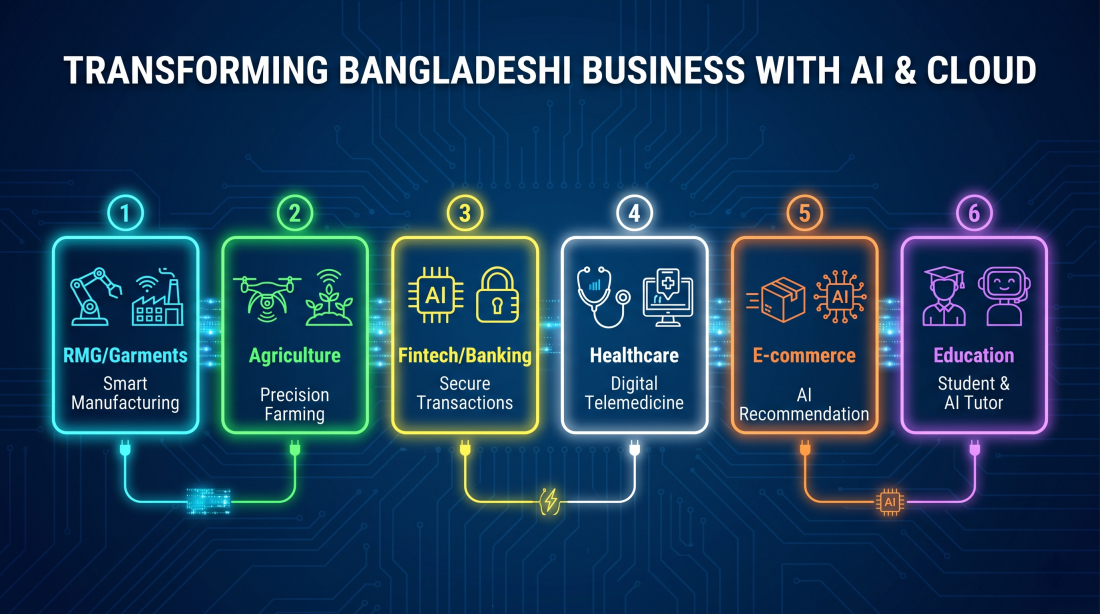
2. 🌾 Agriculture (60% of Bangladesh's Population Depends on It)
Bangladesh's farmers face climate volatility, pest outbreaks, flooding, and unpredictable market prices — often without the resources to absorb even one bad season. AI changes this equation dramatically.
AI-powered mobile apps already allow farmers to photograph their crops and receive instant disease diagnosis using computer vision — tools being piloted across South Asia including Bangladesh. AI-driven forecasting tools can predict crop prices based on weather patterns, supply-demand dynamics, and historical data, empowering farmers to plan their planting and selling cycles strategically. Projects like Krishok.ai, developed at the Solvio AI Hackathon 2025, are building AI-powered agritech solutions specifically for Bangladeshi farming contexts. IoT sensors measure soil moisture, temperature, and pH in real time, enabling precision irrigation that saves water and increases yield.
For a country where agriculture underpins the livelihoods of tens of millions, and where one flood or one pest outbreak can devastate a season's income, AI is not a luxury — it's a lifeline.
3. 💰 Fintech & Banking
Bangladesh's fintech sector is already one of the most dynamic in South Asia — and AI is its core engine. bKash serves 84.4% of individual MFS account holders in the country, processing over $416 million in daily transactions. Platforms like bKash, Nagad, and Rocket are deploying AI fraud detection systems that have achieved an impressive 97% fraud detection rate with 95% accuracy. That's AI protecting millions of Bangladeshis' money, every single day.
But the most transformative opportunity is AI credit scoring for the 80% of Bangladesh's population who remain underserved by traditional banking. By analyzing mobile usage patterns, transaction history, and behavioral data, AI can extend credit to rural populations who have never had a bank account. Cloud infrastructure is what allows fintech startups to scale nationally without the cost of physical branch networks. Bangladesh's fintech market is projected to grow from $1.6 billion to $12.1 billion by 2030 — and AI is the accelerant.
4. 🏥 Healthcare
Bangladesh's healthcare system faces a structural challenge: most specialist doctors are concentrated in Dhaka and a handful of major cities, while 60% of the population lives in rural areas far from quality care. AI and cloud are the bridge.
Telemedicine platforms like Aroggo are integrating AI-based symptom checkers and triage tools, narrowing the rural-urban specialist gap and reducing unnecessary patient journeys to Dhaka hospitals. In 2025, Bangladesh became the first country in Asia to adopt a portable AI-ultrasound device, making diagnostic imaging accessible in settings without radiology infrastructure. AI diagnostic tools for chest X-rays, diabetic screening, and early disease detection are being piloted, with pilot studies showing up to 40% productivity improvements among caregivers using AI tools. The COVID-19 pandemic laid bare how urgently Bangladesh's healthcare system needed cloud infrastructure — and the country's Digital Health Strategy now explicitly prioritizes scaling telemedicine nationwide.
5. 🛒 E-Commerce & Retail
Bangladesh's B2C e-commerce market is expected to grow to $7.41 billion by 2025, with a projected CAGR of 6.8% through 2029. Daraz — backed by Alibaba — already uses AI to auto-generate product descriptions in both English and Bengali, and deploys NLP for internal linking and recommendation optimization. Pickaboo uses AI-driven analytics to identify which content formats are converting best, then doubles down on those using predictive models.
For smaller retailers and shop owners, cloud-based inventory management systems powered by AI demand forecasting can eliminate dead stock — one of the biggest killers of cash flow for Bangladeshi SMEs. AI chatbots deployed on WhatsApp Business can handle customer inquiries in Bangla at 3 AM, turning a frustrated customer into a repeat buyer. Cloud logistics optimization can reduce last-mile delivery costs — a critical challenge in a country where Dhaka traffic makes every delivery an adventure.
6. 📚 Education
Bangladesh's education system serves over 40 million students across different levels — a scale so massive that teacher-to-student ratios are stretched thin, especially in rural districts. AI can be the great equalizer.
EdTech platforms like 10-Minute School and Shikho are already introducing AI-driven analytics to tailor educational content to individual learners' needs. AI-powered intelligent tutoring systems can provide personalized instruction aligned to individual learning styles and pacing — meaning a student in Rangpur can receive the same quality of adaptive education as one in Gulshan. Cloud Learning Management Systems (LMS) allow institutions to deliver quality courses at scale without physical infrastructure. AI-based exam proctoring is enabling scalable, secure assessment online.
For Bangladesh's 40+ million students, AI in education isn't about replacing teachers — it's about extending great teaching to every corner of this country.
💼 How Any Business Can Start With AI and Cloud Today
I work with business owners across Bangladesh — from RMG factories in Gazipur to fintech startups in Gulshan to agriculture companies in Sylhet. And the single most common mistake I see is trying to do everything at once. Here's my practical, no-nonsense roadmap for getting started.
Step 1: Start With One Problem
Don't try to transform everything at once. Pick one painful business problem — late invoices? Customer complaints that aren't being tracked? Stock-outs at the wrong time of year? — and solve that first with AI. The win will be measurable, the team will gain confidence, and the path forward becomes clear. I've seen businesses transform their operations 90 days after starting with a single focused AI project.
Step 2: Use Cloud-Based SaaS Tools (No IT Team Needed)
You don't need to build anything from scratch to start benefiting from cloud and AI. Tools that are available to you right now, with a credit card and a browser:
- Google Workspace — Cloud-native email, documents, sheets, video meetings. Your first step into the cloud.
- Zoho CRM — AI-powered customer management; track every lead, every deal, every follow-up automatically.
- WhatsApp Business API with AI chatbot — Connect an AI chatbot to your existing WhatsApp number; let it handle FAQs, order status, and basic customer support 24/7 in Bangla.
- ChatGPT / Gemini — Use for drafting business communication, analyzing data, generating marketing content, summarizing reports.
- Zoho Invoice / Wave — Cloud accounting and invoicing; automated reminders, real-time reporting, no server required.
Step 3: Hire or Consult an AI Engineer
You don't need to learn to code. You need one expert who understands both technology and your industry well enough to connect the two. An experienced AI and cloud engineer can assess your business, identify your highest-ROI automation opportunities, and build the right solution — whether that's a chatbot, a predictive analytics dashboard, or an AI-powered document processing pipeline. That's exactly the kind of engagement I offer through brlikhon.engineer.
Step 4: Start Small, Measure, Scale
Set a 90-day goal with a single clear metric — response time, defect rate, order processing speed, customer satisfaction score. Measure that metric before you deploy anything. Deploy your AI solution. Measure again at 30, 60, and 90 days. If you're seeing improvement, scale. If not, you've learned something valuable at minimal cost. This is how smart businesses adopt technology — not with a single massive bet, but with disciplined, evidence-based iteration.
❓ What Does It Cost? (Real Numbers for Bangladesh)
This is the question every business owner asks first — and rightly so. Let me give you honest, grounded numbers.
The good news is that cloud and AI are far more affordable than most people assume. Here's a realistic cost breakdown:
| Solution | Estimated Monthly Cost (BDT) | What You Get |
|---|---|---|
| Google Cloud Starter (compute + storage) | Tk. 1,100–3,300/month | Basic cloud hosting, file storage, compute |
| Microsoft Azure / AWS equivalent | Tk. 2,500–5,500/month | Enterprise-grade cloud infrastructure |
| WhatsApp AI Chatbot (setup + running) | Tk. 5,500–22,000/month | 24/7 customer service in Bangla/English |
| Zoho CRM (AI-powered) | Tk. 1,600–4,400/month | Full sales pipeline and customer management |
| Cloud ERP for SME (e.g., Odoo) | Tk. 5,000–15,000/month | Finance, inventory, HR, operations |
| Custom AI Solution (one-time) | Tk. 1–5 lakh (one-time build) | Tailored system for your specific business |
A standard 2 CPU/8 GB virtual machine on major cloud platforms costs roughly $43–$48 per month — around Tk. 4,700–5,200, far less than the salary of a single IT employee, and it runs 24/7 without sick days or overtime.
To make the ROI concrete: one Dhaka garments supplier I know reduced manual quality checking costs by over Tk. 80,000 per month after deploying an AI visual inspection tool. The setup took 60 days and the cost recovered itself within a quarter. That's not a hypothetical — it's a real outcome from real cloud technology applied to a real Bangladesh factory.
AI is not just for big companies. The cloud makes enterprise-grade technology accessible to a 10-person team in Uttara, a family-run pharmacy in Sylhet, or a boutique export house in Chittagong. The barrier is not cost — it's awareness and the courage to take the first step.
Bangladesh's cloud market is projected to grow from USD 1.27 billion in 2025 to USD 3.19 billion by 2030, at over 20% annual growth. Every month you delay is a month your competitors gain ground.
🚀 The Businesses That Don't Adopt AI Will Lose the Decade
I want to be honest with you — not to create fear, but to give you the clear picture that I'd give a business partner sitting across from me.
Your competition is not standing still. Regional competitors from Vietnam, India, and China are deploying AI across manufacturing, agriculture, and services faster than many Bangladeshi businesses realize. Bangladesh's global IT export clients — companies in the USA, UK, and EU — increasingly expect AI-capable partners. When they evaluate outsourcing partners in Bangladesh, they are asking: "Do you use AI tools? Can you build AI-powered solutions?" The answer to that question is now a competitive filter.
Bangladesh's IT exports grew 13.54% in FY2025–26 precisely because global AI demand pulled Bangladeshi talent forward. Software exports within that period jumped 54% — not because of luck, but because Bangladeshi developers and engineers raced to build AI skills that global clients would pay for. The same logic applies to every sector. The RMG buyers placing orders from Europe are increasingly demanding traceability, quality documentation, and sustainability data — all of which require digital systems to produce.
The government's National AI Policy 2026–2030 means that regulatory frameworks, tax incentives, and AI-focused programs are being designed right now. Businesses that build their AI foundations today will be positioned to take full advantage of those incentives when they land. Businesses that wait will be trying to catch up under a regulatory environment designed for early adopters.
The next three years will draw a clear line between digitally-ready Bangladeshi businesses and those left behind. The cost of inaction is not zero — it compounds every quarter.
🤝 How MD Bazlur Rahman Likhon Helps Bangladeshi Businesses With AI and Cloud
I'm MD Bazlur Rahman Likhon — a Senior Cloud and AI Engineer based in Dhaka, Bangladesh. I've spent the last several years building AI systems and cloud infrastructure for companies across Bangladesh, the USA, the UK, and the Middle East. I hold 5 Google Cloud Professional certifications, 4 Microsoft Azure certifications, the AWS AI/ML Scholar designation, Oracle certifications, and over 100 professional credentials in AI, cloud, and software engineering.
But more than certifications, what I bring is context. I understand what it means to build technology that works in Bangladesh's real conditions — variable internet connectivity, local language requirements, SME budget constraints, and the specific pressures of industries like RMG, fintech, and agriculture. I've built OCR systems that process Bangla documents, medical prescription extraction tools for healthcare providers, AI-powered communication systems, and multi-agent AI pipelines for enterprise clients.
Here's what MD Bazlur Rahman Likhon offers Bangladeshi businesses:
- AI Readiness Assessment — I review your current business systems, map your data and workflows, and identify the top 3 AI and cloud opportunities with the highest ROI for your specific business. No jargon, no theoretical fluff — a practical action plan you can execute.
- Cloud Migration — Moving your business operations to GCP, AWS, or Azure safely, affordably, and with zero disruption to daily operations. I architect systems that are secure, scalable, and built for Bangladesh's operating environment.
- Custom AI Solutions — Building chatbots in Bangla/English, AI visual inspection systems for RMG quality control, AI-powered fraud detection for fintech, automated document processing, demand forecasting dashboards, and smart automation pipelines tailored precisely to your business requirements.
- AI Training and Mentoring — Teaching your team how to use AI tools effectively — from ChatGPT and Gemini for business productivity to cloud dashboards for real-time operations intelligence.
I serve clients across Bangladesh and globally, always with the goal of making AI and cloud transformation practical, affordable, and measurably impactful for your business.
❓ Frequently Asked Questions
Q1: আমার কি IT টিম লাগবে AI ব্যবহার করতে? (Do I need an IT team to use AI?)
Not at all. Many AI and cloud tools today are designed to be used directly by business owners and managers without any technical background. Tools like Google Workspace, Zoho CRM, and WhatsApp-integrated chatbots require no coding knowledge — you simply configure them through a web interface. For more custom AI solutions specific to your business, you need one experienced AI engineer (like myself) to build and deploy the system, after which your team can operate it with basic training.
Q2: ছোট ব্যবসার জন্য কি AI সত্যিই কাজ করে? (Does AI really work for small businesses?)
Absolutely — in fact, small and medium businesses often see the most dramatic ROI from AI because they're replacing manual, error-prone processes with automated systems. A 5-person team that deploys an AI chatbot for customer service effectively gains a sixth team member working 24/7 without salary. A small garments supplier that deploys AI quality inspection catches defects that were previously slipping through and costing money with every returned shipment. The technology doesn't discriminate by business size — it delivers results where there is data to learn from.
Q3: Cloud মানে কি আমার data বিদেশে চলে যাবে? (Does cloud mean my data goes abroad?)
This is a completely valid concern, and I respect you for asking it. Bangladesh's National AI Policy 2026–2030 explicitly addresses data sovereignty, requiring that sensitive and critical datasets — including health, financial, and national security data — be stored and processed within Bangladesh or in explicitly designated trusted jurisdictions. Major cloud providers like AWS, Google Cloud, and Azure offer data residency options and compliance frameworks that allow you to keep your most sensitive data within regional boundaries. For most business data (inventory, customer records, analytics), cloud providers offer enterprise-grade security that is far stronger than most on-premise server setups.
Q4: AI শুরু করতে কত টাকা লাগবে? (How much does it cost to start with AI?)
You can start using cloud-based AI tools for as little as Tk. 1,100–2,000 per month for basic infrastructure. A fully integrated AI chatbot for your business customer service costs Tk. 5,500–22,000 per month in running costs. A custom AI solution built specifically for your business processes typically involves a one-time development investment in the range of Tk. 1–5 lakh, after which operating costs are minimal. In almost every case I've seen, the first month of cost savings or revenue improvement covers the first quarter of investment.
Q5: আমি কীà¦à¦¾à¦¬à§‡ শুরু করব? (How do I get started?)
The simplest starting point is a conversation. Book a free AI and cloud strategy session at brlikhon.engineer, describe your business and your biggest operational pain point, and I'll give you a clear, honest picture of what's possible for your specific situation. Within that conversation, you'll have at least three concrete actions you can take — some of them for free, today, without any technical help at all.
📞 Ready to Transform Your Business With AI?
🚀 Book a Free AI & Cloud Strategy Session with Md Bazlur Rahman Likhon
Whether you run a garment factory, a fintech startup, a restaurant chain, or an e-commerce brand — I'll help you identify exactly where AI and cloud can save you money, cut waste, and grow revenue. No jargon. No pressure. Just a clear, honest conversation about what's possible for your business in 2026.
→ Book Free Discovery Call → View AI Services for Bangladesh → Email: [email protected]
👤 About the Author
MD Bazlur Rahman Likhon is a Senior Cloud & AI Engineer based in Dhaka, Bangladesh. Holding 5× Google Cloud Professional, 4× Microsoft Azure, AWS AI/ML Scholar, Oracle certifications, and 100+ professional credentials, he builds production-grade AI systems and cloud architectures for clients across Bangladesh, the USA, UK, and the Middle East. He specializes in Retrieval-Augmented Generation (RAG) pipelines, multi-agent AI systems, MLOps, document intelligence (OCR and NLP), and enterprise cloud architecture on GCP and AWS. MD Bazlur Rahman Likhon is passionate about democratizing AI access for Bangladeshi businesses of every size — from Dhaka startups to rural SMEs — believing that practical, locally-contextualized AI adoption is the key to Bangladesh's next decade of economic growth.
Connect with MD Bazlur Rahman Likhon:
Published on brlikhon.engineer | URL: /blog/ai-cloud-technology-business-bangladesh-2026 Meta description: Discover how AI and cloud technology are transforming businesses in Bangladesh — from RMG to fintech. Expert guide by MD Bazlur Rahman Likhon. Primary keyword: AI and cloud technology Bangladesh business 2026 Secondary keywords: cloud computing Bangladesh, digital transformation Bangladesh, AI tools for SMEs Bangladesh, AI for agriculture Bangladesh, AI fintech Bangladesh
References
-
[PDF] Bangladesh National AI Policy 2026-2030 - This National AI Policy is anchored in Bangladesh's broader national development objectives and alig...
-
Bangladesh's AI Moment: Testing the Implementation Gap - Bangladesh's draft AI policy represents genuine governance thinking, with risk-based frameworks, rig...
-
Digital 2026: Bangladesh — DataReportal – Global Digital Insights - The "state of digital" in Bangladesh in 2026
There were 82.8 million individuals using the interne...
-
Half of Bangladeshis still offline despite rapid digital expansion - The survey shows that 99 percent of households have at least one mobile phone, and 72.4 percent now ...
-
98.9% households now use mobile phones: BBS - In 2023, 43.6% of households had internet access, which increased to 55.1% in FY25 and reached 56.2%...
-
Opportunities in Freelancing in 2025 for Bangladeshis - LinkedIn - Additionally, the government's "Digital Bangladesh" initiative aims to create a more tech-enabled wo...
-
The Growth of Online Freelancing in Bangladesh - RSIS International - This paper discusses the fast growth of online freelancing in Bangladesh, its contribution to econom...
-
Bangladesh IT Exports Rise 13.54% in FY2025-26 - LinkedIn - Bangladesh's IT exports grew 13.54% to USD 269.84 million between July and November of FY2025-26, dr...
-
IT exports up 14% in Jul-Nov on AI-driven demand | The Daily Star - Bangladesh IT Export Growth 2025: Bangladesh's information technology (IT) exports grew 13.54 percen...
-
Bangladesh Fintech Sector Investment Opportunities Report 2025 - Bangladesh's fintech sector is set to grow from $1.6B to $12.1B by 2030. Explore the opportunities, ...
-
Bangladesh Startup Ecosystem 2025: Funding Trends and Insights - What Happened in Bangladesh's Startup Ecosystem in 2025? ✓ Funding rebounded in value: Total startup...
-
[PDF] Bangladesh Startup Investments Report 2025: Year In Review - Report 2025: Year In Review. An Ecosystem Between Pause and Progress. January 2026. Page 2 ... In 20...
-
Cloud Computing in Bangladesh: Opportunities, Challenges ... - In Bangladesh, cloud adoption is accelerating across banking, manufacturing, telecom, healthcare, an...
-
Bangladesh Public Cloud Market | Outlook & Forecast 2031 - According to 6Wresearch, Bangladesh Public Cloud Market is anticipated to rise at a CAGR of 25.4% du...
-
Cloud Computing in Bangladeshi SMEs | PDF - Scribd - 17.5% from 2020 to 2025, reaching $832.1 ... Cloud Computing minimizes technical spending in Banglad...
-
Cloud Providers Comparison 2025: AWS vs. Azure vs. Google ... - Compare AWS, Azure, and Google Cloud in this detailed Cloud Providers Comparison 2025. Discover pric...
-
AI-powered agriculture and economic transformation in Bangladesh - Here, it is possible to develop smart agriculture by applying AI, IoT and Big-Data technologies, suc...
-
How AI could curb mobile banking fraud - The Daily Star - Platforms such as bKash, Nagad, and Rocket have fundamentally ... Our system achieved an impressive ...
-
How AI could fight mobile banking fraud | The Daily Star - Platforms such as bKash, Nagad and Rocket have expanded financial ... The system achieved a 97 perce...
-
Is AI the Future of SEO in Bangladesh? (2025 Guide) - Ready for AI-driven SEO? Explore how Bangladeshi brands use tools like ChatGPT & Gemini to create hi...
-
Artificial Intelligence in Bangladesh's RMG and Textile Sector and ... - If Bangladesh adopts AI properly, factories can improve production efficiency, strengthen quality co...
-
Bangladesh's RMG Industry Leaps Into The Digital Era - In a 2025 implementation at a knitwear factory in Dhaka, use of this system led to a notable 12% inc...
-
[PDF] RMG'S NEW PLAYBOOK FOR 2026 - BGMEA - Bangladesh's RMG sector is responding with a multi-pronged strategy aimed at sustaining growth throu...
-
Bangladesh garment industry adopts AI for efficiency and demand ... - AI-Enabled Apparel Supply Chain Optimization in Bangladesh RMG Industry ... As we navigate 2026, AI ...
-
Transforming Bangladesh's Agriculture and Healthcare with AI - ... 2025—are bringing global expertise to local problems. At the summit, AI in agriculture and healt...
-
Krishok.ai | Bangladesh's Next Agri-Tech Revolution - YouTube - Krishok.ai is not just a project — it's a vision. Developed by Team Hackhawks at the Solvio AI Hacka...
-
[PDF] Governance Challenges in Mobile Financial Services Sector in ... - The involvement of MFSPs such as bKash, Nagad, Rocket, and Upay in online gambling, gaming, and bett...
-
AI in Healthcare: Global Transformation and the Bangladesh ... - The global AI healthcare market is projected to reach USD 56.01 billion in 2026, growing at a CAGR e...
-
[PDF] Telemedicine In Action: Transforming healthcare in LMICs - Intelehealth is proud to collaborate with the WHO SEARO office to drive the future of telemedicine a...
-
How can AI democratise rural healthcare in Bangladesh? - In 2025, Bangladesh became the first country in Asia to adopt a portable AI-ultrasound device. "This...
-
Bangladesh B2C Ecommerce Market Forecast Report ... - The ecommerce market in Bangladesh is expected to grow by 8.3% annually, reaching US$7.41 billion by...
-
[PDF] education sector plan (esp) for bangladesh - Planipolis - ... 2025 into literacy and adult education ... Bangladesh's education system is large with over 40 m...
-
The role of AI in revolutionising Bangladesh's education system - Integrating AI into Bangladesh's education system is more than a technological shift: it is a reimag...
-
AI and Educational Technology in K–12 Curriculum Reform - This paper investigates the ways in which AI-enabled tools and educational technologies help build t...
-
AWS vs Azure vs GCP: Cloud Cost Analysis 2025 - For a standard 2 CPU/8 GB VM, monthly costs are $43.80 (AWS), $48.06 (Azure), and $45.66 (GCP). Azur...
-
Bangladesh's cloud market to grow by 2030, driven by private clouds - Bangladesh's cloud market is on a strong growth trajectory, projected to expand from US$1.27 billion...
-
$5b ICT export target missed by huge margin. Here's why - Bangladesh's information and communication technology (ICT) service exports reached $724.6 million i...
-
Draft AI policy targets innovation, better public services | The Daily Star - The draft National AI Policy Bangladesh 2026-2030 provides a formal framework for these goals, align...