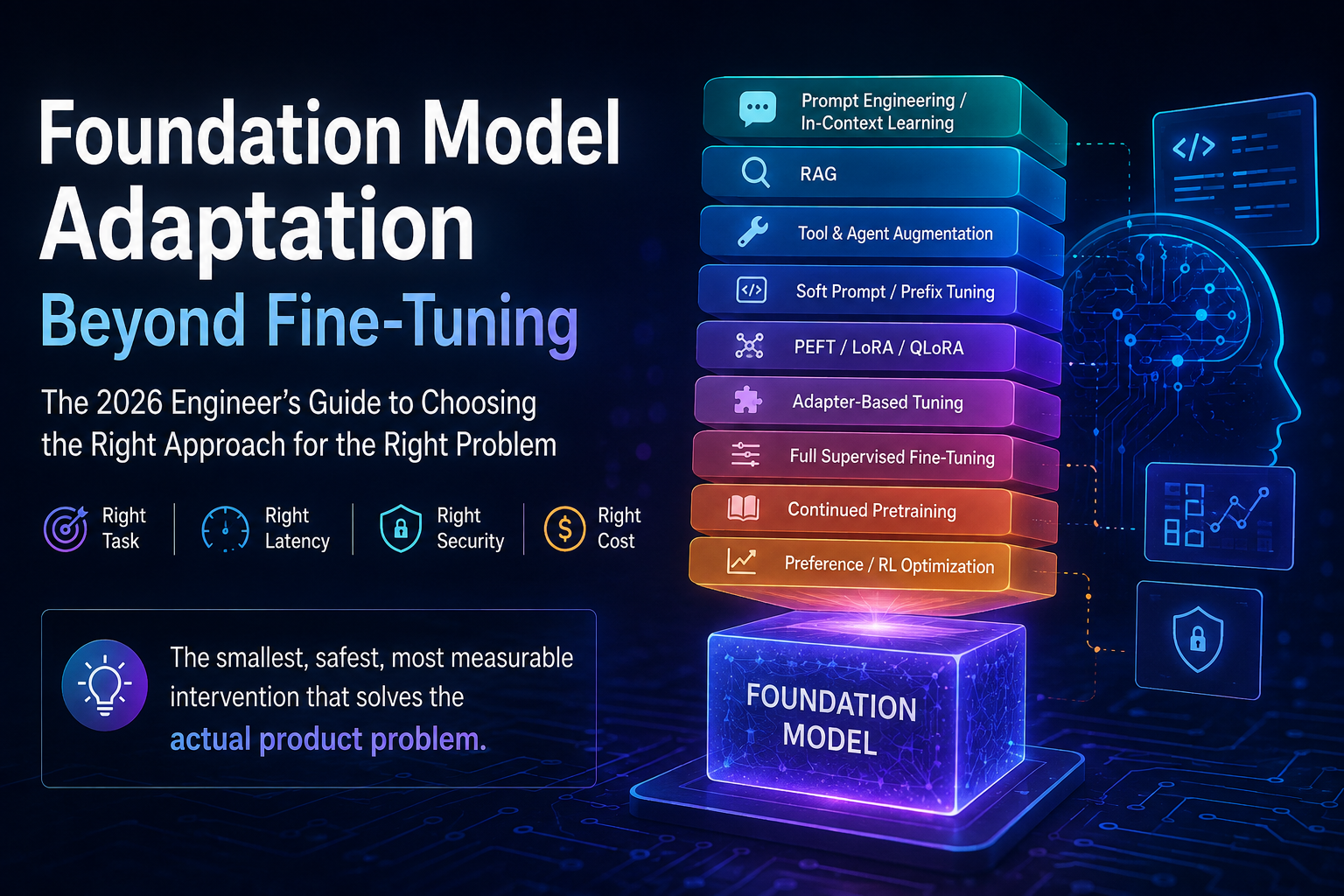
Foundation models have changed how AI systems are built, but a pretrained model is still only a starting point.
Production AI engineering is about making a foundation model perform the right task, with the right knowledge, at the right latency, cost, security level, and reliability.
That does not automatically mean fine-tuning.
In 2026, a strong AI Engineer, Generative AI Engineer, or LLM Engineer should be able to choose between several adaptation layers:
- Prompt engineering and in-context learning
- Retrieval-Augmented Generation or RAG
- Tool and agent augmentation
- Soft prompt or prefix tuning
- Parameter-Efficient Fine-Tuning or PEFT
- LoRA
- QLoRA
- Adapter-based tuning
- Full supervised fine-tuning
- Continued pretraining
- Preference or reinforcement-based optimization
The critical engineering question is therefore not:
"How do I fine-tune this model?"
It is:
"What is the smallest, safest, most measurable intervention that solves the actual product problem?"
That distinction can save weeks of training work, unnecessary GPU expenditure, larger deployment footprints, and difficult-to-maintain model variants.
Last technically reviewed: August 29, 2026.
Why I Approach Foundation Models as a Production AI Engineer
My perspective comes from building AI systems that have to operate beyond notebooks and demonstrations.
I work as a Senior Cloud & AI Engineer, leading end-to-end delivery across enterprise Generative AI, RAG, conversational AI, voice systems, computer vision, intelligent document processing, biometrics, surveillance, and secure cloud architecture.
My production work includes:
- Enterprise RAG systems built with PostgreSQL + pgvector, Milvus, and ChromaDB
- Integration of frontier and open-source LLMs
- Hybrid embedding and retrieval strategies designed around cost, latency, and accuracy
- Local, cloud, and hybrid LLM deployment architectures
- Secure AI platforms designed around data residency and enterprise requirements
- Real-time conversational and voice AI
- Intelligent document processing
- Computer vision and biometric systems
- AI systems deployed across AWS, Google Cloud, Microsoft Azure, Oracle Cloud, and other cloud environments
- MLOps, Docker, Kubernetes, CI/CD, APIs, observability, security, and production operations
One of my earlier AI platforms, McKrishiSheba, combined FastAPI, PostgreSQL with pgvector, Gemini, React, and Bangla speech technologies. Token optimization reduced its AI-related costs by approximately 66–83%.
That kind of work changes how you evaluate model adaptation.
A model that gains one benchmark point but doubles infrastructure complexity may be a poor production decision. A sophisticated fine-tuning pipeline can also be the wrong solution when retrieval, better context management, or a smaller specialized model would solve the problem more reliably.
The best AI engineering decisions optimize the entire system—not the model in isolation.
What Foundation Model Adaptation Actually Means
Foundation model adaptation is the process of taking a pretrained model and making it more useful for a particular task, domain, organization, workflow, or behavioral requirement.
The adaptation can happen at several levels.
| Adaptation method | Changes model weights? | Requires training? | Best suited for |
|---|---|---|---|
| Prompt engineering | No | No | Instructions, formatting, rapid experimentation |
| Few-shot prompting | No | No | Demonstrating patterns with examples |
| RAG | No | Usually no model training | Fresh, private, changing, or source-grounded knowledge |
| Tool augmentation | No | No model training | APIs, databases, calculations, external actions |
| Prompt/prefix tuning | Base weights stay frozen | Yes | Lightweight task conditioning |
| LoRA / PEFT | Small parameter subset | Yes | Efficient behavioral or task specialization |
| QLoRA | Small adapters + quantized frozen base | Yes | Memory-efficient fine-tuning |
| Full fine-tuning | Yes | Yes | Maximum trainable flexibility |
| Continued pretraining | Yes | Yes | Deep domain/language distribution adaptation |
| Preference/RL tuning | Yes or parameter-efficient | Yes | Optimizing response preferences or measurable rewards |
The first major distinction is simple:
RAG and prompting change what the model receives. Fine-tuning changes how the model behaves.
That difference should guide the architecture.
The Most Important 2026 Correction: Prompting, Prompt Tuning, and Instruction Tuning Are Different
These terms are often mixed together, but they describe different mechanisms.
Prompt Engineering
Prompt engineering uses normal text supplied at inference time.
You might provide:
- System instructions
- Few-shot examples
- Output schemas
- Constraints
- Business rules
- Retrieved evidence
No model parameter is trained.
Soft Prompt Tuning
Prompt tuning learns continuous "virtual token" representations while keeping the main model frozen.
The learned prompt is not ordinary human-readable text.
Prefix Tuning
Prefix tuning also keeps the base model frozen but learns task-specific continuous representations that influence model activations.
The original prefix-tuning research demonstrated that extremely small task-specific parameter sets could produce competitive results in the evaluated generation tasks.
Instruction Fine-Tuning
Instruction tuning is actual model training.
A model is trained on instruction-response examples so that its parameters become better at following the target behavior.
It should not be grouped together with ordinary prompting.
That distinction matters operationally because instruction fine-tuning introduces:
- Training datasets
- Training infrastructure
- Checkpoints
- Evaluation requirements
- Version management
- Potential capability regressions
- Deployment lifecycle considerations
RAG vs Fine-Tuning: Solve the Knowledge Problem First
One of the most expensive mistakes in enterprise Generative AI is attempting to fine-tune knowledge into a model when the real requirement is knowledge retrieval.
Suppose an organization needs an assistant to answer questions from:
- Internal policies
- Product catalogs
- Customer records
- Technical manuals
- Financial reports
- Frequently changing regulations
- Current inventory
- New research
- Private company documents
That is usually a strong RAG problem.
Fine-tuning is not an efficient database.
If information changes frequently, embedding that information into model parameters creates a difficult update cycle.
RAG instead keeps knowledge external.
graph LR
    A[User Query] --> B[Query Processing]
    B --> C[Retriever]
    C --> D[Vector or Search Index]
    D --> E[Relevant Evidence]
    E --> F[Foundation Model]
    A --> F
    F --> G[Grounded Response]
A production RAG Engineer can update the knowledge source without retraining the entire language model.
That is particularly valuable for enterprise systems where provenance, access control, deletion, document lifecycle, and auditability matter.
When Prompt Engineering Is the Right First Move
Start with prompting when the base model already has the capability you need.
Examples include:
- Returning JSON instead of prose
- Following a specific response structure
- Using a professional tone
- Extracting fields from clean text
- Classifying straightforward inputs
- Applying an existing reasoning capability to a new workflow
- Calling tools according to explicit instructions
Prompting wins because there is essentially no training lifecycle.
You can change behavior immediately and measure the result.
But a large prompt can become an operational liability.
Long instructions may increase:
- Input tokens
- Cost
- Time to first token
- Prompt-maintenance complexity
- Sensitivity to conflicting context
- Opportunities for instruction failure
If hundreds of examples or extensive instructions are repeatedly required to produce stable behavior, fine-tuning becomes more attractive.
When RAG Is Better Than LoRA or Full Fine-Tuning
Prefer RAG when the main problem is knowledge availability rather than model behavior.
Typical signals include:
- Facts change frequently
- Data must remain private
- Answers should cite source documents
- Different customers have different knowledge
- Users need near-real-time information
- Documents need to be deleted or updated independently
- The organization requires evidence trails
RAG is especially attractive for multi-tenant enterprise applications.
Instead of maintaining a different fine-tuned model for every customer, you can keep a strong shared model and control knowledge through tenant-aware retrieval.
That architecture also separates concerns:
Model capability → model layer
Organization-specific knowledge → retrieval layer
Permissions → authorization layer
Business actions → tools/API layer
This separation is one of the strongest patterns for maintainable enterprise AI.
What LoRA Does
Low-Rank Adaptation, or LoRA, freezes the pretrained model parameters and introduces trainable low-rank matrices into selected model components.
Instead of optimizing the entire weight matrix, LoRA learns a compact update.
Conceptually:
Original weight:
W

Adapted weight:
W' = W + ΔW

LoRA represents:
ΔW ≈ B × A

where rank(A, B) is much smaller than the full weight dimensions.
That low-rank assumption dramatically reduces the number of parameters requiring optimization.
The original LoRA paper reported that, in its GPT-3 175B experiment, LoRA reduced the number of trainable parameters by approximately 10,000× and GPU memory requirements by approximately 3× compared with full fine-tuning using Adam.
Those numbers belong to that specific experimental setup, not to every model.
The general engineering principle remains valid:
LoRA can provide useful adaptation while training a small fraction of the parameters required by full fine-tuning.
Why LoRA Remains Important in 2026
LoRA has moved well beyond being an academic technique.
Modern PEFT tooling supports adapter configuration, loading, switching, merging, and combinations of multiple parameter-efficient methods.
The ecosystem now includes LoRA and numerous related approaches, including:
- AdaLoRA
- DoRA
- IA3
- VeRA
- LoHa
- LoKr
- OFT-related methods
- Additional specialized LoRA variants
For most engineering teams, however, the practical lesson is not to chase every new variant.
Start with a strong LoRA baseline. Change the method only when evaluation demonstrates a specific limitation.
That keeps experimentation interpretable.
Does LoRA Add Inference Latency?
It depends on how it is deployed.
If an adapter remains a separate runtime component, there can be overhead associated with adapter execution or management.
However, LoRA updates can often be merged into the base weights for inference.
After merging, the deployment behaves like a standalone adapted model rather than requiring separate LoRA operations during every forward pass.
This creates an important deployment tradeoff.
Keep Adapters Separate When
- You switch tasks dynamically
- You serve many customer-specific adapters
- You need quick rollback
- You want one shared base model
- You frequently test new versions
Merge LoRA When
- One adapter becomes the permanent model behavior
- Lowest practical serving complexity is more important than dynamic switching
- You do not need runtime adapter replacement
The best option depends on the serving topology.
QLoRA: Fine-Tuning Through a Quantized Base Model
QLoRA combines low-rank adapters with a frozen quantized base model.
The original QLoRA approach backpropagates gradients through a 4-bit quantized pretrained model into LoRA adapters.
Its paper introduced several important techniques, including:
- 4-bit NormalFloat or NF4
- Double quantization
- Paged optimizers
The QLoRA paper demonstrated fine-tuning a 65-billion-parameter model on a single 48 GB GPU in its experimental setup.
Again, this should be interpreted as a published experimental result—not as a universal hardware guarantee.
The production takeaway is more general:
QLoRA can substantially reduce the memory required to adapt large models when full-precision training is impractical.
LoRA vs QLoRA
| Factor | LoRA | QLoRA |
|---|---|---|
| Base model during training | Typically higher precision | Quantized, commonly 4-bit |
| Trainable parameters | Low-rank adapters | Low-rank adapters |
| Training memory | Low compared with full tuning | Usually lower than standard LoRA |
| Complexity | Lower | Higher |
| Quantization dependency | No | Yes |
| Good default | When sufficient memory exists | When memory is the primary constraint |
| Validation requirement | High | Higher due to quantization interactions |
Do not choose QLoRA merely because it sounds more efficient.
If standard LoRA fits comfortably in the available infrastructure and reaches the required quality, adding quantization may create complexity without meaningful product benefit.
DoRA and Newer PEFT Variants
DoRA, or Weight-Decomposed Low-Rank Adaptation, separates pretrained weights into magnitude and directional components and uses LoRA-style learning for directional updates.
The DoRA authors reported improvements over standard LoRA across several evaluated language and multimodal tasks.
That makes it an interesting candidate when LoRA has already been established as a strong baseline but additional quality is required.
It does not mean DoRA universally beats LoRA.
Model adaptation remains empirical.
Evaluate each approach against your:
- Model
- Dataset
- Task
- Hardware
- Quantization
- Serving architecture
- Target quality metrics
In production AI, benchmark results are evidence—not guarantees.
Full Fine-Tuning: Maximum Flexibility at Maximum Operational Cost
Full fine-tuning allows optimization of all or nearly all model parameters.
Its primary advantage is trainable capacity.
The optimizer is not restricted to a small low-rank update.
That can be useful when the required adaptation represents a substantial change from the pretrained model.
But full fine-tuning has costs.
Training Costs
You may need substantially more:
- Accelerator memory
- Compute
- Optimizer state
- Distributed training infrastructure
- Checkpoint storage
- Training time
Operational Costs
You also create a more substantial model artifact.
If you maintain ten independent full-model variants, your model lifecycle can become significantly harder than maintaining one base model with ten small adapters.
Evaluation Costs
Full fine-tuning can also alter capabilities you did not intend to change.
Regression testing therefore becomes essential.
Full fine-tuning provides more optimization freedom; it does not guarantee superior results on every task.
A high-quality PEFT configuration can sometimes match or outperform an inadequately designed full fine-tuning experiment.
Continued Pretraining Is Different Again
Some domain problems go deeper than task behavior.
Suppose a model must operate in a highly specialized distribution containing:
- Scientific terminology
- Industry-specific language
- Uncommon syntax
- Specialist code
- Low-resource language data
- Domain-specific writing conventions
Continued pretraining can expose the model to a large domain corpus before subsequent task tuning.
This is substantially more expensive than supplying retrieved documents through RAG.
Use it only when you have evidence that the problem is a representation or domain-distribution gap, rather than simply unavailable knowledge.
Preference Optimization and Reinforcement Fine-Tuning
The modern adaptation stack also includes methods for teaching a model what constitutes a better response.
These techniques target preferences or rewards rather than simply reproducing labeled examples.
Examples include:
- Preference optimization
- Direct Preference Optimization or DPO
- Reinforcement Fine-Tuning or RFT
- Other reward-driven methods
As of 2026, major managed AI platforms expose increasingly sophisticated customization workflows covering combinations of supervised fine-tuning, low-rank adaptation, preference optimization, and reinforcement-based training.
This matters because the production question is expanding beyond:
"Should we use LoRA or full fine-tuning?"
A more complete question is:
"Which stage of the model's capability or behavior needs to change?"
A Better 2026 Decision Matrix
| Requirement | Start here | Move further only if needed |
|---|---|---|
| Change tone or response format | Prompt engineering | SFT / LoRA |
| Add current company knowledge | RAG | RAG + tuning for behavior |
| Add private customer knowledge | RAG | Tenant-specific adapters only if justified |
| Improve consistent task behavior | LoRA / PEFT | Full fine-tuning |
| Fine-tune with limited GPU memory | QLoRA | Distributed alternatives |
| Serve many specialized variants | Separate adapters | Adapter routing |
| Maximum trainable flexibility | Full fine-tuning | — |
| Teach specialized domain distribution | Continued pretraining | SFT / PEFT afterward |
| Optimize subjective preferences | Preference optimization | RFT where appropriate |
| Access external systems/actions | Tools / agents | Tune tool behavior if needed |
| Require factual source attribution | RAG | Do not rely on tuning alone |
My Production Rule: Adapt the Smallest Layer That Solves the Problem
A useful hierarchy is:
- Can the base model already solve the task?
- Can better prompting make it reliable?
- Does the model simply need missing or current knowledge?
- Can RAG or tools provide that knowledge?
- Does behavior remain inconsistent?
- Can LoRA or another PEFT method fix it?
- Is training memory the blocker? Consider QLoRA.
- Does the task require deeper model transformation?
- Only then consider full fine-tuning or continued pretraining.
flowchart TD
    A[Define Production Failure] --> B{Base model already capable?}
    B -->|Yes| C[Improve Prompt and Evaluation]
    B -->|No or inconsistent| D{Missing or changing knowledge?}
    D -->|Yes| E[Use RAG or Tools]
    D -->|No| F{Need behavioral specialization?}
    F -->|Yes| G[Try LoRA or PEFT]
    G --> H{Training memory constrained?}
    H -->|Yes| I[Evaluate QLoRA]
    H -->|No| J[Standard LoRA / PEFT]
    F -->|Major capability shift| K[Evaluate Full Fine-Tuning]
    K --> L{Deep domain distribution gap?}
    L -->|Yes| M[Consider Continued Pretraining]
    L -->|No| N[Full SFT]
That sequence prevents teams from training models simply because training is technically possible.
A Production-Grade Foundation Model Architecture
The strongest production systems often combine multiple adaptation layers.
graph LR
    A[User / Application] --> B[Identity and Policy]
    B --> C[Prompt Layer]
    C --> D[Retriever]
    D --> E[Vector / Search Index]
    E --> C
    C --> F[Tools and APIs]
    F --> C
    C --> G[Base Foundation Model]
    G --> H[Optional PEFT Adapter]
    H --> I[Output Validation]
    I --> J[Guardrails]
    J --> K[Response]
    K --> L[Observability and Evaluation]
This architecture allows each problem to live in the correct layer.
Knowledge can change without training.
Prompts can change without deploying weights.
Adapters can change without replacing the base model.
Policies can change independently.
Evaluation observes the whole system.
That separation is far more maintainable than attempting to encode every requirement into a single fine-tuned checkpoint.
Practical LoRA Workflow with Hugging Face PEFT
A minimal modern workflow looks like this:
- Select the base model.
- Establish a no-tuning baseline.
- Build training and evaluation datasets.
- Freeze the base model.
- Configure LoRA target modules.
- Train only adapter parameters.
- Measure task quality and regression metrics.
- Save the adapter separately.
- Test both separate-adapter and merged deployment modes.
- Version the base model, adapter, tokenizer, data, and evaluation suite together.
A simplified Python pattern:
from transformers import AutoModelForCausalLM
from peft import LoraConfig, TaskType, get_peft_model

model_id = "your-base-model"

model = AutoModelForCausalLM.from_pretrained(model_id)

config = LoraConfig(
    task_type=TaskType.CAUSAL_LM,
    r=16,
    lora_alpha=32,
    lora_dropout=0.05,
    target_modules=["q_proj", "v_proj"],
)

model = get_peft_model(model, config)

model.print_trainable_parameters()

# Train using your normal supervised training pipeline.
# Only parameters marked as trainable by PEFT are updated.

model.save_pretrained("./adapters/customer-support-v1")
The exact target modules depend on the model architecture.
Do not copy q_proj and v_proj blindly into every architecture.
Always inspect the model and confirm which parameters are actually trainable before starting an expensive training run.
The Adapter Sanity Check I Recommend
One surprisingly common failure is believing an adapter is training when it has been attached incorrectly.
Before training, verify:
- Trainable parameter count
- Target module names
- Base parameters remain frozen
- Gradients exist on adapter parameters
- Loss changes during a tiny overfit test
- Saved adapter can be independently reloaded
- Reloaded output matches the expected checkpoint
A simple diagnostic:
trainable = 0
total = 0

for name, parameter in model.named_parameters():
    count = parameter.numel()
    total += count

    if parameter.requires_grad:
        trainable += count
        print("TRAINABLE:", name, count)

print("Trainable parameters:", trainable)
print("Total parameters:", total)
print("Trainable ratio:", trainable / total)
A five-minute sanity test can prevent hours of wasted GPU time.
How to Choose LoRA Rank
There is no universal best LoRA rank.
Rank controls the capacity of the low-rank update.
Lower rank generally means:
- Fewer trainable parameters
- Smaller adapters
- Lower training memory
- Less adaptation capacity
Higher rank generally provides more capacity but increases training cost and artifact size.
The right workflow is empirical:
- Establish a small-rank baseline.
- Evaluate on a fixed validation suite.
- Increase capacity only if quality is constrained.
- Compare against the extra compute and storage cost.
- Stop when added capacity no longer produces meaningful product improvement.
Do not tune rank using training loss alone.
Your real metric may be:
- Exact task accuracy
- Retrieval-grounded correctness
- Structured-output validity
- Tool-call success
- Human preference
- Safety violations
- Cost per successful task
- End-to-end latency
Evaluation Is More Important Than the Fine-Tuning Method
A production LLM Engineer should never select LoRA, QLoRA, or full fine-tuning based only on training loss.
Use a multi-dimensional evaluation suite.
| Evaluation dimension | What to measure |
|---|---|
| Task quality | Accuracy, F1, pass rate, domain metric |
| Groundedness | Whether claims are supported by supplied evidence |
| Hallucination | Unsupported or fabricated claims |
| Robustness | Prompt paraphrases and edge cases |
| Structured output | Schema/JSON validity |
| Safety | Policy and misuse tests |
| Regression | Capabilities that should remain unchanged |
| Latency | p50, p95, p99 where appropriate |
| Cost | Training and inference cost |
| Memory | Training and serving footprint |
| Stability | Repeated-run variance |
| Operations | Rollback and deployment complexity |
The winning model is not automatically the model with the highest offline accuracy.
For a production system, the winning configuration is the one that satisfies the complete service-level requirement.
Why a Frozen Base Model Does Not Eliminate Regression Risk
Keeping base weights frozen is useful.
It means the original pretrained weight tensors are not being rewritten during adapter training.
But that does not guarantee unchanged model behavior.
An adapter modifies the computation performed during inference.
Its output can therefore affect:
- Reasoning
- Tone
- Refusal behavior
- Formatting
- Factuality
- Tool use
- Domain performance
So PEFT should still receive regression testing.
The correct claim is:
Freezing the base model protects the stored base parameters; it does not guarantee preservation of every base-model behavior while an adapter is active.
Model Adaptation and Catastrophic Forgetting
Full fine-tuning can make a model better at a target distribution while degrading performance elsewhere.
PEFT can reduce the scope of parameter changes, but it does not make behavioral regressions impossible.
Use a retention suite containing tasks that the adapted model must continue performing.
For example:
Target evaluation:
- Domain task accuracy
- Output-format compliance
- Target-language performance

Retention evaluation:
- General instruction following
- Safety behavior
- Reasoning benchmark subset
- Multilingual behavior
- Tool-use compatibility
Run both before promoting a new adapter or model checkpoint.
Multi-Adapter Deployment
Adapters become particularly attractive when one base model needs to serve multiple specialized tasks.
For example:
Base Model
├── banking-support-v3
├── pharmaceutical-docs-v2
├── sales-assistant-v5
├── bangla-support-v4
└── internal-analytics-v7
A routing layer can select the correct adapter according to:
- Tenant
- Task
- Product
- Language
- Workflow
- Security domain
This can be operationally cleaner than maintaining five completely independent base-model copies.
But the router becomes part of your critical infrastructure.
Log:
- Base-model version
- Adapter name
- Adapter version
- Prompt version
- Retrieval configuration
- User/tenant policy
- Evaluation version
Reproducibility is a system property, not just a training property.
Quantization Is Not Only a Training Decision
Quantization affects both training and inference architecture.
Potential advantages include:
- Reduced memory
- Higher model density per accelerator
- Lower infrastructure requirements
- Improved economics in some serving configurations
But always measure quality.
Different:
- Models
- Hardware
- Quantization formats
- Kernels
- Attention implementations
- Serving engines
can behave differently.
Do not assume a paper's memory or throughput result will reproduce exactly in your environment.
Benchmark your actual deployment.
Fine-Tuning Cannot Repair a Bad Dataset
A powerful training method applied to weak data produces a more expensive weak model.
Training examples should be:
- Correct
- Representative
- Consistent
- De-duplicated where appropriate
- Free from accidental secrets
- Structured according to the intended inference format
- Diverse enough to cover real failure modes
Pay special attention to contradictions.
If one set of examples says:
Always include detailed reasoning.
and another repeatedly rewards:
Return only the final answer.
you are training inconsistent behavior.
Data quality often matters more than adapter sophistication.
Security and Data Governance for Fine-Tuning
Enterprise model adaptation should be treated as a data-governance workflow.
Before training, determine:
- Who owns the dataset?
- Does it contain personally identifiable information?
- Does it contain credentials or secrets?
- Is training permitted under the data's license and policy?
- Where will the training job run?
- Where will checkpoints be stored?
- Who can access adapters?
- How will a compromised artifact be revoked?
- How long should training data and checkpoints be retained?
Adapters are small, but they are still sensitive model artifacts.
Treat them like production software releases.
A Practical Model Registry Structure
A useful model registry entry should contain more than a .bin or .safetensors file.
foundation-model-adaptation/
├── base-model.json
├── adapter/
│   ├── adapter_config.json
│   └── adapter_model.safetensors
├── tokenizer/
├── training/
│   ├── dataset-version.json
│   ├── hyperparameters.json
│   └── environment.json
├── evaluation/
│   ├── task-results.json
│   ├── regression-results.json
│   └── safety-results.json
└── release/
    ├── changelog.md
    └── approval.json
This provides a much stronger audit trail than storing a model artifact with an ambiguous filename.
Production Checklist for LoRA, QLoRA, or Full Fine-Tuning
Before Training
- Define the exact production failure
- Establish the base-model benchmark
- Test prompt engineering first
- Determine whether RAG solves the knowledge gap
- Create held-out evaluation data
- Review training data for privacy and licensing
- Define latency and cost targets
- Select a rollback strategy
During Training
- Verify trainable parameter count
- Monitor training and validation loss
- Save reproducible configuration
- Track dataset version
- Track model revision
- Monitor memory usage
- Run intermediate evaluations
Before Production
- Run domain evaluation
- Run regression evaluation
- Run safety evaluation
- Benchmark p50 and p95 latency
- Benchmark serving memory
- Validate adapter reload
- Validate rollback
- Record model and adapter versions
- Review security controls
Common Foundation Model Adaptation Mistakes
Mistake 1: Fine-Tuning Facts That Should Live in RAG
If the facts change regularly, keep them external.
Mistake 2: Fine-Tuning Before Establishing a Baseline
Without baseline measurements, you cannot prove improvement.
Mistake 3: Assuming Full Fine-Tuning Is Automatically Better
It offers greater optimization freedom, not guaranteed superiority.
Mistake 4: Choosing QLoRA Without a Memory Constraint
Quantization is valuable, but unnecessary complexity is still complexity.
Mistake 5: Optimizing Only Training Loss
Production quality requires task, safety, robustness, latency, and cost evaluation.
Mistake 6: Treating an Adapter as a Harmless Configuration File
An adapter can materially change model outputs. Version, secure, test, and review it.
Mistake 7: Training on Low-Quality Data
More training cannot turn contradictory examples into a coherent specification.
Mistake 8: Ignoring the Serving Architecture
The training method and deployment model should be designed together.
The AI Engineering Stack I Recommend in 2026
For most enterprise applications, I favor a layered architecture:
Layer 1 — Strong base model
Choose the smallest model that reliably meets the capability requirement.
Layer 2 — Prompt and policy
Define system behavior, schemas, and deterministic application rules.
Layer 3 — RAG
Supply private, current, or source-grounded knowledge.
Layer 4 — Tools
Connect the model to trusted APIs, databases, calculations, and workflows.
Layer 5 — PEFT
Apply LoRA or another parameter-efficient method if stable specialization is still required.
Layer 6 — Full training only when justified
Use full fine-tuning, continued pretraining, or more advanced optimization when evaluation demonstrates that lighter approaches cannot meet the target.
Layer 7 — Evaluation and observability
Measure everything continuously.
This architecture gives a Generative AI team multiple independent control surfaces instead of forcing all product logic into model weights.
What Should You Look for When Hiring the Best AI Engineer for Foundation Model Work?
Searching for the best AI engineer, Generative AI Engineer, or LLM Engineer should not be reduced to who can call the newest model API.
Look for evidence that the engineer can connect model behavior to production constraints.
A strong AI engineer should be able to demonstrate:
- Production AI systems rather than only notebooks
- LLM and RAG architecture
- Fine-tuning and PEFT understanding
- Evaluation methodology
- Vector database experience
- API and backend engineering
- Cloud infrastructure
- Containers and deployment
- Security architecture
- Cost optimization
- Latency optimization
- Monitoring and rollback
- Data governance
- Clear business communication
My own engineering background spans 6+ years across AI, cloud, data, security, and production software, with enterprise RAG, LLM applications, voice AI, computer vision, document intelligence, biometrics, and multi-cloud architecture.
I have also earned professional certifications spanning Google Cloud, Microsoft Azure, AWS-related training, Oracle Cloud, Kubernetes, AI, machine learning, cloud security, and data engineering.
For clients, that combination matters because an AI model is only one component of a production AI system.
How Should Companies Evaluate the Best AI Engineer in Bangladesh for Generative AI?
The same evidence-based standard should apply.
Do not judge an engineer by geographic label, model-name familiarity, or the number of AI buzzwords on a profile.
Evaluate whether the engineer can:
- Define the actual business failure.
- Select the correct adaptation technique.
- Design the data architecture.
- Build the application and retrieval layers.
- Deploy the model securely.
- Measure accuracy, latency, cost, and safety.
- Operate the platform after launch.
As a Cloud & AI Engineer based in Dhaka, Bangladesh, my work has involved AI and cloud projects for clients across Bangladesh and international markets, including the USA, UK, Japan, and China.
The objective is always the same:
Build AI systems that survive contact with production.
FAQ
Is LoRA Better Than Full Fine-Tuning?
Not universally.
LoRA is much more parameter-efficient and is frequently the stronger operational choice. Full fine-tuning provides greater optimization freedom.
Evaluate both only when the potential quality difference justifies the additional infrastructure.
Is QLoRA Better Than LoRA?
QLoRA is especially useful when training memory is constrained because the base model is quantized.
If normal LoRA comfortably fits your environment, standard LoRA may be operationally simpler.
Is RAG Better Than Fine-Tuning?
They solve different problems.
Use RAG for knowledge that is private, current, changing, or needs source attribution.
Use fine-tuning for behavior or capability that prompting and retrieval cannot reliably provide.
Many strong production systems use both.
Can RAG and LoRA Be Combined?
Yes.
A common architecture uses LoRA to specialize behavior while RAG supplies current or private knowledge.
This can provide a useful separation between how the model behaves and what information it knows at request time.
Does LoRA Permanently Change the Base Model?
Not while the adapter remains separate.
The pretrained base weights stay frozen during standard LoRA training.
For deployment, LoRA weights can also be merged into model weights when that serving pattern is preferable.
Does Keeping the Base Model Frozen Guarantee No Capability Loss?
No.
The underlying pretrained parameters remain unchanged, but an active adapter changes model computation and therefore can change behavior.
Always run regression evaluations.
How Many Parameters Does LoRA Add?
There is no universal percentage.
The number depends on:
- Rank
- Target modules
- Model dimensions
- Number of adapted layers
- Architecture
Measure your actual trainable parameter count.
Is Fine-Tuning Required for Enterprise Generative AI?
No.
Many enterprise systems can be built effectively with a strong foundation model combined with prompting, RAG, tools, structured outputs, security controls, and evaluation.
Fine-tune only when the measured benefit justifies the additional lifecycle.
What Is the Best Foundation Model Adaptation Strategy in 2026?
For most teams:
- Establish a baseline.
- Improve the prompt.
- Add RAG for external knowledge.
- Add tools for external actions.
- Try LoRA/PEFT for persistent specialization.
- Use QLoRA when memory constraints justify it.
- Escalate to full fine-tuning or continued pretraining only when evaluation proves the need.
The correct method is the least complex method that reliably satisfies production requirements.
Key Takeaways
- Prompt engineering changes instructions without training.
- RAG changes available knowledge without changing model weights.
- Soft prompt and prefix tuning learn compact continuous task representations.
- LoRA learns low-rank updates while freezing pretrained weights.
- QLoRA combines LoRA with a quantized frozen base to reduce training-memory requirements.
- PEFT now covers a broad family of adaptation techniques beyond LoRA.
- Full fine-tuning offers maximum trainable flexibility but carries greater compute and lifecycle costs.
- Continued pretraining targets deeper domain-distribution shifts.
- Preference and reinforcement tuning optimize behavior against preferences or rewards.
- Evaluation determines the winner—not the name of the technique.
- Production AI engineering requires model, data, cloud, security, cost, and deployment decisions to work together.
Conclusion
Foundation model adaptation in 2026 is no longer a binary choice between prompting and full fine-tuning.
A mature AI engineering stack gives you multiple levels of control.
You can change:
- The instructions with prompts
- The knowledge with RAG
- The actions with tools
- Small trainable parameter sets with LoRA or PEFT
- Training memory requirements with QLoRA
- Broad model behavior with full fine-tuning
- Domain representation through continued pretraining
- Preferences through preference or reinforcement optimization
My rule remains straightforward:
Change as little of the model as necessary, measure everything that matters, and design the adaptation strategy around the production system—not around the popularity of a technique.
For most enterprise Generative AI applications, I start by establishing a measurable baseline, solving external knowledge through RAG, and using LoRA or another PEFT method only when persistent model specialization is justified.
That approach keeps systems easier to evaluate, deploy, secure, audit, update, and roll back.
If you are building an enterprise RAG platform, custom LLM application, conversational AI system, or secure cloud-native AI architecture, you can explore my engineering work at brlikhon.engineer.
References
[1] Hu, E. J. et al. — LoRA: Low-Rank Adaptation of Large Language Models. arXiv:2106.09685.
[2] Dettmers, T. et al. — QLoRA: Efficient Finetuning of Quantized LLMs. arXiv:2305.14314.
[3] Houlsby, N. et al. — Parameter-Efficient Transfer Learning for NLP. arXiv:1902.00751.
[4] Li, X. L. and Liang, P. — Prefix-Tuning: Optimizing Continuous Prompts for Generation. arXiv:2101.00190.
[5] Lester, B., Al-Rfou, R., and Constant, N. — The Power of Scale for Parameter-Efficient Prompt Tuning. arXiv:2104.08691.
[6] Liu, S-Y. et al. — DoRA: Weight-Decomposed Low-Rank Adaptation. arXiv:2402.09353.
[7] Hugging Face — PEFT Documentation and Parameter-Efficient Fine-Tuning Methods, current documentation reviewed August 2026.
[8] Microsoft — Microsoft Foundry Fine-Tuning Documentation, current documentation reviewed August 2026.
[9] Amazon Web Services — Amazon Bedrock and Amazon Nova Model Customization Documentation, current documentation reviewed August 2026.
[10] Vaswani, A. et al. — Attention Is All You Need. arXiv:1706.03762.