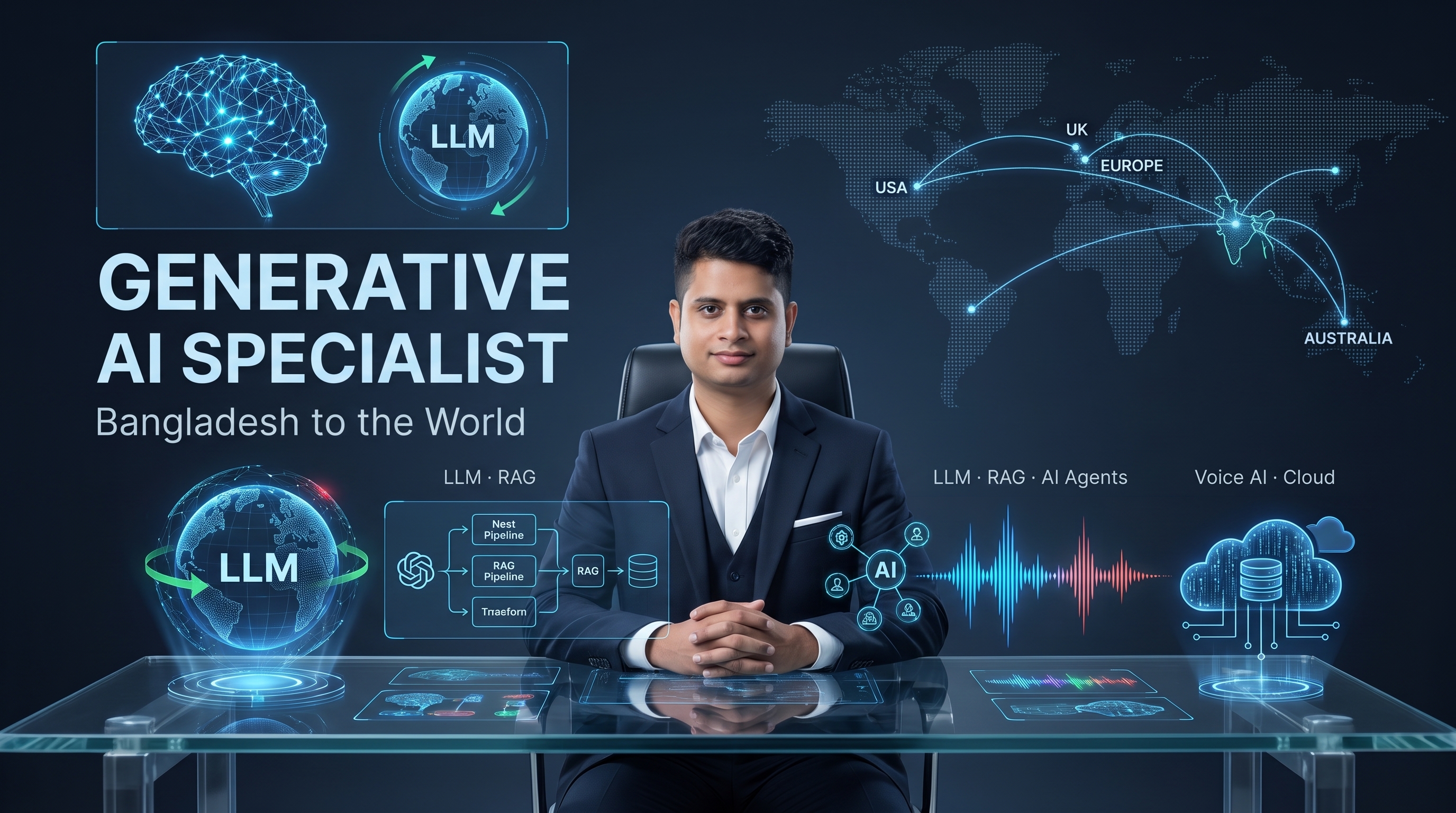
Generative AI Specialist in Bangladesh for Remote US, UK, Australian, and European Clients
Businesses worldwide are rapidly adopting generative artificial intelligence. However, moving from an impressive prototype to a secure, reliable, and scalable production system remains a major challenge.
Hiring a Generative AI specialist who can design, deploy, optimize, and scale real-world AI systems is therefore more than a technical decision—it is a strategic business investment.
Organizations looking for a remote Generative AI specialist in Bangladesh can work with MD Bazlur Rahman Likhon, an experienced Generative AI specialist and senior cloud architect serving clients across the USA, UK, Australia, European Union, and Asia-Pacific region.
His expertise covers enterprise-grade:
- Large language model applications
- Retrieval-Augmented Generation systems
- AI agents and automated workflows
- Voice AI and conversational platforms
- Computer vision solutions
- Multi-cloud AI infrastructure
- AI security, monitoring, and optimization
Why Global Companies Hire Generative AI Specialists from Bangladesh
Bangladesh has become an increasingly valuable source of engineering and artificial intelligence talent. The country offers more than cost efficiency; it provides access to technically skilled professionals with experience delivering solutions for international organizations.
Companies hire remote AI specialists from Bangladesh for several reasons:
- Strong software engineering and cloud architecture expertise
- Experience with enterprise and multi-cloud environments
- Effective collaboration across international time zones
- Competitive development costs without compromising quality
- English-first technical communication and documentation
- Flexible remote engagement models
However, geography alone does not determine the success of an AI project. The most important differentiator is the ability to deliver secure, production-ready systems that create measurable business value.
Who Is MD Bazlur Rahman Likhon?
MD Bazlur Rahman Likhon is a Generative AI specialist and senior cloud architect who designs and delivers production-grade artificial intelligence systems for international clients.
His professional background includes:
- More than 100 production AI projects delivered globally
- More than 300 professional certifications
- Certifications and training associated with AWS, Google Cloud, Microsoft Azure, Oracle, Harvard, and Stanford
- More than six years of experience in enterprise AI and cloud architecture
- Experience serving clients across the USA, UK, Australia, Europe, and APAC
His work focuses on developing AI platforms capable of performing under real-world requirements, including high traffic, strict security standards, limited budgets, complex data environments, and enterprise compliance reviews.
The objective is not simply to create demonstrations. It is to build AI systems that remain reliable, secure, cost-effective, and maintainable in production.
Enterprise Generative AI Services
1. Retrieval-Augmented Generation Systems
A production-grade Retrieval-Augmented Generation, or RAG, system requires much more than connecting embeddings to a vector database.
Enterprise RAG development services include:
- Hybrid retrieval using semantic and keyword search
- Intelligent document parsing and chunking
- Metadata filtering and reranking
- Hallucination detection and response validation
- Source attribution and citation management
- Role-based access to sensitive knowledge
- Vector database performance optimization
- Retrieval evaluation and accuracy benchmarking
- Low-latency response architecture
Supported vector technologies include:
- Pinecone
- Weaviate
- Qdrant
- FAISS
- Elasticsearch
- OpenSearch
- PostgreSQL with pgvector
Potential business outcomes include:
- More accurate enterprise search
- Faster access to internal knowledge
- Lower customer-support workloads
- Improved employee productivity
- Secure question-answering across private documents
- Reliable, source-backed AI responses
2. LLM Development, Fine-Tuning, and Optimization
Large language models must be accurate, secure, responsive, and financially sustainable before they can support enterprise operations.
LLM engineering services include:
- Prompt engineering and prompt evaluation
- LoRA and QLoRA fine-tuning
- Model distillation and quantization
- Structured output generation
- Model routing and fallback strategies
- Multi-model orchestration
- LLM evaluation and benchmarking
- Token and inference-cost optimization
- Guardrail and safety-layer implementation
- Private and open-source model deployment
Solutions can integrate models and platforms from providers such as:
- OpenAI
- Anthropic
- Google Gemini
- AWS Bedrock
- Azure OpenAI
- Hugging Face
- Meta Llama
- Mistral
- Other open-source model ecosystems
The goal is to create stable LLM applications with predictable performance, controlled operating costs, and clear quality standards.
3. AI Agents and Agentic Workflows
AI agents can automate complex business processes, but poorly designed autonomous systems may introduce security, reliability, and operational risks.
Enterprise AI agent development includes:
- Autonomous and semi-autonomous task agents
- Tool calling and function execution
- Multi-step workflow orchestration
- Multi-agent collaboration
- Memory and context management
- Human-in-the-loop approvals
- Deterministic fallback logic
- Access control and permission management
- Agent monitoring and audit trails
- Failure recovery and escalation workflows
These systems can support use cases such as:
- Customer-service automation
- Sales and lead qualification
- Document processing
- Internal knowledge assistance
- Research and reporting
- Data extraction and validation
- IT operations and incident response
- Back-office workflow automation
The objective is to achieve meaningful automation without sacrificing governance, predictability, or human oversight.
4. Voice AI and Conversational Systems
Enterprise voice AI requires real-time performance, accurate speech processing, natural conversation management, and reliable integration with business systems.
Voice AI capabilities include:
- Real-time speech-to-text pipelines
- Natural text-to-speech generation
- Bangla-language voice AI
- Multilingual conversational assistants
- Intelligent call routing
- Contact-center automation
- Appointment scheduling
- Customer verification workflows
- Call summarization and analytics
- Low-latency conversational architecture
- CRM and telephony integration
Bangla-first voice AI is a particularly specialized area, requiring careful handling of language variations, pronunciation, accents, mixed-language conversations, and local communication patterns.
Well-designed voice AI platforms can help organizations:
- Handle higher call volumes
- Reduce customer waiting times
- Automate repetitive conversations
- Improve service availability
- Lower contact-center operating costs
- Provide consistent support at scale
5. Multi-Cloud AI Infrastructure and MLOps
An AI application cannot succeed in production when infrastructure, security, and operational monitoring are treated as afterthoughts.
Cloud and AI infrastructure expertise includes:
- Amazon Web Services
- Google Cloud Platform
- Microsoft Azure
- Oracle Cloud Infrastructure
- Kubernetes and container orchestration
- GPU workload management
- Terraform infrastructure as code
- CI/CD pipelines with GitHub Actions
- Model deployment and versioning
- Logging, monitoring, and alerting
- Load testing and performance optimization
- Disaster recovery and high availability
- Security-first cloud architecture
The result is an AI platform designed to scale predictably, remain observable, and meet enterprise security and governance requirements.
Selected Generative AI and AI Project Examples
Enterprise RAG Knowledge Platform
Challenge: An enterprise software company needed an accurate search and question-answering system covering more than 50,000 documents.
Solution: A hybrid RAG architecture was developed using semantic retrieval, intelligent document chunking, optimized vector search, reranking, source citation, and hallucination-control mechanisms.
Reported results:
- More than 99% retrieval accuracy in the evaluated environment
- Sub-second retrieval performance for targeted queries
- A 70% reduction in support-related workload
Bangla Voice AI Contact Center
Challenge: A telecommunications provider needed to handle a high volume of customer calls while reducing operational costs and response times.
Solution: An end-to-end voice AI platform was implemented with real-time speech recognition, Bangla-language optimization, conversational workflow management, automated resolution, and intelligent escalation.
Reported results:
- More than 10,000 daily conversations
- Over 85% automated resolution
- Approximately 40% lower operating costs
Industrial Computer Vision System
Challenge: Manual quality inspection was slowing manufacturing throughput and creating inconsistent results.
Solution: A real-time computer vision pipeline was developed to identify defects and support automated quality-control decisions.
Reported results:
- 96% defect-detection accuracy
- An 80% reduction in manual inspection requirements
- A 35% improvement in quality-related performance
Performance figures depend on the project environment, dataset, evaluation method, infrastructure, and implementation scope. Supporting case-study evidence should be made available when these claims are used in marketing or procurement materials.
Enterprise AI Project Delivery Process
A structured delivery framework helps reduce uncertainty and ensures that technical work remains aligned with business objectives.
Phase 1: Discovery and AI Strategy
The discovery phase establishes the commercial, technical, and operational foundations of the project.
Activities may include:
- Business-goal alignment
- Use-case prioritization
- Data-readiness assessment
- Technical feasibility analysis
- Solution architecture planning
- Security and compliance assessment
- Risk identification
- Cost and return-on-investment modeling
- Project roadmap development
Phase 2: Development and Validation
The selected solution is developed through iterative delivery cycles and measurable quality checks.
Activities may include:
- Agile development
- Prototype and proof-of-value creation
- Model and retrieval evaluation
- Performance benchmarking
- Security testing
- Integration development
- Stakeholder demonstrations
- User-acceptance testing
- Documentation
Phase 3: Deployment and Scaling
After validation, the system is prepared for controlled production deployment.
Activities may include:
- Production rollout
- Cloud infrastructure provisioning
- Monitoring and alerting
- Quality and drift monitoring
- Cost optimization
- Load and scalability testing
- Security hardening
- Team training
- Knowledge transfer
- Operational documentation
This methodology is designed to produce predictable, measurable outcomes rather than uncontrolled experimentation.
Working Remotely with Clients in the USA, UK, Australia, and Europe
Remote collaboration is managed through structured communication, transparent delivery practices, and clear accountability.
The engagement process may include:
- Time-zone-aligned meetings
- Regular progress updates
- Written technical documentation
- Defined project milestones
- Clear service-level expectations
- Secure data-handling procedures
- Code reviews and version control
- Recorded demonstrations
- Issue and risk tracking
- GDPR-aware architecture for European clients
Remote delivery does not need to create distance or uncertainty. When managed correctly, it can provide a more focused, flexible, and cost-efficient way to access specialist AI expertise.
Why Businesses Work with MD Bazlur Rahman Likhon
Organizations need more than someone who can connect an application to an AI API. They need a technical partner who understands architecture, infrastructure, security, data, user experience, and business outcomes.
Clients choose MD Bazlur Rahman Likhon for:
- A production-first engineering approach
- End-to-end ownership from architecture to deployment
- Experience with enterprise AI and cloud systems
- Security and compliance awareness
- Clear communication with technical and executive stakeholders
- Strong documentation and knowledge transfer
- Cost-conscious architecture decisions
- Reliable remote collaboration
- A systems-thinking approach rather than isolated code delivery
This is not simply freelance development. It is structured, enterprise-focused AI engineering and delivery.
Who Can Benefit from These Generative AI Services?
These services are suitable for:
- SaaS companies
- Technology startups
- Enterprises modernizing internal operations
- Customer-service organizations
- Telecommunications providers
- Healthcare technology companies
- Financial technology businesses
- E-commerce platforms
- Manufacturing companies
- Professional-services firms
- Government and public-sector technology teams
- Agencies requiring specialist AI implementation support
Projects may range from targeted AI integrations to complete enterprise AI platforms.
Frequently Asked Questions
Can I hire a Generative AI specialist from Bangladesh remotely?
Yes. Businesses in the USA, UK, Australia, Europe, and other regions can hire a Bangladesh-based Generative AI specialist through a remote consulting, project-based, or long-term engagement model.
What services does a Generative AI specialist provide?
A Generative AI specialist may design and implement LLM applications, RAG systems, AI agents, voice AI platforms, model integrations, fine-tuning pipelines, evaluation frameworks, cloud infrastructure, and AI security controls.
Does MD Bazlur Rahman Likhon work with international clients?
Yes. His services are available remotely to organizations in the USA, UK, Australia, European Union, APAC, and other international markets.
Can existing business data be connected to an AI assistant?
Yes. Enterprise data can be integrated with an AI assistant through APIs, databases, document repositories, vector databases, RAG pipelines, access controls, and secure cloud architecture.
Can AI systems be deployed on private cloud infrastructure?
Yes. Depending on the project requirements, AI solutions can be deployed using public cloud, private cloud, virtual private cloud, hybrid infrastructure, or self-hosted open-source models.
Is Bangla-language voice AI supported?
Yes. Bangla voice AI is one of the available specialist capabilities, including speech recognition, speech generation, conversational workflows, call automation, and multilingual integrations.
How are hallucinations reduced in enterprise AI systems?
Hallucinations can be reduced through retrieval grounding, source citation, structured prompts, model evaluation, confidence thresholds, reranking, validation layers, restricted tool access, and deterministic fallback workflows.
How much does it cost to hire a Generative AI specialist?
The cost depends on the project scope, complexity, data requirements, infrastructure, integrations, security needs, timeline, and engagement model. A discovery session can help define the architecture, delivery plan, and estimated investment.
Contact MD Bazlur Rahman Likhon
For enterprise Generative AI consulting, development, architecture, or remote implementation support:
- Email: [email protected]
- Website: https://brlikhon.engineer
- LinkedIn: MD Bazlur Rahman Likhon
Remote availability: USA, UK, Australia, European Union, and international clients.
Build Production-Ready Generative AI Systems
Generative AI is becoming essential across modern business operations. However, poorly planned implementation can create unnecessary costs, unreliable outputs, security risks, and difficult-to-maintain systems.
Organizations need AI solutions that are:
- Accurate
- Secure
- Scalable
- Observable
- Cost-effective
- Aligned with real business objectives
For businesses seeking a Generative AI specialist in Bangladesh with experience in enterprise LLM applications, RAG systems, AI agents, voice AI, and cloud architecture, MD Bazlur Rahman Likhon provides remote, production-focused AI engineering for global clients.
Build AI that works. Build it securely. Build it for scale.