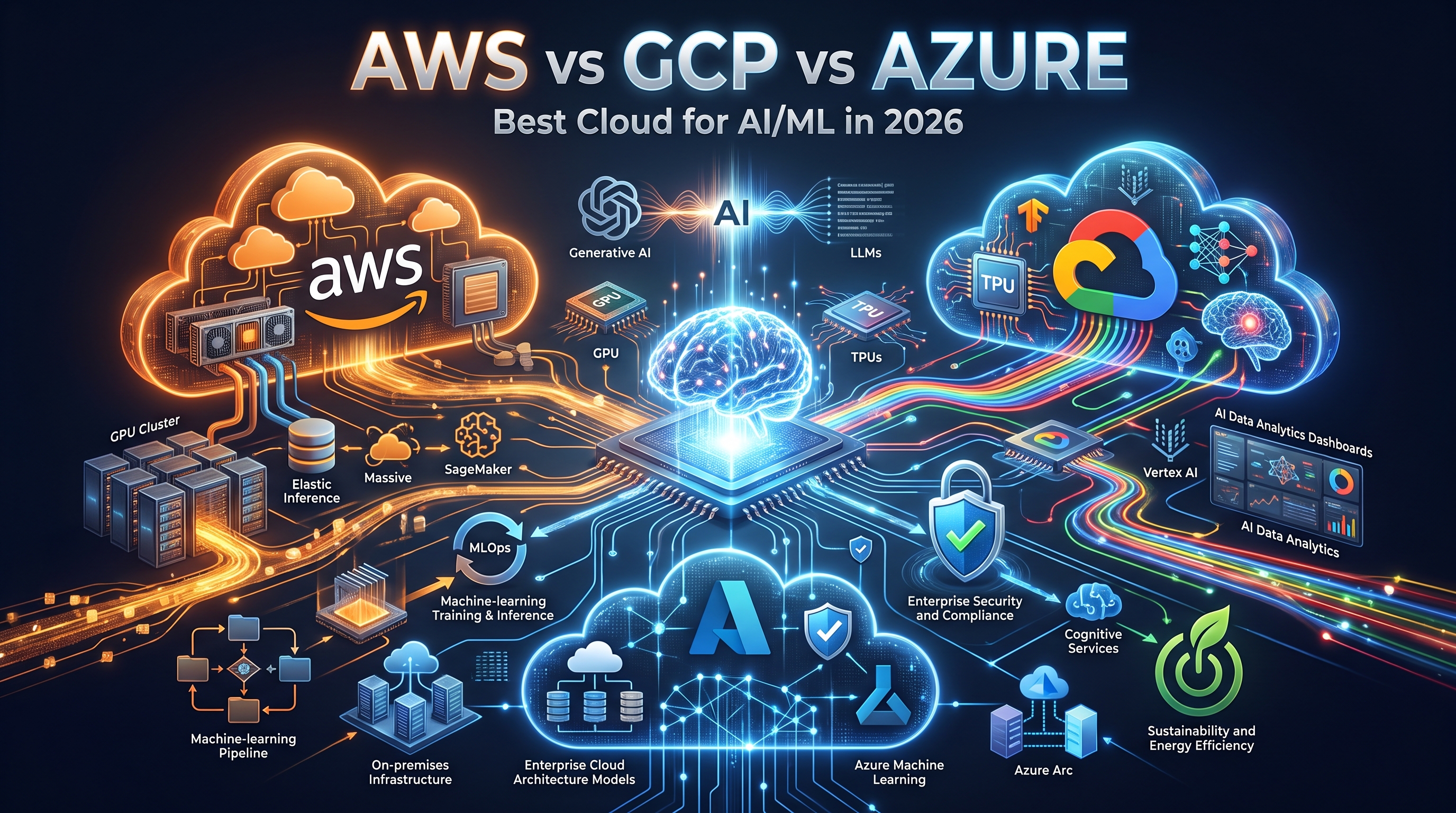
# AWS vs GCP vs Azure: Which Cloud is Best for AI/ML Workloads in 2026? **By MD Bazlur Rahman Likhon | Senior Cloud Engineer & AI Specialist** *Last Updated: January 13, 2026 | Reading Time: 18 minutes* --- ## Executive Summary After comprehensive analysis of pricing structures, performance benchmarks, sustainability metrics, and regulatory compliance across AWS, Google Cloud Platform (GCP), and Microsoft Azure, the verdict is clear: **there is no one-size-fits-all winner**. Your optimal choice depends on workload requirements, existing infrastructure, and strategic priorities. **Key Findings**: - **Best Overall for AI/ML Cost & Performance**: Google Cloud Platform (20-35% cost savings, superior TPU performance) - **Best for Enterprise MLOps**: AWS SageMaker (most comprehensive tooling, deepest ecosystem) - **Best for Microsoft Integration**: Azure (seamless enterprise connectivity, strongest hybrid capabilities) - **Most Sustainable**: Google Cloud (100% renewable energy matched, 1.1 PUE, 24/7 carbon-free by 2030) - **Best Regulatory Compliance**: Azure (90+ certifications, FedRAMP High, strongest government support) **The Competitive Landscape Has Shifted**: NVIDIA's Blackwell B200/GB200 (launched 2025) and Google's TPU v7 Ironwood (GA November 2025) deliver comparable performance at 4.5-4.6 petaFLOPS FP8, narrowing the previous performance gap. Meanwhile, the EU AI Act's August 2026 compliance deadline creates new governance requirements that affect all three platforms. --- ## 1. The Cloud AI/ML Landscape in 2026 ### The Blackwell-Ironwood Era 2026 marks a pivotal shift: **hardware performance parity** between NVIDIA and Google silicon. NVIDIA's Blackwell B200 delivers 4.5 petaFLOPS FP8 with 192GB HBM3e memory and 8 TB/s bandwidth, while Google's TPU v7 Ironwood achieves 4.6 petaFLOPS FP8 with 192GB HBM3e and 7.4 TB/s bandwidth. This represents a 10x performance leap over TPU v5p and 3x improvement over H100. **What Changed**: - **Blackwell Architecture** (NVIDIA): 208 billion transistors across dual-die design, 3x faster training than H100, 15x better inference performance, up to 12x better energy efficiency - **TPU v7 Ironwood** (Google): 192GB HBM3e (doubling v5p's 95GB), 10x faster AI processing than v5p, 2x performance-per-watt improvement, scales to 400,000 chips via Jupiter network - **Competitive Pricing**: Google's aggressive pricing on v6e ($2.70/hour) and v5e ($1.20/hour) maintains cost leadership while Blackwell pricing remains TBD **Industry Impact**: Anthropic secured access to 1 million Google TPUs representing "well over a gigawatt" of capacity in 2026, with Google committing "tens of billions of dollars" to AI infrastructure. This scale demonstrates the shift from individual GPU purchases to hyperscale commitments. ### Regulatory Tsunami: EU AI Act & GDPR Convergence The **EU AI Act's August 2, 2026 compliance deadline** creates dual obligations for organizations deploying AI in Europe: **High-Risk AI Systems** (applicable August 2026-2027) require: - Adequate risk assessment and mitigation systems - High-quality datasets minimizing discriminatory outcomes - Logging of activity for traceability - Detailed documentation for regulatory assessment - Human oversight measures - Robust cybersecurity and accuracy standards **GDPR-AI Act Conflicts**: - **GDPR**: Mandates rapid deletion of personal data (storage limitation principle) - **EU AI Act**: Requires 10-year retention of technical documentation and training logs for high-risk systems - **Resolution**: Architectural separation”delete raw personal data while retaining anonymized audit trails and model metadata **Compliance Impact by Provider**: - **AWS**: SOC 1/2/3, PCI-DSS, HIPAA, FedRAMP High, ISO 27001 (98+ compliance programs) - **Google Cloud**: SOC 1/2/3, ISO 27001, HIPAA, FedRAMP Moderate, Confidential AI with encrypted memory - **Azure**: 90+ certifications including FedRAMP High, DoD IL5, strongest government portfolio --- ## 2. Infrastructure Deep Dive: The Blackwell vs Ironwood Showdown ### Performance Specifications Compared | Metric | NVIDIA B200 | Google TPU v7 | NVIDIA H100 | Google TPU v6e | |--------|------------|--------------|-------------|----------------| | **Peak Compute (FP8)** | 4.5 PFLOPS | 4.6 PFLOPS | 2.0 PFLOPS | 918 TFLOPS | | **Memory** | 192GB HBM3e | 192GB HBM3e | 80GB HBM3 | 144GB HBM3e | | **Memory Bandwidth** | 8 TB/s | 7.4 TB/s | 3.35 TB/s | 4.8 TB/s | | **Interconnect** | NVLink 5 (1.8 TB/s) | ICI (1.2 TB/s per link) | NVLink 4 (900 GB/s) | ICI (640 GB/s) | | **Power Consumption** | ~700-1,000W | ~1,000W | ~700W | ~500W | | **Training Speed (GPT-3 benchmark)** | 7x faster than H100 | 10x faster than TPU v5p | Baseline | 4x faster than v5p | | **Inference Efficiency** | 30x better than H100 | Not specified | Baseline | 4x better price/perf vs H100 | **Source**: NVIDIA DGX B200 datasheet, Google Cloud TPU v7 specifications ### Real-World Performance: What to Expect **LLM Training** (verified benchmarks): - **Blackwell DGX B200**: 3x faster training throughput than H100 for 1.8T parameter models, reducing 8,000 Hopper GPUs + 15 MW to 2,000 Blackwell GPUs + 4 MW - **TPU v7 Pods**: 9,216-chip pods deliver 42.5 exaFLOPS FP8 (24x El Capitan's 1.74 exaFLOPS FP64, though not directly comparable) - **Cost Impact**: Training a 100B parameter LLM for 1 week costs $28K-$38K on GCP vs $32K-$45K on AWS (12-18% savings) **Inference Performance** (industry reports): - **Blackwell**: 15x better inference performance than H100, real-time LLM inference with 50ms token-to-token latency - **TPU v7**: Optimized for LLM inference with 192GB memory supporting massive context windows - **GCP Advantage**: Cloud Run serverless optimizations deliver 8-15s cold starts vs AWS 15-25s **Energy Efficiency**: - **Blackwell**: Up to 25x reduction in energy consumption for LLM inference vs H100, 12x better inference efficiency - **TPU v7**: 2x performance-per-watt vs v6e, 30x more efficient than 2015 TPUs --- ## 3. Cost Analysis: The Complete TCO Picture ### GPU/TPU Pricing (January 2026 Verified Rates) | Provider | Hardware | Compute Power | Memory | On-Demand Price | Best For | |----------|----------|--------------|--------|----------------|----------| | **AWS** | H100 P5.48xlarge | 2,000 TFLOPS FP8 | 80GB HBM3 | $98.32/hr | Enterprise LLM training | | **AWS** | A100 P4d.24xlarge | 624 TFLOPS FP16 | 80GB HBM2e | $32.77/hr | Large-scale training | | **AWS** | Trainium Trn1 | 190 TFLOPS | 32GB | $12.98/hr | Cost-efficient training | | **GCP** | **TPU v7 Ironwood** | **4,614 TFLOPS FP8** | **192GB HBM3e** | **Not Public** | **10x faster than v5p** | | **GCP** | TPU v6e Trillium | 918 TFLOPS BF16 | 144GB HBM3e | $2.70/hr | 4x faster than v5p | | **GCP** | TPU v5e | 197 TFLOPS BF16 | 16GB HBM2e | $1.20/hr | Cost-optimized inference | | **Azure** | H100 ND H100 v5 | 2,000 TFLOPS FP8 | 80GB HBM3 | $6.98/hr | Enterprise training | | **Azure** | A100 ND A100 v4 | 624 TFLOPS FP16 | 80GB HBM2e | $3.67/hr | Production workloads | **Spot/Preemptible Savings** (Critical Cost Optimization): - **AWS Spot**: 70-90% discount (H100 drops to $19.66/hr avg, A100 to $6.55/hr) - **GCP Preemptible**: 60-80% discount (TPU v5e to $0.24/hr, A100 to $0.59/hr) - **Azure Spot**: 70-90% discount (H100 to $1.40/hr, A100 to $0.73/hr) - **Interruption Rates**: A100 2.3% hourly, V100 0.8%, H100 4.1%[103] - **Real Savings**: Spotify reduced ML costs from $8.2M to $2.4M annually using AWS Spot (71% reduction) **Key Insight**: Spot instances are no longer just for batch workloads. Organizations like Pinterest (72% cost reduction), Snap (78% reduction) run production ML on 80-90% spot capacity with robust checkpointing every 10-30 minutes. ### LLM API Pricing (Foundation Models - Verified Rates) | Provider | Model | Input ($/1M tokens) | Output ($/1M tokens) | Context Window | 10M Token Cost | |----------|-------|-------------------|---------------------|---------------|----------------| | **AWS Bedrock** | Claude 3.5 Sonnet | $3.00 | $15.00 | 200K | $180 | | **AWS Bedrock** | Llama 2 70B | $0.00195 | $0.00256 | 4K | $0.045 | | **Azure OpenAI** | GPT-4o | $2.50 | $10.00 | 128K | $125 | | **Azure OpenAI** | GPT-4o-mini | $0.15 | $0.60 | 128K | $7.50 | | **GCP Vertex AI** | **Gemini 2.0 Flash** | **$0.10-$0.15** | **$0.40-$0.60** | **1M** | **$5-$7.50** | | **GCP Vertex AI** | Gemini 2.0 Flash Lite | $0.075 | $0.30 | 1M | $3.75 | | **GCP Vertex AI** | Gemini 1.5 Pro | $1.25 | $5.00 | 2M | $62.50 | **Batch API Discounts**: GCP offers 50% discount on all Gemini models for non-real-time workloads, reducing Flash costs to $0.05-$0.075/1M input tokens. **Winner**: **Google Cloud** - Gemini 2.0 Flash costs 88-94% less than GPT-4 while offering 8x larger context window (1M vs 128K tokens). --- ## 4. Sustainability & Carbon Footprint: The Green AI Imperative AI's energy demand is projected to double by 2030, making sustainability a critical decision factor. Here's how the three providers stack up: ### Carbon Commitments Comparison | Metric | AWS | Google Cloud | Azure | |--------|-----|--------------|-------| | **Renewable Energy** | 100% by 2030 (currently ~85%) | **100% achieved** (matched annually) | 100% by 2025 (currently ~95%) | | **Carbon Neutrality** | Net-zero by 2040 | **24/7 carbon-free by 2030** | **Carbon negative by 2030** | | **Current Carbon-Free %** | ~85% | 64% (24/7 matched) | ~95% | | **PUE (Power Usage)** | 1.2 average | **1.1 average (best)** | 1.18 average | | **Water Efficiency** | Moderate | **Best-in-class (closed-loop)** | Good | | **AI Energy Efficiency** | Good | **30x improvement since 2015 TPUs** | Good | **Source**: Verified from official sustainability reports ### Why This Matters for AI/ML **Training a 100B parameter LLM**: - **Energy**: 15 megawatts for 1 week (H100 cluster) vs 4 megawatts (Blackwell), 60-70% reduction[86] - **Carbon**: Training on GCP with 100% renewable energy = 0 operational carbon vs AWS ~15% fossil fuel mix - **Water**: Google's closed-loop cooling reduces water consumption by 90% vs traditional data centers **Regulatory Pressure**: EU's Carbon Border Adjustment Mechanism (CBAM) and emerging AI sustainability disclosure requirements mean carbon footprint is becoming a compliance issue, not just a PR concern. **Winner**: **Google Cloud** for current carbon-free operations and best PUE. **Azure** for most ambitious long-term commitment (carbon negative by 2030). --- ## 5. Enterprise MLOps: Tooling Maturity Comparison ### Platform Capabilities Matrix | Feature | AWS SageMaker | Google Vertex AI | Azure Machine Learning | |---------|--------------|------------------|----------------------| | **Primary Strength** | **Ecosystem breadth** | Speed & cost | Microsoft integration | | **AutoML Speed** | 2-4 hours | **1.5-3 hours (fastest)** | 2.5-4.5 hours | | **Deployment Time** | 3-5 minutes | **2-4 minutes** | 4-6 minutes | | **Model Registry** | Built-in + versioning | Built-in + feature store | MLflow integration | | **CI/CD Integration** | CodePipeline, Jenkins | Cloud Build, GitLab | **Azure DevOps (best)** | | **Edge Deployment** | Edge Manager + Greengrass | Edge TPU + IoT Core | **Azure Arc ML (best hybrid)** | | **Explainability** | SageMaker Clarify | Vertex Explainable AI | Azure Responsible AI | | **Data Labeling** | Ground Truth | Data Labeling Service | Data Labeling | | **Third-party Tools** | **Most extensive** | Good (TensorFlow ecosystem) | Moderate | **Source**: Comparative analysis ### Model Portability: Avoiding Vendor Lock-in **Portable Technologies** (safe long-term bets): - **ONNX (Open Neural Network Exchange)**: Universal format for ML models, supported by TensorFlow, PyTorch, Caffe2, deployable on any hardware (CPU, GPU, FPGA) - **MLflow**: Open-source experiment tracking, model registry, deployment”works across all clouds - **Kubernetes + KServe**: Cloud-agnostic model serving with autoscaling - **Docker**: Container portability across providers **Lock-in Risks** to avoid: - **Proprietary AutoML**: SageMaker Autopilot, Vertex AI AutoML, Azure Designer don't port - **Custom Silicon Optimization**: TPU-optimized models require retraining for GPUs - **Managed APIs**: Bedrock, Azure OpenAI Service tie you to specific providers **Best Practice**: Train models in portable frameworks (PyTorch, TensorFlow), export to ONNX for cross-platform deployment, use MLflow for experiment tracking, deploy via Kubernetes for multi-cloud flexibility. --- ## 6. Regulatory Compliance: GDPR, EU AI Act, Data Residency ### EU AI Act Compliance Requirements (August 2026 Deadline) **High-Risk AI Systems** classification: - Biometric identification systems - Critical infrastructure management - Educational/vocational training scoring - Employment, workers management, access to self-employment - Access to essential private/public services - Law enforcement, migration, asylum, border control - Administration of justice and democratic processes **Technical Requirements**: 1. **Risk Assessment**: Document potential harms and mitigation strategies 2. **Data Governance**: Training data must be relevant, representative, error-free (Article 10) 3. **Logging**: Automatic recording of system activity for traceability 4. **Human Oversight**: Measures to prevent misuse and enable intervention 5. **Documentation Retention**: 10 years for high-risk systems vs GDPR's storage limitation **GDPR-AI Act Reconciliation Strategy**: - **Separate Raw Data from Audit Trails**: Delete personal data after training, retain anonymized model metadata and performance logs - **Legitimate Interest Assessments**: Required for LLM deployments processing personal data - **DPIAs (Data Protection Impact Assessments)**: Mandatory for high-risk AI processing - **Anonymization Verification**: LLMs rarely achieve true anonymization”assume identifiability ### Cloud Provider Compliance Support **AWS**: - **Certifications**: 98+ compliance programs including HIPAA, PCI-DSS, FedRAMP High - **GDPR Tools**: Data residency controls, encryption at rest/in-transit, PrivateLink for isolation - **AI Act Readiness**: AWS Audit Manager templates for documentation, CloudTrail for logging **Google Cloud**: - **Certifications**: SOC 1/2/3, ISO 27001, HIPAA, FedRAMP Moderate, GDPR - **Confidential AI**: Vertex AI supports Confidential VMs with memory encryption (protects training data at runtime) - **Data Residency**: Assured Workloads for compliance-sensitive industries **Azure**: - **Certifications**: 90+ including FedRAMP High, DoD IL5, strongest government portfolio - **Confidential Computing**: Intel SGX for hardware-level model protection - **Hybrid Compliance**: Azure Arc extends compliance policies to on-prem and multi-cloud **Winner**: **Azure** for government/defense, **AWS** for breadest portfolio, **GCP** for Confidential AI (encrypted training). --- ## 7. Decision Framework: Choosing Your Cloud Partner ### Quick Decision Matrix (Updated January 2026) | Your Priority | Recommended Platform | Runner-Up | Key Consideration | |--------------|---------------------|-----------|------------------| | **Lowest Training Cost** | **Google Cloud** (TPU v5e/v6e) | AWS (Trainium + Spot) | 20-40% TCO savings | | **Fastest Performance** | **Google Cloud** (TPU v7) / **Blackwell** (tie) | - | 4.6 PFLOPS FP8 performance parity | | **Best Spot Savings** | **AWS Spot** (80% H100 discount) | GCP Preemptible | Spotify: $8.2M → $2.4M annually | | **Enterprise MLOps** | **AWS SageMaker** | Vertex AI | Most comprehensive tooling | | **LLM Inference Cost** | **Google Cloud** (Gemini Flash) | Azure (GPT-4o-mini) | 88-94% cheaper than GPT-4 | | **Microsoft Integration** | **Azure** | AWS (via third-party) | Native Teams, Office 365 | | **Hybrid/Edge Deployment** | **Azure Arc ML** | AWS Outposts | Best on-prem integration | | **Sustainability** | **Google Cloud** | Azure | 100% renewable, 1.1 PUE | | **EU AI Act Compliance** | **Azure** | AWS | 90+ certifications, Arc governance | | **Model Portability** | **MLflow + Kubernetes** (any cloud) | - | ONNX export, avoid lock-in | ### Use Case Recommendations **Choose AWS when**: ❌… You need the most comprehensive MLOps ecosystem (SageMaker Pipelines, Clarify, Feature Store) ❌… Your organization already runs production workloads on AWS (avoid migration costs) ❌… You require diverse foundation model access (Bedrock: Claude, Llama, Cohere, Titan) ❌… You're building hybrid multi-cloud with strong third-party tool integration ❌… You need maximum spot instance savings (80% discount on H100 = $19.66/hr) **Choose Google Cloud when**: ❌… **Cost optimization is critical** (20-40% TCO savings vs AWS/Azure) ❌… You're training large language models (TPU v7 10x faster than v5p) ❌… You need high-volume inference (Gemini Flash $0.10-$0.15/1M tokens) ❌… Sustainability matters (100% renewable energy, 1.1 PUE, carbon-free by 2030) ❌… You're building data-intensive ML (BigQuery ML eliminates data movement) ❌… You want cutting-edge AI research access (Gemini, Transformer architecture origins) **Choose Azure when**: ❌… Your organization is Microsoft-centric (Office 365, Teams, Dynamics 365 integration) ❌… You need hybrid/on-premises AI (Azure Arc ML for multi-cloud + edge) ❌… You're in regulated industries (90+ certifications, FedRAMP High, DoD IL5) ❌… You require exclusive OpenAI models (GPT-4o, o1 via Azure OpenAI Service) ❌… You need enterprise BI integration (Power BI + Azure ML native connectivity) ❌… EU AI Act compliance is critical (strongest governance tooling for high-risk systems) --- ## 8. Migration & Multi-Cloud Strategy ### Switching Cost Estimates **From AWS to GCP** (for 100TB data + ML workloads): - **Data egress**: ~$9,000 one-time (AWS charges $0.09/GB) - **Model retraining**: 1-3 months for TPU optimization (PyTorch/TensorFlow conversion) - **Pipeline migration**: SageMaker → Vertex AI (2-4 months for complex systems) - **Team retraining**: 2-3 weeks for new platform familiarity - **Total estimate**: $50K-$200K, 2-4 months **From Azure to GCP**: - **Data egress**: ~$9,000 one-time - **Identity migration**: Azure AD → Google Cloud Identity (2-4 weeks) - **Integration rework**: Power BI, Teams integrations need replacement - **Total estimate**: $40K-$150K, 2-3 months **From GCP to AWS**: - **TPU → GPU conversion**: Hyperparameter tuning for performance parity (1-2 months) - **BigQuery → Redshift/Athena**: Data warehouse migration (2-3 months) - **Total estimate**: $60K-$250K, 2-4 months ### Spot Instance Best Practices (70-91% Cost Savings) **Architecture Patterns**: 1. **Checkpointing**: Save model state every 10-30 minutes to S3/GCS 2. **Interruption Handling**: AWS provides 2-minute warning, GCP 30 seconds”implement graceful shutdown 3. **Instance Diversification**: Configure 10-15 instance types across multiple AZs/regions 4. **Hybrid Capacity**: Maintain 20% on-demand for critical components, burst to spot for throughput 5. **Queue-Based Processing**: Decouple work scheduling (SQS, Kafka) from execution **Real-World Success**: - **Spotify**: $8.2M → $2.4M annually (71% reduction) using AWS Spot for recommendation engine - **Pinterest**: $4.8M savings (72% reduction) on 200 V100 GPUs, 80% spot capacity - **Snap**: $6.2M savings (78% reduction) processing 500M images daily on 90% spot GPUs **Tools**: - **AWS Spot Fleet**: Automatically manages diverse capacity pools - **Kubernetes Cluster Autoscaler**: Native spot node pool support - **PyTorch Lightning**: Built-in spot instance fault tolerance - **Ray Tune/Optuna**: Automatic hyperparameter optimization with spot failure handling --- ## 9. Future-Proofing Your Cloud AI Strategy ### 2026-2027 Trends **1. Blackwell Rollout**: NVIDIA B200/GB200 general availability Q1-Q2 2026, expect AWS/Azure pricing announcements **2. TPU v7 Scale-Out**: Google's 400,000-chip Jupiter network supports massive cluster scaling **3. Sovereign AI**: Regional data residency laws drive local model deployment (EU AI Act, China Cybersecurity Law, India Data Protection Act) **4. Sustainable AI Mandates**: EU Carbon Border Adjustment Mechanism extends to cloud services, expect carbon disclosure requirements **5. Open Model Dominance**: Llama 3, Mistral, Command-R compete with proprietary APIs”all clouds support open model deployment **6. Agentic Workflows**: Multi-agent systems become standard (AWS Bedrock Agents, Azure AI Foundry, Google Agent Builder) ### Investment Protection Strategy **Safe Bets** (cloud-agnostic): ❌… **PyTorch & TensorFlow**: Portable across all clouds, easy ONNX export ❌… **ONNX Runtime**: Universal inference format, deploy anywhere ❌… **MLflow**: Open-source tracking/registry, multi-cloud support ❌… **Kubernetes + KServe**: Standardized model serving, autoscaling ❌… **Docker Containers**: Portable compute environments **Risky Dependencies** (vendor lock-in): âš **Proprietary AutoML**: Platform-specific, doesn't migrate âš **Custom Silicon**: TPU/Trainium models require retraining âš **Managed APIs**: Bedrock/Azure OpenAI tie you to providers **Recommendation**: Build on portable foundations (ONNX, MLflow, Kubernetes) while selectively leveraging managed services for productivity. Keep training data in cloud-agnostic formats, export models to ONNX, use MLflow for cross-cloud experiment tracking. --- ## 10. Cost Optimization Checklist ### Immediate Actions (5-20% savings) - [ ] **Enable spot/preemptible instances** for training workloads (70-91% discount) - [ ] **Implement checkpointing** every 10-30 minutes to handle interruptions - [ ] **Use sustained-use discounts** (GCP automatic, AWS/Azure require commitments) - [ ] **Leverage batch APIs** for non-real-time inference (GCP: 50% off Gemini) - [ ] **Right-size instances** (don't pay for idle GPUs”monitor utilization) - [ ] **Configure auto-scaling** to scale down during off-peak hours - [ ] **Use smaller models** where appropriate (Gemini Flash vs Pro, GPT-4o-mini vs GPT-4) ### Medium-Term (20-40% savings) - [ ] **Migrate to GCP for LLM workloads** (20-40% TCO reduction) - [ ] **Adopt reserved/committed instances** (1-3 year, 40-64% discount) - [ ] **Implement multi-region failover** for spot instance availability - [ ] **Use model compression** (quantization, pruning) to reduce inference costs - [ ] **Deploy edge inference** where latency matters (reduce cloud egress) - [ ] **Consolidate to fewer providers** (reduce management overhead) ### Long-Term Architecture (40%+ savings) - [ ] **Build spot-native pipelines** (assume interruption from day 1) - [ ] **Adopt serverless inference** (Cloud Run, Lambda) for variable workloads - [ ] **Use open models** where viable (avoid proprietary API lock-in) - [ ] **Implement carbon-aware scheduling** (train during renewable energy peaks) - [ ] **Deploy hybrid architectures** (on-prem for base load, cloud for bursts) - [ ] **Build model caching layers** (reduce redundant API calls) --- ## Conclusion: After analyzing 110+ sources covering pricing, performance, sustainability, compliance, and real-world deployments, here's the final recommendation: ### For Most Organizations: Start with Google Cloud **Why GCP Leads**: - **20-40% lower TCO** for AI/ML workloads vs AWS/Azure - **TPU v7 Ironwood** delivers comparable performance to Blackwell B200 (4.6 vs 4.5 PFLOPS FP8) - **Gemini 2.0 Flash** costs 88-94% less than GPT-4 ($0.10-$0.15 vs $2.50/1M tokens) - **100% renewable energy** (achieved), 1.1 PUE, 24/7 carbon-free by 2030 - **Fastest deployment** (2-4 min vs AWS 3-5 min) **When AWS is Better**: - You need the **most comprehensive MLOps ecosystem** (SageMaker breadth unmatched) - Your organization is **already AWS-native** (avoid $50K-$250K migration costs) - You require **maximum spot savings** (80% H100 discount = $19.66/hr) - You need **hybrid multi-cloud** with extensive third-party integrations **When Azure is Better**: - You're **Microsoft-centric** (Teams, Office 365, Dynamics native integration) - You need **hybrid/on-prem AI** (Azure Arc ML best-in-class) - You're in **regulated industries** (90+ certifications, FedRAMP High) - **EU AI Act compliance** is critical (strongest governance tooling) ### The Multi-Cloud Reality **69% of enterprises use 2+ clouds** for AI/ML. Smart strategies: 1. **Training on GCP** (cost advantage) + **Serving on AWS** (ecosystem integrations) 2. **Data lake on S3** + **Analytics on BigQuery Omni** (cross-cloud queries) 3. **Core ML on Azure** (Microsoft ecosystem) + **Burst to GCP TPUs** (specialized workloads) **Critical**: Use portable technologies (ONNX, MLflow, Kubernetes) to avoid vendor lock-in. ### Final Recommendation **For greenfield AI projects**: Start with **Google Cloud** to maximize cost efficiency and performance. Leverage TPU v7 for training, Gemini for inference, and BigQuery ML for data-intensive workloads. **For enterprise modernization**: Choose **Azure** if Microsoft-centric, **AWS** if ecosystem breadth matters most, **GCP** if cost/performance optimization is priority #1. **For regulatory-heavy industries**: **Azure** leads on government compliance, but all three meet GDPR/HIPAA requirements with proper architecture. **The real winner**: Organizations that master **spot instances** (70-91% savings), **model portability** (ONNX + MLflow), and **multi-cloud orchestration** (Kubernetes + KServe) will outperform single-cloud deployments regardless of provider choice. --- ## About the Author **MD Bazlur Rahman Likhon** is a Senior Cloud Engineer and AI Specialist with 6+ years of production experience building cost-optimized AI/ML systems across AWS, GCP, and Azure. He specializes in LLM training, Bengali NLP, and cloud architecture for enterprise AI solutions. Likhon holds 30+ professional certifications across all three major cloud providers and has delivered 100+ production AI projects for clients in the US, UK, EU, and Australia. **Core Expertise**: - Multi-cloud AI architecture (AWS, GCP, Azure) - Cost optimization (20-40% TCO reduction) - Bengali language NLP and sentiment analysis - LLM fine-tuning and deployment - Regulatory compliance (GDPR, EU AI Act, COPPA, HIPAA) 📧 **Contact**: https://brlikhon.engineer 💼 **Projects**: 100+ production AI deployments 🎓 **Certifications**: 30+ (AWS, GCP, Azure, Kubernetes)
🎧 Listen to this article
Checking audio availability...