Vibe Coding: AI Takes Over Software Development
Vibe coding has moved from a single tweet to the Collins English Dictionary Word of the Year in under twelve months — and understanding what it actually means, where it genuinely works, and where it seriously breaks down is now a strategic concern for every engineering team.
Introduction
A single post on X in February 2025 introduced a phrase that redefined how the world talks about software development. Andrej Karpathy — co-founder of OpenAI and former head of AI at Tesla — described a mode of building software where the developer "fully gives in to the vibes, embraces exponentials, and forgets that the code even exists." He called it vibe coding.
Within weeks, the term had appeared in the New York Times, The Guardian, and Ars Technica. By the end of 2025, Collins English Dictionary had named it Word of the Year. By early 2026, engineering leaders at Fortune 500 companies, solo founders at Y Combinator startups, and non-technical product managers around the world were using the concept — in wildly different ways, with equally varied results.
Vibe coding matters now because it is not merely a trend. It is a directional shift in who can build software, how fast software can be assembled, and how much risk gets introduced when the engineering judgment that once lived in a developer's head is partially delegated to a language model. For CTOs, founders, and engineering leads evaluating AI-assisted development, the question is no longer whether to engage with this paradigm — it is how to engage with it thoughtfully.
What Vibe Coding Actually Is
Definition: Vibe coding is a software development practice in which a developer or non-technical builder describes an intent or goal in natural language, and an AI system — typically a large language model — generates the corresponding code. In its original conception, the developer accepts the output with minimal review, using follow-up prompts and runtime results to steer the outcome rather than reading or writing code directly.
Karpathy's original framing was deliberately casual. He described barely touching the keyboard, dictating instructions via voice transcription, accepting all AI-generated code changes without reviewing diffs, and pasting error messages directly back to the model. He was explicit that this approach worked well for "throwaway weekend projects" — not production systems.
The term has since expanded beyond that original scope, which is why precision matters. Here is how vibe coding differs from adjacent concepts:
Code autocomplete tools like traditional Copilot suggest the next line or block as a developer types. The developer still authors the structure; the AI fills gaps. In vibe coding, the AI is the primary author, not an autocomplete engine.
AI copilots in the GitHub Copilot style assist developers who retain full code literacy, review every suggestion, and maintain architectural ownership. The assistance is subordinate to human judgment. Vibe coding inverts this relationship — the AI leads, the human approves or redirects.
No-code and low-code platforms provide visual abstractions: drag-and-drop interfaces, form builders, workflow engines. Vibe coding tools generate actual code — often complex, multi-file code — from natural language, usually in a standard programming language like TypeScript, Python, or JavaScript.
Prompt-to-app tools like Bolt, Lovable, and Replit Agent are commercial implementations of vibe coding at the product layer. They offer guided interfaces that allow non-developers to describe applications and receive working prototypes. These sit closest to the popular understanding of vibe coding.
Traditional software engineering involves deliberate architecture decisions, line-by-line code authorship, version control discipline, code review, testing, and explicit ownership of every component. Vibe coding, in its pure form, bypasses most of this in exchange for speed of output.
As developer and technologist Simon Willison noted, if a developer has an LLM write code and then reviews, tests, and can explain every part of it, that is not vibe coding — that is competent AI-assisted engineering. The defining characteristic of true vibe coding is reduced comprehension of the generated output.
Why Vibe Coding Became the Breakout Development Trend
Several converging forces made 2025 the year vibe coding moved from curiosity to mainstream conversation.
Model capability crossed a threshold. By late 2024 and into 2025, models like Claude 3.5 Sonnet and subsequent releases could generate multi-file, contextually coherent code that actually ran on the first or second attempt for common tasks. The quality gap between a competent junior developer and a well-prompted LLM narrowed significantly for standard web application work.
IDE-native AI tooling matured. Cursor — built on a fork of Visual Studio Code by Anysphere — integrated AI not as an add-on but as the core interaction model. Developers could work in a familiar environment while the AI understood the full context of their repository. This contextual awareness made outputs far more useful than earlier, stateless chat-based approaches.
The non-developer builder emerged. Product managers, founders, designers, and domain experts discovered they could use tools like Replit Agent, Bolt, and Lovable to build functional web applications without writing a single line of code. This expanded the definition of "who builds software" in ways that had profound implications for startup velocity, internal tooling, and enterprise innovation teams.
Karpathy's cultural framing resonated. The phrase "forget that the code even exists" captured something genuine about what developers were experiencing: LLMs had become capable enough that treating code as a steerable draft — rather than a document requiring line-by-line authorship — was a rational choice for certain categories of work. The meme quality of the phrase accelerated its spread.
Institutional signals followed. Y Combinator reported in March 2025 that 25% of companies in its Winter 2025 batch had codebases that were 95% AI-generated — though that data point referred to AI-generated code broadly, not specifically to vibe-coded projects. By July 2025, the Wall Street Journal reported that professional software engineers were adopting vibe-coding workflows for commercial use cases. Even Linus Torvalds acknowledged using an AI tool to vibe-code a visualizer component for a personal audio project, documented in the project's README as of January 2026.
The trend was real. The hype, in some corners, outpaced the reality.
Verified Market Signals
The following table presents only claims that can be supported by named, verifiable sources. Confidence ratings reflect how strongly the claim is attributed and corroborated.
| Signal | Verified Claim | Type | Confidence |
|---|---|---|---|
| GitHub Copilot users | ~20 million cumulative users as of July 2025; confirmed by Microsoft CEO Satya Nadella | Vendor-confirmed fact | High |
| Fortune 100 adoption | 90% of Fortune 100 companies using GitHub Copilot as of 2025 | Vendor claim (Microsoft) | High |
| GitHub Copilot paid subscribers | 4.7 million paid subscribers as of January 2026 | Vendor-confirmed fact | High |
| Cursor ARR growth | $100M ARR in January 2025 → $500M by June 2025 → $1B by late 2025 → $2B by February 2026 | Reported by Bloomberg, TechCrunch, confirmed by Anysphere | High |
| Cursor valuation | $29.3B post-money valuation following November 2025 Series D | Confirmed by Anysphere | High |
| AI-generated code share | GitHub Copilot contributes ~46% of code written by active users | Vendor claim (GitHub) | Medium |
| Developer AI tool intent | 84% of developers use or plan to use AI tools — Stack Overflow 2025 Developer Survey | Survey data | High |
| Developer trust in AI output | 46% of developers distrust AI tool accuracy; only 3% "highly trust" outputs — Stack Overflow 2025 | Survey data | High |
| YC AI-generated codebases | 25% of Y Combinator Winter 2025 batch had codebases 95% AI-generated (AI code broadly, not vibe coding specifically) | Y Combinator statement, reported by TechCrunch | High |
| Security in AI-generated code | 29.1% of Python code generated by Copilot contains potential security weaknesses | Research cited by GitHub | Medium |
| AI coding market size | Gartner estimated the 2025 AI code-assistant market at $3.0–$3.5B; other estimates range higher | Analyst estimate (range varies by methodology) | Medium |
| Collins Word of the Year | "Vibe coding" named Collins English Dictionary Word of the Year 2025 | Confirmed by Collins | High |
| Vibe coding security incidents | 170 of 1,645 Lovable-created web applications had a vulnerability exposing personal data (reported May 2025) | Reported by security researchers | High |
| Enterprise AI coding intent | Gartner forecasts 90% of enterprise software engineers will use AI coding assistants by 2028 | Analyst forecast | Medium |
What Is Fueling the Adoption
Beyond the headline numbers, specific developments have made AI-assisted development genuinely practical at scale.
Natural language as the primary interface. The shift from writing code to describing intent is not trivial. It removes the syntax barrier that has historically gatekept software creation. Developers can prototype ideas in minutes rather than hours. Non-developers can reach a working artifact without any formal training.
Agentic coding assistants. The most capable AI coding tools in 2026 operate as agents: they can read files, write code across multiple files, execute terminal commands, run tests, interpret results, and iterate — all within a single instruction cycle. This is categorically different from a chat interface that suggests a code snippet. Cursor's agent mode, GitHub Copilot's workspace capabilities, and Claude Code represent this generation of tooling.
Repository-aware intelligence. Early AI coding tools were stateless — they could only respond to what was in the prompt window. Modern tools maintain awareness of the full codebase: they understand existing conventions, import structures, naming patterns, and inter-file dependencies. This makes generated code more coherent and far more likely to integrate cleanly.
Faster prototyping and solo-founder velocity. For founders without large engineering budgets, AI-assisted development has compressed the time between idea and working demo to a degree that was not possible two years ago. Teams that previously needed three engineers to build a proof of concept can now reach the same milestone with one — or sometimes none, using prompt-to-app tools.
Non-technical builder adoption. Product managers building internal dashboards, marketing teams creating data visualizations, operations staff automating workflows — these builders are now using vibe coding tools to produce software that previously required developer time. This is simultaneously freeing for organizations and a new source of ungoverned code risk.
Documentation and test generation. Even teams that write production code entirely by hand are using AI tools to generate unit tests, write docstrings, produce API documentation, and create onboarding materials. This adoption is quieter but widespread and carries far lower risk.
The Reality Check
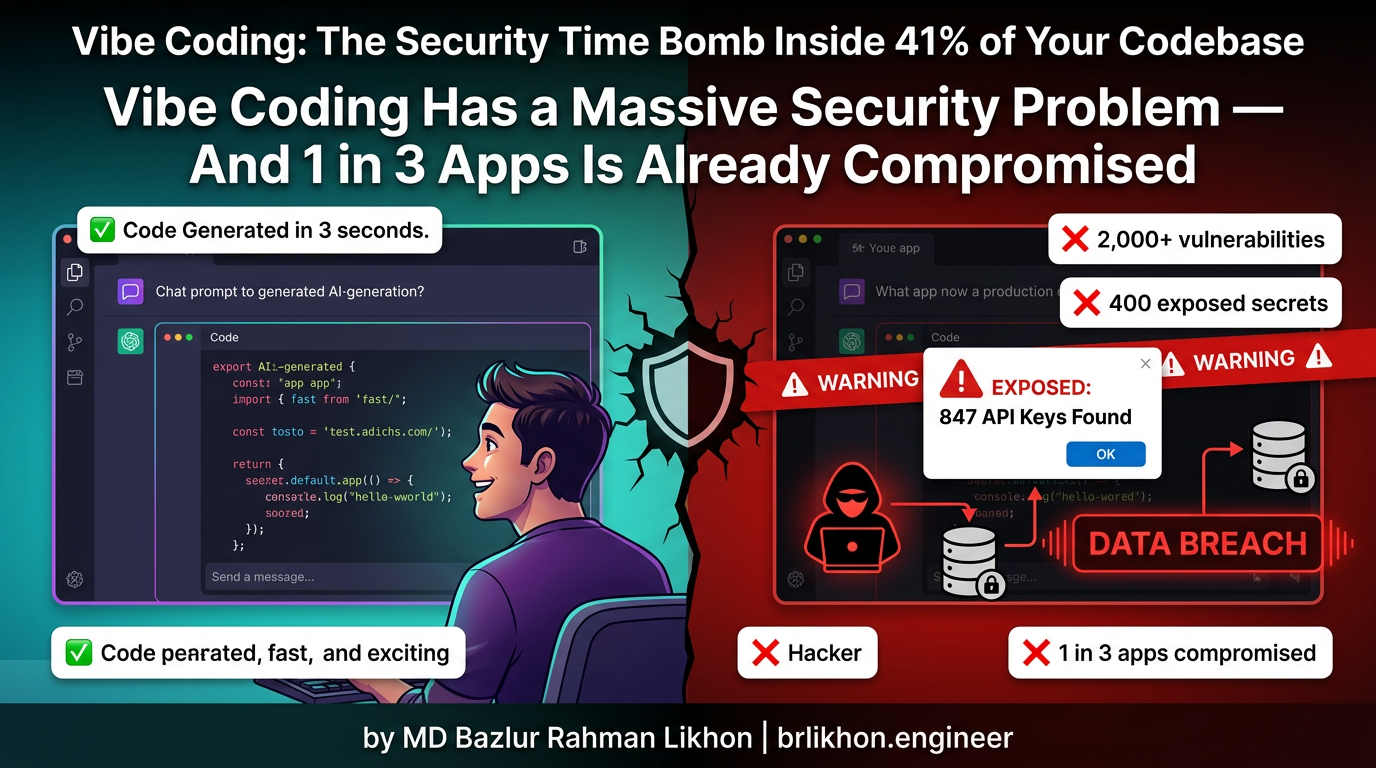
The vibe coding conversation has at times been characterized by enthusiasm that outpaces the engineering evidence. Several categories of risk deserve careful, direct examination.
Hallucinated code and silent logic errors. Language models generate plausible-looking code that can be wrong in ways that do not produce obvious errors. A function may handle common cases correctly and fail silently on edge cases that only appear in production. Unlike a compilation error, a logic error may pass all tests and only surface when a real user triggers the right condition.
Debugging complexity. Code you did not write and do not fully understand is harder to debug. This is not an opinion — it is a structural property of the vibe coding workflow as Karpathy originally described it. When the codebase "grows beyond usual comprehension," the time cost of tracking down a regression increases significantly. A September 2025 Fast Company report cited senior software engineers describing "development hell" when working with AI-generated codebases that had accumulated without adequate review.
Security by default is poor. The Veracode study published in October 2025 found that while LLMs had become dramatically better at generating functional code over the preceding three years, the security quality of generated code had not meaningfully improved. Larger models were not demonstrably better than smaller ones at generating secure code. The security researcher-confirmed vulnerability in the Orchids vibe coding platform, demonstrated to the BBC in February 2026, was not an isolated incident.
Insecure defaults and dependency risk. AI-generated code frequently introduces third-party packages without considering their maintenance status, licensing implications, or known vulnerabilities. It may default to HTTP where HTTPS is required, store credentials in environment variables with insufficient protection, or generate SQL queries vulnerable to injection in contexts where prepared statements are standard.
Architecture drift. Vibe coding is iterative by design — the developer prompts, reviews output, prompts again, redirects. This cycle can produce a system that works but lacks coherent architecture. Without deliberate design decisions, components accumulate technical debt, interfaces become inconsistent, and the system becomes progressively harder to extend, refactor, or hand off.
Testing gaps. If tests are generated by the same AI that generated the implementation, those tests are likely to test the behavior the AI produced — not the behavior the product requires. Tests generated to describe wrong code will pass consistently.
Knowledge transfer and ownership problems. If a significant portion of a codebase was generated through vibe coding workflows and the developers who guided those sessions leave the team, there may be no human in the organization who fully understands how the system works. This is a compliance risk in regulated environments and an operational risk in any system that requires maintenance.
Technical debt at speed. Vibe coding does not eliminate technical debt — it accelerates its accumulation. Code that is generated quickly without architectural review, security consideration, or maintainability standards creates obligations that will have to be paid by future engineers. An independently published CodeRabbit analysis from December 2025 found approximately 1.7 times more issues in AI-coauthored pull requests than in purely human-authored ones.
The SaaStr founder's documented experience in July 2025 — where a Replit AI agent deleted a database despite explicit instructions not to — is a reminder that agentic systems operating with insufficient constraint can cause irreversible harm.
How Real AI-Assisted Software Development Works
The gap between vibe coding as a meme and responsible AI-assisted engineering as a practice is significant. Professional teams that are getting genuine value from AI coding tools are not simply prompting and shipping. They are following a structured workflow that maintains human accountability at critical decision points.
flowchart TD
    A[Define intent and requirements] --> B[Gather repository context]
    B --> C[AI generates initial code]
    C --> D[Human reviews structure and logic]
    D --> E{Acceptable?}
    E -- No --> F[Refine prompt or edit manually]
    F --> C
    E -- Yes --> G[Generate and review tests]
    G --> H[Security and dependency check]
    H --> I[Peer code review]
    I --> J{Approved?}
    J -- No --> K[Human-led revisions]
    K --> I
    J -- Yes --> L[Merge and deploy]
    L --> M[Monitor in production]
    M --> N[Rollback if needed]
Intent and specification. Effective AI-assisted development starts with a clear, precise specification — not a vague request. The quality of the prompt directly governs the quality of the output.
Repository context. Tools like Cursor and GitHub Copilot's workspace mode load the full codebase before generating code. Developers should ensure the model has access to the relevant context: existing patterns, naming conventions, and interface contracts.
Validation and testing. Generated code requires tests — ideally written with awareness of the requirement, not just the generated implementation. Human engineers should confirm that tests cover edge cases, not just the happy path.
Security review. AI-generated code should be treated as untrusted code from an external contributor. Static analysis, dependency scanning, and targeted security review are not optional in any production context.
Explicit ownership. Someone on the team must be able to explain how the code works, why it was structured that way, and how to debug it. If no one can, the code should not merge.
Deployment and monitoring. Rollback capability and production monitoring matter especially for AI-generated code, where unexpected behavior under real-world conditions is more likely than with code that has been carefully hand-authored and reviewed.
Where Vibe Coding Works Best
AI-assisted development, including its more casual vibe-coding expression, delivers genuine value in specific contexts.
Where it genuinely helps:
- Rapid prototyping and proof-of-concept. AI can compress the time from idea to working demo dramatically. For founders, product teams, and innovation labs, this acceleration is material.
- Internal tooling. Low-stakes dashboards, admin interfaces, data export tools, and operations utilities that serve small internal teams and do not handle sensitive data are reasonable candidates for AI-heavy development with lighter review.
- CRUD applications. Standard create-read-update-delete applications with conventional data structures are well within the competence of current AI coding tools.
- Frontend scaffolding. UI components, layout structures, styling adjustments, and boilerplate frontend work are areas where AI tools perform reliably and where the visual feedback loop makes errors immediately obvious.
- Documentation and test generation. Generating docstrings, API documentation, README files, and initial unit test suites from existing code is a strong use case for AI tools with relatively low risk.
- Migration assistance. Converting code between frameworks, translating deprecated patterns, or scaffolding the repetitive portions of a large migration are tasks where AI tools add significant speed without high architectural risk.
- Developer productivity augmentation. Even highly skilled developers benefit from AI assistance on boilerplate, syntax lookups, and routine tasks — freeing attention for the genuinely complex work.
- Solo founder speed. A single technical or semi-technical founder can reach a functional MVP significantly faster with AI assistance than without. The tradeoffs are acceptable at the prototype stage.
Where it is not a good fit:
- Safety-critical systems. Aviation, medical devices, autonomous vehicles, and any system where software failure can cause physical harm requires deterministic, auditable, human-authored code. AI-generated code in these contexts introduces unacceptable risk.
- Highly regulated environments. Financial services, healthcare, legal, and government systems subject to regulatory audit require provable accountability for every design decision. The opacity of AI-generated code conflicts with this requirement.
- Deep infrastructure and performance-sensitive systems. Low-level systems programming, database engine internals, network stack components, and latency-sensitive real-time systems require precise, deliberate engineering that AI tools are not reliably capable of producing at the required standard.
- Complex legacy architectures. Large, interrelated legacy codebases with years of accumulated context require deep human understanding before any modification. AI-generated changes in these environments are high-risk without thorough review.
How Engineering Teams Should Evaluate Vibe Coding
Before incorporating AI-generated code into production workflows, engineering teams benefit from asking a specific set of questions.
When is AI-generated code appropriate? Define clear categories of work where AI assistance is permitted without additional review, versus categories that require a second human set of eyes. Internal tools, tests, and documentation typically sit in the lower-risk tier. Authentication logic, payment processing, and data access layers do not.
When does human-written architecture matter more? When system design decisions will constrain the organization for years — data models, API contracts, service boundaries, security models — those decisions warrant human deliberation. AI tools can assist with implementation once the architecture is decided.
How should AI-generated code be reviewed? Treat it as you would a contribution from a capable but junior external contractor: assume it is plausible, read it carefully, run it through static analysis, check dependencies, and verify edge case handling. Accepting AI-generated code without review is not a policy any engineering team should formally adopt.
How do you protect security and compliance posture? Include AI-generated code in your existing security toolchain: SAST, DAST, dependency scanning, and secrets detection. Do not create exceptions for AI-generated code — apply the same standards uniformly.
How do you preserve maintainability? Establish a norm that any AI-generated code entering the codebase must be understood by at least one engineer who can explain it, modify it, and debug it. Code that no one understands should not ship.
What does governance need? Legal and compliance teams may need to understand what AI tools are being used, what training data those tools were built on (for IP and licensing questions), and what records exist of AI-generated contributions. This is an emerging governance area, and organizations benefit from establishing policy before incidents require retroactive clarity.
When is a coding assistant enough vs. when is full agentic coding risky? Autocomplete-style assistance carries low risk in most engineering environments. Fully agentic coding — where an AI can write, execute, and modify code across a repository with minimal interruption — requires significantly stronger governance, especially for any agent with access to production data, external APIs, or deployment pipelines.
What red flags should you watch for in tool claims? Be skeptical of tools that demonstrate impressive demos on narrow, well-structured tasks without discussing failure modes. Examine security track records carefully — the Lovable vulnerability disclosure of May 2025 is a useful benchmark. Ask vendors what happens when the generated code is wrong: can it be audited, corrected, and explained?
Why This Perspective Matters
Understanding vibe coding requires more than familiarity with the memes and the market numbers. It requires working experience with what happens after the prototype — when AI-generated code meets production infrastructure, real user data, and regulatory requirements.
MD Bazlur Rahman Likhon brings that production perspective directly. As a Senior Cloud & AI Engineer and Head of AI Engineering with over six years of experience, his work spans the full lifecycle of generative AI systems: from initial architecture through to production deployment, monitoring, and iteration. His client portfolio — spanning Bangladesh, the USA, the UK, Japan, and China — has included enterprise RAG platforms, AI-powered outbound call center systems built on FastAPI, Twilio Media Streams, and Gemini Native Audio, document AI and OCR pipelines, biometric identity and KYC systems, and security-focused multi-cloud AI infrastructure.
This breadth of delivery experience across multiple cloud environments — Google Cloud, Microsoft Azure, Oracle Cloud Infrastructure — is reflected in a certification profile that spans production ML engineering, data engineering, cloud security operations, and generative AI leadership. His recognition as a Top 50 Achiever in the Google Cloud Gen AI Academy APAC Edition 2025 and as an AWS AI & ML Scholar reflects consistent engagement with the frontier of applied AI — not theoretical familiarity.
What this background provides, in the context of vibe coding, is a grounded view of where AI-generated code genuinely accelerates work and where it introduces the kind of debt that production systems cannot sustain. The gap between a compelling demo and a system that runs reliably at scale, handles edge cases correctly, and can be maintained by the next engineer who joins the team — that gap is real, and it is exactly where experienced AI engineering judgment matters most.
Frequently Asked Questions
What is vibe coding? Vibe coding is a software development approach in which a developer or non-technical builder describes a goal in natural language and an AI system generates the corresponding code. In its original definition, coined by Andrej Karpathy in February 2025, the approach involves accepting AI-generated output with minimal review, relying on prompts and runtime results to guide the work rather than reading or writing code directly.
Is vibe coding the same as AI-assisted coding? No. AI-assisted coding refers to any use of AI tools in the development process, including careful, reviewed, tested integration of AI suggestions into code a developer fully understands. Vibe coding specifically describes a workflow where the developer delegates heavily to the AI and accepts reduced comprehension of the output. Not all AI-assisted development is vibe coding, and conflating the two misrepresents both.
Will vibe coding replace software engineers? No — not in any near-term timeframe that the evidence supports. AI tools are changing what software engineers spend their time on, and making certain categories of software more accessible to non-engineers. But systems that require architectural judgment, security accountability, debugging under pressure, and long-term maintainability still require experienced engineering leadership. Gartner forecasts that 90% of enterprise software engineers will use AI coding assistants by 2028 — that is augmentation, not replacement.
Is AI-generated code safe for production? It depends on the review process, the type of system, and the risk profile. AI-generated code introduces specific risks: potential security vulnerabilities, logic errors that tests may not catch, undisclosed dependencies, and insecure defaults. A Veracode study from October 2025 found that LLMs had not meaningfully improved at generating secure code even as functional quality improved. AI-generated code can be used safely in production, but only with the same review standards applied to any external code contribution.
Which tasks are best for vibe coding? Rapid prototyping, internal tooling, CRUD application scaffolding, frontend boilerplate, documentation generation, test drafting, and migration assistance are strong candidates. Tasks where mistakes are immediately visible, stakes are low, and review is accessible benefit most from vibe-coding approaches.
What are the biggest risks of vibe coding? Silent logic errors, security vulnerabilities, architecture drift, testing gaps, debugging complexity, and knowledge transfer problems are the primary risks. The speed advantage of vibe coding can compound these risks if teams adopt it without governance or review standards. Code that works in a demo may fail in production under real conditions.
Can non-developers build real applications with AI? Yes, within limits. Non-technical builders using tools like Bolt, Lovable, Replit Agent, and Firebase Studio can produce functional web applications, internal tools, and data interfaces. The constraint is maintainability, security, and scalability: applications built without engineering judgment tend to reach limits quickly when real users, real data volumes, and real security requirements arrive.
How should teams review AI-generated code? Treat it as code from an external contributor. Read it before merging. Run it through static analysis and dependency scanning. Ensure at least one team member can explain how it works and debug it. Do not exempt AI-generated code from standard review processes, regardless of how quickly it was generated.
What is the difference between a coding copilot and vibe coding? A coding copilot (in the original GitHub Copilot sense) suggests code within the developer's existing workflow. The developer reads the suggestion, accepts or rejects it, and retains full understanding of the codebase. Vibe coding inverts this: the AI generates broad portions of the code, often across multiple files, and the developer may not read or fully understand what was produced. The former is a productivity aid; the latter is a change in the fundamental relationship between developer and code.
Is vibe coding good for startups but risky for enterprises? Broadly, yes — with nuance. Early-stage startups prototyping unproven ideas with low user counts and no regulatory exposure can absorb the risks of vibe-coded code and benefit from the speed. As a company matures — handles customer data, becomes subject to regulation, scales its user base, or hands code to a growing engineering team — the risk profile of undocumented, lightly reviewed, AI-generated code increases significantly. The right approach shifts from acceptance to governance as the stakes grow.
Conclusion
Vibe coding arrived as a joke, became a cultural moment, and is now a genuine paradigm shift that organizations are navigating in production. The honest picture is more interesting than either the hype or the backlash suggests.
AI-assisted development, including its more casual vibe-coding form, is delivering real productivity gains for developers, enabling non-technical builders to create software that was previously out of reach, and compressing the timeline from idea to prototype in ways that have strategic value. These are not marketing claims — they are outcomes confirmed by enterprise adoption data, developer surveys, and market dynamics that have moved hundreds of millions of dollars in a short period.
At the same time, the "vibe coding hangover" is also real. Code generated at speed without sufficient review, security consideration, or architectural intent accumulates into systems that are difficult to maintain, expensive to debug, and potentially dangerous. The risks are not hypothetical — they are documented in security disclosures, reported in engineering post-mortems, and visible in the industry's growing focus on AI code review as a category in its own right.
The productive path forward is neither uncritical adoption nor reflexive resistance. It is structured engagement: clear policies on where AI-generated code is appropriate, consistent review standards applied uniformly, explicit human ownership of every component that ships to production, and ongoing investment in the engineering judgment that distinguishes a working demo from a maintainable system.
If you are leading an engineering team, building a product, or evaluating AI development tooling for your organization and want a grounded technical perspective on how these systems work in practice — not in theory — the conversation is worth having before the code is already in production.
Md Bazlur Rahman Likhon is a Senior Cloud & AI Engineer with over six years of production-grade experience across generative AI, RAG systems, voice AI, computer vision, and multi-cloud infrastructure. He has delivered AI systems for clients across Bangladesh, the USA, the UK, Japan, and China, and holds professional certifications from Google Cloud, Microsoft Azure, Oracle Cloud Infrastructure, and Proofpoint. He was recognized as a Top 50 Achiever in the Google Cloud Gen AI Academy APAC Edition 2025 and as an AWS AI & ML Scholar.