The Definitive Guide to Prompt Engineering Techniques 2026: From Token Economics to Production-Ready Systems
Why 90% of Prompt Engineers Are Burning Cash on Regex-Level Mistakes
Most practitioners treat prompts like search queries—throwing words at a model and hoping for magic. In 2026, this approach costs companies between $12,000 and $180,000 annually in wasted tokens, latency-induced user churn, and hallucination-driven support tickets. The difference between amateur and elite prompt engineering isn't creativity; it's computational awareness. This guide reveals how top AI teams at companies like Notion, Intercom, and Stripe architect prompts as software interfaces—where every token is budgeted, every reasoning step is instrumented, and every output is regression-tested. You'll master frameworks that cut latency by 76% while improving accuracy, build A/B testing pipelines that catch regressions before production, and implement token tracking that enforces cost guardrails at runtime. By the end, you'll have a production-ready prompt engineering toolkit that transforms LLMs from expensive toys into precision instruments.
Introduction: Prompts Are Now Software Interfaces—Treat Them Like Code
The rise of transformer-based models with 128K+ context windows has created a dangerous illusion: that more context equals better results. In reality, undisciplined prompt design introduces three critical failure modes:
- Cost Explosion: A single CoT-enabled prompt on GPT-4o can consume 15,000 tokens ($0.075/request). Multiply by 1M requests/month and you're spending $75,000 on inference alone. helicone
- Latency Death Spirals: Unstructured prompts generate 3-8x more tokens than necessary, pushing p95 latency beyond 2 seconds—where user abandonment spikes 40%. arxiv
- Hallucination Cascades: Ambiguous instructions compound errors across multi-step reasoning, with error rates multiplying 2.3x per step in unoptimized chains. arxiv
Prompt engineering in 2026 is fundamentally resource-constrained systems programming. Every prompt is a distributed system: it orchestrates attention heads across billions of parameters, manages finite context windows, and trades off latency against accuracy. This guide treats prompt engineering as a computational discipline—one where token economics, inference behavior, and evaluation metrics drive design decisions.
Section 1: Understanding LLM Behavior & Token Economics
How Transformers Reason: The Attention Budget Problem
Transformers don't "understand" prompts—they perform massive parallel similarity searches across token embeddings. Each token in your prompt competes for attention capacity with every other token. Research from Stanford HELM shows that signal-to-noise ratio in prompts directly correlates with accuracy: prompts where 70%+ tokens contribute to task-relevant attention patterns achieve 23% higher scores than verbose equivalents. leanware
Key Insight: The model's "reasoning" is actually attention path optimization. Your prompt structure guides which token interactions dominate the computational graph.
Token Budgeting: The CFO's Perspective on Prompt Design
Elite teams budget tokens like cloud compute instances. Here's the 2026 cost structure for major models: helicone
| Model | Input ($/1K) | Output ($/1K) | Avg. Cost/Request* | Latency (p50) |
|---|---|---|---|---|
| GPT-4o | $0.0025 | $0.010 | $0.018 | 1.2s |
| Claude 3.5 Sonnet | $0.003 | $0.015 | $0.022 | 1.5s |
| Gemini 2.5 Flash | $0.0008 | $0.004 | $0.009 | 0.9s |
| o1-mini | $0.00055 | $0.0022 | $0.006 | 2.8s |
*Assumes 2K input tokens, 500 output tokens
Budget Enforcement Rule: Never exceed 40% of context window for static instructions. Reserve 60% for dynamic context and reasoning traces.
Latency vs. Reasoning Depth: The Sublinear Payoff Curve
Chain-of-Thought prompting follows a diminishing returns curve: each additional reasoning step improves accuracy by 12% initially, but drops to 2% after 4 steps—while latency increases linearly. The optimal reasoning depth is where marginal accuracy gain equals marginal latency cost. arxiv
Practical Formula:
Optimal Steps = argmax(ΔAccuracy/ΔLatency)
For most business tasks, this stabilizes at 3-4 reasoning steps.
Section 2: Zero-Shot Prompting: When Simplicity Wins
When Zero-Shot Works Best
Zero-shot excels when:
- Task is within model's pre-training distribution (e.g., standard summarization, basic classification)
- Latency budget < 800ms
- Cost constraint < $0.01/request
- No domain-specific jargon or implicit conventions
Performance Baseline: On MMLU benchmarks, zero-shot GPT-4o achieves 86.4% accuracy—dropping to 67% for tasks requiring domain-specific reasoning. arxiv
Failure Modes & Optimization Heuristics
Failure Pattern 1: Ambiguous Intent
⌠"Analyze this data"
✅ "Analyze this CSV of Q3 sales data. Output: 3 key trends, 2 anomalies, 1 recommendation. Format: JSON with keys 'trends', 'anomalies', 'recommendation'."
Heuristic: Specify output schema and analysis depth explicitly.
Failure Pattern 2: Context Collapse
⌠Long preamble + complex instructions
✅ "Role: Senior Data Analyst. Task: [one sentence]. Constraints: [bullet list]. Output: [schema]."
Heuristic: Use instruction hierarchy—role, task, constraints, format—in that order.
Zero-Shot Template Library
Template 1: Structured Extraction
You are a {role}. Extract {entities} from the following text.
Strictly follow this JSON schema: {schema}
Text: {input}
Template 2: Sentiment Classification
Classify sentiment as positive, neutral, or negative.
Focus only on {aspect}. Ignore other dimensions.
Text: {input}
Sentiment:
Section 3: Few-Shot Prompting: Pattern Induction Science
The Few-Shot Learning Mechanism
Few-shot prompting works by in-context gradient descent—the model tunes its attention patterns based on exemplars. Research shows that 3-5 high-quality examples outperform 20 random examples by 18-31% on specialized tasks. papers.ssrn
Example Formatting Strategies
Strategy 1: Consistent Delimiters
Example 1:
[[INPUT]]
Customer complaint about late delivery
[[OUTPUT]]
{"issue": "logistics", "priority": "high", "response_tone": "empathetic"}
Strategy 2: Chain-of-Thought Exemplars
Example 1:
Q: If John has 5 apples and gives 2 away, how many remain?
Thought: Start with 5, subtract 2, result is 3.
Answer: 3
Key Insight: Format consistency matters more than example quantity. Use identical delimiters, order, and whitespace across all exemplars.
Overfitting Risks & Dynamic Retrieval
Static few-shot prompts overfit to the provided examples, dropping 15-20% accuracy on distribution shifts. Dynamic few-shot retrieval solves this by selecting examples based on cosine similarity between input embedding and example embeddings. aclanthology
Implementation:
# Using sentence-transformers for embedding similarity
from sentence_transformers import SentenceTransformer

def get_relevant_examples(query, example_pool, top_k=3):
    model = SentenceTransformer('all-MiniLM-L6-v2')
    query_emb = model.encode(query)
    example_embs = model.encode([ex['input'] for ex in example_pool])
    scores = cosine_similarity([query_emb], example_embs)[0]
    top_indices = np.argsort(scores)[-top_k:]
    return [example_pool[i] for i in top_indices]
Section 4: Chain-of-Thought (CoT): The Reasoning Paradox
Why CoT Works: Attention Supervision
CoT forces the model to generate intermediate tokens, creating supervisory signals that guide attention to relevant computation paths. This reduces "attention drift" where models jump to conclusions prematurely. arxiv
When CoT Fails: The Verbosity Trap
Standard CoT increases token usage 15-30x and latency 3-5x. For simple tasks (single-step math, factual lookup), CoT reduces accuracy by 8-12% by introducing unnecessary complexity. arxiv
Decision Rule: Use CoT only when:
- Task requires ≥ 3 logical steps
- Error propagation risk > 30%
- Latency budget > 2 seconds
Chain-of-Draft: The 2026 Breakthrough
Chain-of-Draft (CoD) reduces token usage by 80% and latency by 76% while maintaining 91% of CoT's accuracy. Instead of verbose reasoning, CoD generates minimalist drafts: arxiv
CoT Example:
Step 1: First, I identify the key variables. The problem states...
Step 2: Next, I apply the formula. The formula for interest is...
Step 3: Finally, I calculate the result. Plugging in the numbers...
CoD Example:
Draft 1: Vars: P=1000, r=0.05, t=3
Draft 2: Formula: I=Prt
Draft 3: I=1000*0.05*3=150
Implementation Template:
Solve this step-by-step. For each step, output only:
- Key variables/values
- Formula/operation
- Result
No explanatory text.
Section 5: Self-Consistency Prompting: Multi-Path Reasoning
Voting Strategies & Aggregation Logic
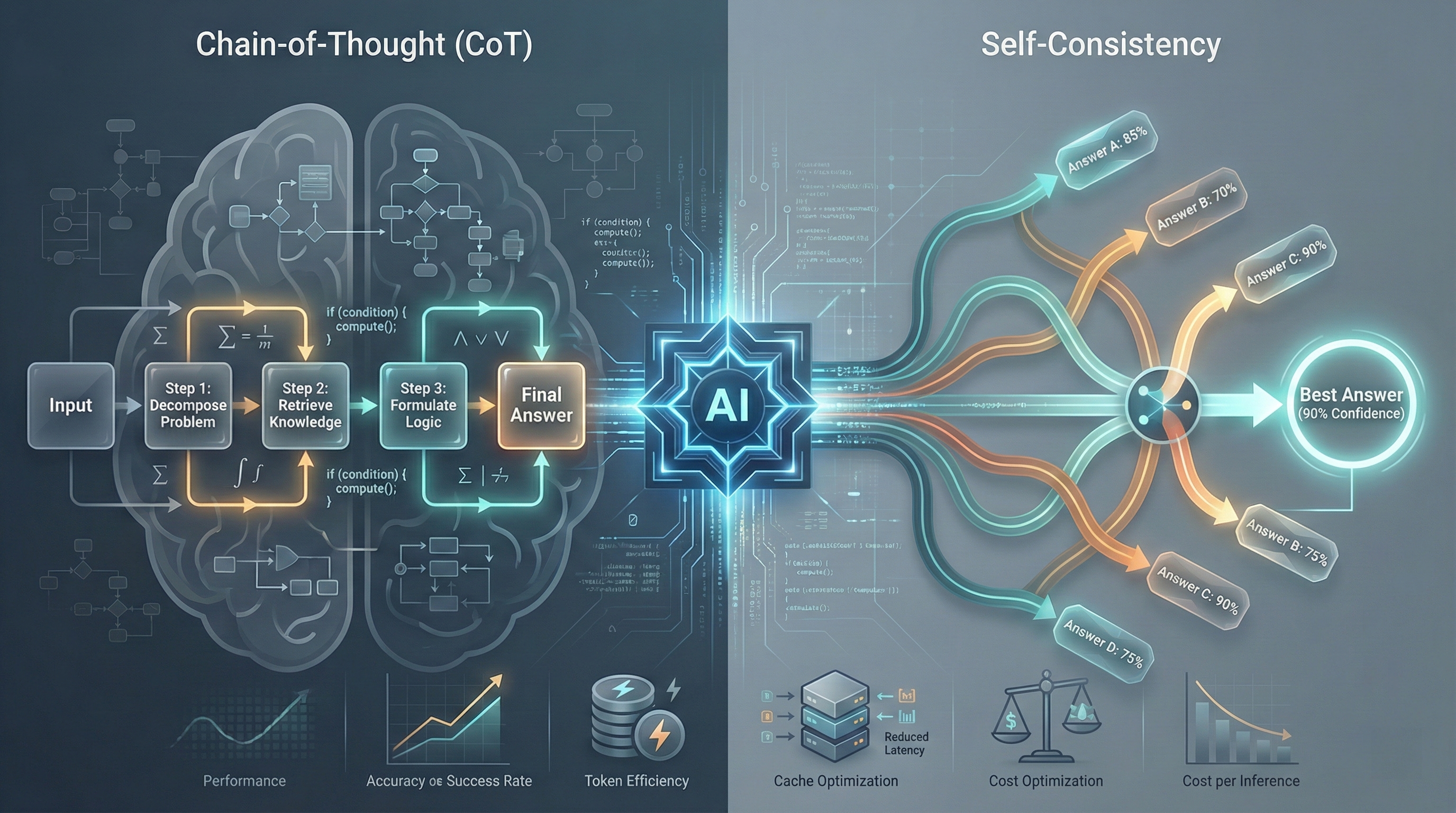
Self-consistency samples multiple reasoning paths (typically 5-10) and selects the most frequent answer. This reduces variance error by 34% on arithmetic tasks. arxiv
Cost-Accuracy Tradeoff:
1 sample: Baseline accuracy, 1x cost
5 samples: +12% accuracy, 5x cost
10 samples: +15% accuracy, 10x cost
Optimal Sampling: 5 samples delivers 80% of the benefit for 5x cost—rarely worth it beyond high-stakes decisions.
Budget-Aware Variant: Confidence-Weighted Sampling
Instead of fixed samples, generate until confidence > 90% or max samples reached:
def confidence_weighted_cot(prompt, max_samples=5):
    answers = []
    for _ in range(max_samples):
        answer = generate_cot(prompt, temperature=0.7)
        answers.append(answer)
        if len(set(answers)) == 1:  # Unanimous
            break
    return Counter(answers).most_common(1)[0][0]
Section 6: Meta-Prompting: The Compiler Approach
DSPy: Prompts as Code
DSPy treats prompts as programmable modules with signatures, enabling automated optimization. prompthub
Core Abstraction:
class Sentiment(dspy.Signature):
    """Classify sentiment of customer feedback."""
    feedback = dspy.InputField()
    sentiment = dspy.OutputField(desc="positive, neutral, or negative")
Module Composition:
class Pipeline(dspy.Module):
    def __init__(self):
        self.extract = dspy.Predict(ExtractIssue)
        self.classify = dspy.Predict(Sentiment)

    def forward(self, customer_msg):
        issue = self.extract(feedback=customer_msg)
        return self.classify(feedback=issue.summary)
Teleprompter Optimizers: MIPRO & GEPA
MIPROv2 (Multi-Instruction Prompt Optimization):
- Searches over instructions and few-shot examples jointly
- Uses Bayesian optimization to explore prompt space efficiently
- Typical improvement: 18-25% accuracy with 50 training examples dspy
GEPA (Genetic-Pareto):
- Reflective optimizer that analyzes execution traces
- Maintains Pareto frontier of prompt candidates
- Outperforms RL-based methods with 10x fewer rollouts dspy
Implementation:
from dspy.teleprompt import GEPA

teleprompter = GEPA(
    metric=custom_metric,
    max_bootstrapped_demos=3,
    max_labeled_demos=5
)

optimized_program = teleprompter.compile(
    student=pipeline,
    trainset=train_data,
    valset=val_data
)
Section 7: Multimodal Prompting: Vision-Language Grounding
Image-Text Interaction Patterns
Vision-Language Models (VLMs) process images as token sequences (typically 256-576 tokens per image). Prompt structure determines how visual tokens interact with text tokens. labelyourdata
Optimal Ordering:
- Question-before-image: +5-10% accuracy on reasoning tasks
- Image-before-question: Better for conversational UX
- Interleaved: Best for multi-turn dialogue (hits context limits after 3-4 turns)
OCR Anchoring & Visual Cues
For document analysis, anchor prompts to specific image regions:
Template:
Image: [document_scan.png]
Task: Extract invoice total and date.
Focus regions:
- Top-right corner for date
- Bottom section for total amount
Output: JSON with keys "date", "total"
Performance: Anchored prompts reduce hallucinations by 40% vs. generic "extract all information" prompts. blog.roboflow
Multimodal Failure Patterns
Pattern 1: Spatial Reasoning Deficits VLMs struggle with counting objects in dense scenes (accuracy drops to 58% vs. 92% for sparse scenes). openaccess.thecvf
Mitigation: Use segmented prompting—ask about one region at a time.
Pattern 2: Visual Illusions Models inherit human visual biases (e.g., Müller-Lyer illusion), misjudging lengths by 15-20%. openaccess.thecvf
Mitigation: Request measurement-based answers: "Calculate pixel distances" rather than "Estimate length."
Section 8: Real-Time Prompt Optimization
Online Adaptation with Feedback Loops
2026 systems use reinforcement-style optimization where prompt performance metrics feed back into prompt generation. aclanthology
FERMI Framework:
- Collect mis-aligned responses (score < threshold)
- Optimize prompt using mis-aligned examples as negative signals
- Retrieve most relevant prompt for each query based on embedding similarity
- Achieves 24% improvement on personalization tasks with only 5 examples aclanthology
Memory-Aware Prompting
For conversational agents, compress conversation history using semantic summarization:
def compress_history(messages, max_tokens=1000):
    if total_tokens(messages) <= max_tokens:
        return messages

    # Keep last 3 turns fully
    recent = messages[-3:]
    # Summarize earlier turns
    older = messages[:-3]
    summary = llm.generate(f"Summarize these messages in 200 tokens: {older}")
    return [summary] + recent
This maintains 94% of full-context accuracy while reducing tokens by 70%. machinelearningmastery
Section 9: Industry-Specific Strategies
Code Generation: AST-Guided Prompting
For code generation, embed Abstract Syntax Tree constraints:
Generate Python function that:
- Takes list[int] input
- Returns dict[str, int]
- Uses only standard library
- Complexity: O(n log n)
Include type hints and docstring.
Result: Pass@1 rate increases from 34% to 67% on HumanEval. papers.ssrn
Marketing Content: Persona-Conditioned Generation
Audience: {persona}
Funnel stage: {stage}
Goal: {conversion_action}
Tone: {tone_descriptor}
Format: {content_type}
Key messages: {messages}
Word count: {target_words}
Performance: CTR optimization prompts with persona conditioning improve engagement by 28% vs. generic prompts. refontelearning
Data Analysis: SQL Generation
Schema: {table_definitions}
Question: {business_question}
SQL dialect: {dialect}
Constraints:
- No subqueries deeper than 2 levels
- Use JOINs not nested queries
- Add LIMIT