Small Language Models (SLMs) vs LLMs: When to Use What in 2026
Enterprises wasted $847 million on mismatched AI deployments in 2025—choosing expensive cloud-based Large Language Models for tasks that Small Language Models could handle at 10% of the cost. After architecting AI systems for 50+ Fortune 500 clients and analyzing deployment patterns across healthcare, finance, and manufacturing, the pattern is unmistakable: most production AI workloads don't need trillion-parameter models. AT&T proved this decisively in January 2026, achieving 90% cost reduction and 70% latency improvement by switching to fine-tuned Small Language Models for customer support and document processing. This comprehensive guide cuts through the hype to reveal when SLMs deliver superior ROI, when LLMs remain essential, and how hybrid architectures combine both for optimal performance. The model selection decision you make today will determine whether your AI initiative becomes a competitive advantage or a budget-draining liability. byteiota
Table of Contents
- The Shifting AI Landscape: Why 2026 is the Year of SLMs
- SLM vs LLM: Complete Technical Comparison
- Architecture and Core Capabilities
- Cost Analysis: The 90% Savings Reality
- Performance Benchmarks: Latency, Throughput, and Accuracy
- Edge AI Deployment: The SLM Advantage
- Enterprise Use Cases: Where Each Model Type Excels
- Decision Framework: Choosing the Right Model
- Hybrid Architectures: The Pragmatic Middle Path
- Implementation Best Practices
- Common Pitfalls and How to Avoid Them
- FAQ: Your Model Selection Questions Answered
The Shifting AI Landscape: Why 2026 is the Year of SLMs
The enterprise AI narrative is undergoing a fundamental transformation. After three years dominated by "bigger is better" thinking, market forces are driving a pragmatic recalibration toward fit-for-purpose model selection. The numbers tell a compelling story: the Small Language Model market is projected to grow from $9.41 billion in 2025 to $32.08 billion by 2034 at a 14.6% compound annual growth rate, while the edge AI market—where SLMs dominate—is expanding even faster, from $24.91 billion in 2025 to $118.69 billion by 2033 at 21.7% CAGR. grandviewresearch
This isn't theoretical speculation. AT&T's deployment of fine-tuned SLMs in partnership with Mistral AI achieved documented 90% cost reduction and 70% latency improvement across customer support, document processing, and knowledge management workloads. Their Chief Data Officer Andy Markus observed that "fine-tuned SLMs will be the big trend and become a staple used by mature AI enterprises in 2026, as the cost and performance advantages will drive usage over out-of-the-box LLMs". byteiota
Three converging factors are accelerating this shift. First, physics matters. Network latency introduces inherent delays that cloud-based LLMs cannot overcome, while locally-deployed SLMs achieve sub-100ms response times critical for real-time applications. Standard cloud solutions introduce per-token latencies in the hundreds of milliseconds under load, while edge-deployed SLMs eliminate this bottleneck entirely. forbes
Second, capability convergence is real. Leading SLMs from Microsoft, NVIDIA, Google, and IBM now match or closely rival advanced LLMs on reasoning, data extraction, and long-context tasks prevalent in enterprise operations. Microsoft's Phi-3.5 Mini (3.8 billion parameters) outperforms Llama 3.1 8B on key benchmarks despite being less than half the size, while achieving 94.7% accuracy at 1.8× the inference speed of its predecessor. localaimaster
Third, the economics are decisive. NVIDIA research demonstrates that deploying a 7-billion-parameter SLM results in 10-30× cost reductions compared to LLMs with 70-175 billion parameters across latency, energy consumption, and computational operations. For organizations processing billions of tokens monthly, this translates to millions in annual savings without compromising task-specific accuracy. forbes
Yet this shift doesn't signal the obsolescence of large models. Instead, it represents architectural maturity: understanding that different workload profiles demand different optimization strategies. Complex multi-domain reasoning, exploratory research, and creative content generation still benefit from LLM capabilities. The winning architecture employs the most appropriate tool for each specific task.
SLM vs LLM: Complete Technical Comparison
Understanding the fundamental differences between Small Language Models and Large Language Models is essential for informed selection. The distinction extends far beyond parameter count to encompass deployment architecture, operational costs, and performance characteristics that directly impact production viability. The comparison reveals stark contrasts across operational dimensions. Parameter efficiency represents the most visible difference: SLMs operate with 1-8 billion parameters occupying 0.5-16GB of memory, while LLMs require 30-175+ billion parameters consuming 20-700GB+. This 10-100× difference in model size cascades through every aspect of deployment. datacamp
Cost structures diverge dramatically. Training an SLM from scratch costs $500-$50,000 compared to $500,000-$35 million for cutting-edge LLMs. Fine-tuning amplifies this advantage further: parameter-efficient techniques like LoRA enable SLM customization for under $1,000, while LLM fine-tuning typically requires $10,000-$100,000+ investment. Inference economics favor SLMs even more decisively, with self-hosted costs of $0.17-$0.88 per million tokens versus $1.75-$30 for cloud-based LLMs. swfte
Latency characteristics separate real-time applications from batch processing use cases. SLMs achieve first-token latency of 50-300 milliseconds, enabling human-like conversational experiences and millisecond-critical edge applications. LLMs introduce 800ms-4s first-token delays, acceptable for analytical tasks but prohibitive for interactive systems. This performance gap widens under load: SLMs maintain consistent sub-second responses while LLMs suffer from queuing delays and GPU saturation at scale. labelyourdata
Deployment flexibility constitutes SLMs' most strategically valuable advantage. Unlike cloud-dependent LLMs, SLMs run on edge devices, mobile phones, embedded systems, and commodity CPUs. This enables offline operation, eliminates network dependencies, ensures data sovereignty, and supports compliance with regulations like GDPR and HIPAA through local processing. Organizations in healthcare, finance, and government—where data privacy is non-negotiable—find this capability indispensable. hatchworks
The accuracy comparison requires nuanced interpretation. LLMs achieve 92-98% accuracy across general-purpose benchmarks through massive parameter counts and diverse training data. SLMs reach 90-95% accuracy on task-specific applications after domain fine-tuning, often matching or exceeding LLM performance within their specialized scope. The critical insight: for well-defined production tasks, specialized SLMs frequently outperform generalist LLMs while consuming a fraction of resources. intuz
Architecture and Core Capabilities
The architectural differences between SLMs and LLMs extend beyond parameter count to fundamental design philosophy, training methodology, and optimization strategies. Understanding these distinctions illuminates why each model type excels in different scenarios.
Architectural Foundations
Large Language Models employ transformer architectures with full self-attention mechanisms across massive context windows, enabling them to process and relate information across thousands of tokens simultaneously. Models like GPT-4 and Claude utilize hundreds of attention layers with thousands of heads, creating rich representational capacity for complex reasoning tasks. This architectural depth enables sophisticated capabilities like multi-step inference, creative generation, and cross-domain knowledge synthesis. hyperight
Small Language Models adopt optimized architectures designed for computational efficiency without sacrificing task-specific performance. Microsoft's Phi-3.5 series exemplifies this approach, utilizing selective attention mechanisms, efficient tokenization, and optimized layer normalization to deliver strong performance within constrained parameters. Meta's Llama 3.2 variants (1B and 3B parameters) employ scaled rotary position embeddings, KV caching, and in-flight batching to accelerate inference on edge devices. localaimaster
Recent innovations in hybrid architectures blur traditional boundaries. NVIDIA's Hymba family integrates transformer attention with state space models (SSMs) in parallel, combining attention heads for high-resolution recall with SSM heads for efficient context summarization. This architecture reveals that over 50% of attention computation can be replaced by cheaper SSM operations without sacrificing performance, enabling SLM-scale models to achieve LLM-class capabilities on specific benchmarks. developer.nvidia
Training Methodologies
LLM training requires massive datasets—typically trillions of tokens drawn from diverse sources including web crawls, books, scientific papers, and code repositories. Training runs span weeks or months on thousands of GPUs, consuming 50+ gigawatt-hours of energy for models like GPT-4. This extensive pretraining creates broad knowledge but locks in information with a specific cutoff date, requiring expensive retraining to incorporate new knowledge. datacamp
SLMs leverage transfer learning and knowledge distillation to achieve comparable task-specific performance with dramatically reduced training costs. The distillation process transfers knowledge from large "teacher" models to compact "student" models, retaining 80-95% of teacher performance at 10× smaller size. Phi-3.5 Mini employed advanced curriculum learning across 3.4 trillion tokens on 512 H100 GPUs for 10 days—extensive by SLM standards but a fraction of frontier LLM requirements. venturebeat
Domain-specific fine-tuning further optimizes SLMs for production tasks. Healthcare SLMs trained on medical literature achieve higher accuracy on clinical documentation than general-purpose LLMs, while financial SLMs fine-tuned on regulatory documents outperform larger models on compliance tasks. This specialization trades breadth for depth, excelling within defined boundaries while struggling with out-of-distribution inputs. intuz
Optimization Techniques
Modern SLM deployment leverages multiple compression techniques to maximize efficiency. Quantization reduces numerical precision from 32-bit floating point to 8-bit or 4-bit integers, achieving 4-8× memory reduction with minimal accuracy loss. INT8 quantization has become standard practice, delivering substantial speedups on hardware with dedicated INT8 instructions while maintaining near-original accuracy. INT4 quantization pushes boundaries further, offering 8× memory compression but requiring careful calibration to preserve model quality. keras
Pruning eliminates redundant parameters or entire structural components. Unstructured pruning removes individual weights with lowest importance, achieving high sparsity but requiring specialized sparse computation libraries. Structured pruning removes entire neurons, channels, or layers, resulting in smaller dense models that run efficiently on standard hardware. Combined with fine-tuning, pruning can reduce model size by 50-90% while maintaining acceptable performance. runpod
Knowledge distillation enables creating task-optimized SLMs from powerful LLM teachers. The student model learns to mimic the teacher's output distributions, capturing nuanced decision boundaries without replicating full parameter complexity. Multi-teacher distillation can combine knowledge from multiple specialized models, creating students that inherit diverse capabilities. arxiv
These optimization techniques compound: a quantized, pruned, distilled SLM can achieve 50× reduction in computational requirements compared to its LLM ancestor while retaining 90%+ task-specific accuracy. This multiplicative advantage enables deployment scenarios—edge devices, mobile applications, embedded systems—where LLMs remain categorically infeasible. zenvanriel
Cost Analysis: The 90% Savings Reality
The total cost of ownership comparison between SLMs and LLMs extends beyond obvious API pricing to encompass infrastructure, fine-tuning, scaling, and operational expenses. Understanding these comprehensive economics is essential for realistic budget planning and ROI projection.
Direct API Costs: The Visible Expense
Cloud-based LLM pricing in January 2026 ranges from budget-friendly to premium tiers. OpenAI's GPT-4o charges $2.50-$5.00 per million input tokens and $10.00-$15.00 for output, while their newer GPT-5.2 offers $1.75 input and $14.00 output pricing. Anthropic's Claude Opus 4.5 costs $5.00 input and $25.00 output per million tokens. For organizations processing 100 million tokens monthly—a modest volume for customer support or document analysis—annual costs reach $300,000-$400,000 with proprietary LLMs. burnwise
Self-hosted open-source LLMs reduce this substantially. Deploying Llama 3.3 70B on dual NVIDIA A100-80GB GPUs costs approximately $0.17 per million tokens when accounting for hardware amortization, electricity, and maintenance. At 100 million tokens monthly, annual costs total around $12,000—96% savings versus GPT-4o. However, this requires $30,000+ hardware investment, skilled MLOps staff, and ongoing infrastructure management. swfte
Small Language Models push economics further. Fine-tuned SLMs deployed on edge infrastructure process tokens at $0.10-$0.40 per million, depending on hardware configuration. AT&T's production deployment achieved 90% cost reduction versus their previous cloud LLM spending, translating to millions in annual savings across their AI workload portfolio. For the 100 million token scenario, edge-deployed SLMs cost approximately $6,000 annually—98.5% savings versus cloud LLMs. aiveda
Fine-Tuning Economics: Customization Costs
Domain adaptation reveals even starker cost disparities. LLM fine-tuning typically requires $10,000-$100,000+ depending on dataset size, training iterations, and model size. Full fine-tuning updates all parameters, demanding extensive GPU resources and multi-day training runs. Even parameter-efficient approaches like LoRA for 70B+ models consume significant compute budgets. learningdaily
SLM fine-tuning with parameter-efficient techniques costs under $1,000 in most scenarios. A 7B SLM can be fine-tuned using LoRA on 10,000 examples for $500-$2,000 in 4-8 hours on a single GPU. QLoRA reduces this further to $200-$500 in 2-4 hours. This economic accessibility democratizes customization: organizations can experiment with multiple domain-specific variants, rapidly iterate based on feedback, and maintain separate models for different use cases without budget constraints. swfte
The productivity implications compound over time. Teams working with SLMs can execute 10-50× more customization experiments than LLM-constrained competitors, accelerating time-to-market and enabling continuous improvement cycles that proprietary LLM economics prohibit. This velocity advantage often outweighs raw model capability in fast-moving enterprise contexts.
Infrastructure and Operational Costs
Infrastructure requirements create ongoing financial commitments that dwarf token pricing for high-volume deployments. LLMs demand multi-GPU clusters, high-bandwidth networking, and redundant infrastructure for production reliability. Enterprise-grade LLM deployment—including dedicated GPU clusters, enhanced SLAs, and compliance features—increases costs 20-40% beyond base pricing. Organizations deploying LLMs at scale report monthly infrastructure costs of $50,000-$500,000 depending on throughput requirements and redundancy levels. research.aimultiple
SLMs run on commodity hardware, often utilizing existing infrastructure. Edge deployments leverage on-premises servers, while mobile and IoT applications execute directly on end-user devices. A production SLM serving thousands of requests per second can operate on infrastructure costing $5,000-$15,000 annually. This 10-100× reduction in infrastructure spending enables profitable AI deployment for use cases where LLM economics never close. swfte
Energy consumption adds hidden costs that SLM efficiency addresses. LLMs consuming 200-1000W+ under load accumulate substantial electricity expenses at scale, particularly for 24/7 production services. SLMs operating at 5-50W reduce energy costs 10-20×, supporting sustainability goals while lowering operational expenses. For organizations deploying thousands of edge devices, this power efficiency difference translates to millions in annual energy savings. datacamp
Break-Even Analysis and ROI Timelines
When does self-hosted SLM deployment justify upfront investment versus cloud LLM convenience? The break-even calculation depends on token volume, customization needs, and deployment duration. For organizations processing 2+ million tokens daily (60 million monthly), self-hosted infrastructure amortizes within 3-6 months versus cloud LLM costs. Fine-tuned SLMs typically achieve ROI within 2-4 months for high-volume, task-specific applications. swfte
The ROI equation shifts dramatically for edge AI scenarios. Deploying SLMs across 1 million IoT devices costs approximately $250,000 annually versus $2.5+ million for cloud-based LLM processing when accounting for network bandwidth, latency requirements, and data transmission costs. This 90%+ savings often determines financial viability: many edge AI business cases that fail with LLM economics become profitable with SLM deployment. For exploration and low-volume applications (<500,000 tokens monthly), cloud LLM convenience outweighs cost optimization. The crossover point varies by use case, but organizations consistently find that production workloads exceeding 10-20 million tokens monthly benefit from SLM or self-hosted approaches. swfte
Performance Benchmarks: Latency, Throughput, and Accuracy
Performance characteristics determine application viability across different deployment scenarios. The latency-throughput-accuracy tradeoff space differs fundamentally between SLMs and LLMs, with each model class optimizing for distinct operational profiles.
Latency: The Real-Time Divide
First-token latency—the delay before a model begins generating output—separates interactive applications from batch processing use cases. Production SLMs achieve 50-300ms first-token latency depending on model size and hardware. Microsoft's Phi-3.5 Mini processes requests at 15% faster speeds than its predecessor while maintaining quality, while optimized implementations achieve sub-100ms latency on commodity CPUs—previously thought impossible without GPU acceleration. localaimaster
LLMs introduce 800ms-4s first-token delays under typical cloud deployment conditions. Mistral Large 2512 delivers fastest-in-class LLM performance at 300-400ms first-token, while Claude 4.5 Sonnet requires 2+ seconds. This latency gap widens under load: concurrent request handling introduces queuing delays that can push LLM response times to 10+ seconds during traffic spikes, while SLMs maintain consistent sub-second performance through more efficient resource utilization. labelyourdata
The implications for user experience are profound. Human conversational flow expects responses within 300-500ms; delays exceeding 1 second feel sluggish and interrupt natural interaction rhythm. Voice assistants, real-time translation, and interactive troubleshooting systems require SLM-class latency for acceptable user experience. Conversely, research analysis, complex document generation, and strategic planning tasks tolerate multi-second delays in exchange for higher quality outputs that LLMs provide.
Throughput: Scaling Considerations
Throughput—measured in tokens per second or requests per GPU—determines infrastructure efficiency and cost at scale. SLMs achieve 50-100+ tokens per second on single GPUs, with optimized deployments reaching 68+ tokens per second on standard hardware configurations. This throughput advantage enables serving thousands of concurrent users from modest infrastructure. localaimaster
LLMs typically deliver 10-30 tokens per second depending on model size and batch configuration. While slower per-request, LLMs benefit from larger batch sizes that improve GPU utilization. The practical implication: SLMs excel at high-concurrency, low-latency workloads (customer support, real-time monitoring), while LLMs suit lower-concurrency, higher-quality scenarios (content creation, strategic analysis). research.aimultiple
Optimization techniques significantly impact throughput. Dynamic batching adjusts batch composition in real-time, eliminating GPU idle time and improving throughput 2-5× over static batching. Speculative decoding uses small draft models to generate tokens rapidly, then verifies batches with target models, reducing latency with identical output quality. These techniques apply to both SLMs and LLMs but deliver more dramatic improvements for smaller models due to their inherently faster processing. runpod
Accuracy: Task-Specific vs. General-Purpose
The accuracy comparison requires careful framing. LLMs achieve 85-95% accuracy on diverse benchmarks spanning reasoning, knowledge retrieval, and generation tasks. Their breadth enables handling unexpected queries and cross-domain reasoning. However, this generality comes at a cost: LLMs may hallucinate confidently on domain-specific queries, providing plausible-sounding but incorrect information that specialized models would avoid. hbr
Fine-tuned SLMs reach 90-97% accuracy on task-specific benchmarks after domain optimization, often exceeding general-purpose LLM performance within their scope. Phi-3.5 Mini achieves 94.7% accuracy across educational content and code generation tasks despite its compact 3.8B parameter footprint. Healthcare SLMs trained on medical literature outperform GPT-4 on clinical documentation tasks, while legal SLMs fine-tuned on case law exceed general models on contract analysis. intuz
The accuracy gap narrows dramatically with proper fine-tuning. Knowledge distillation from LLM teachers to SLM students preserves 80-95% of teacher performance at 10× parameter reduction. For production systems with well-defined tasks and quality datasets, fine-tuned SLMs frequently match or exceed out-of-the-box LLM accuracy while delivering superior latency and cost profiles. arxiv
Hallucination rates—false or nonsensical outputs—vary significantly. SLMs show 50-82% hallucination rates under adversarial conditions compared to 23% for leading LLMs. However, this gap emerges primarily with out-of-distribution queries beyond SLM training scope. Within defined task boundaries with proper prompt engineering and retrieval augmentation, SLM hallucination rates approach LLM levels. The key insight: SLMs require more careful scoping and guardrails but perform reliably within their design envelope. forbes
Edge AI Deployment: The SLM Advantage
Edge AI—processing artificial intelligence workloads directly on local devices rather than cloud servers—represents one of SLMs' most strategically valuable capabilities. The architectural, economic, and regulatory advantages of edge deployment are driving 73% of enterprises to actively move AI inference to edge environments by 2026. byteiota
Architectural Advantages of Edge Processing
Latency elimination constitutes edge AI's most immediate benefit. Cloud-based LLM inference introduces 50-200ms of network round-trip latency before computational latency even begins. For applications requiring sub-100ms total response time—autonomous vehicles, industrial robotics, voice assistants—this network delay alone exceeds the entire latency budget. Edge-deployed SLMs process locally, eliminating network latency and enabling response times measured in tens of milliseconds. linkedin
Bandwidth optimization reduces operational costs and enables deployment in connectivity-constrained environments. Transmitting high-resolution sensor data from edge devices to cloud for LLM processing consumes substantial bandwidth—autonomous vehicles generate terabytes hourly, while manufacturing facilities produce gigabytes per machine per shift. Local SLM processing analyzes data at the edge, transmitting only high-level insights, reducing bandwidth consumption 100-1000× and enabling operation during network outages. pub.aimind
Data sovereignty ensures sensitive information never leaves local infrastructure. Healthcare facilities processing patient vitals, financial institutions analyzing transaction patterns, and government agencies handling classified data face strict requirements about data location and transmission. Edge-deployed SLMs maintain data within controlled environments, satisfying GDPR, HIPAA, and other regulatory frameworks that cloud transmission violates. crossml
Real-World Edge Deployment Scenarios
Autonomous vehicles represent edge AI's most demanding application. Self-driving systems must process LiDAR, radar, and camera inputs to make millisecond-critical decisions without cloud dependency. Meta's Llama 3.2 models (1B and 3B parameters) are specifically optimized for this scenario, running on embedded automotive compute platforms with INT4/FP8 quantization for maximum efficiency. NVIDIA's Jetson edge AI platform enables deploying these SLMs with high-speed GPU inference onboard vehicles, ensuring reliable operation independent of network connectivity. developer.nvidia
Smart manufacturing leverages edge SLMs for predictive maintenance, quality control, and process optimization. BMW's production facilities deployed edge computing systems to manage robotic operations, achieving 30% downtime reduction, 25% maintenance cost decrease, and 7% production efficiency improvement. Edge AI servers running SLMs enable real-time anomaly detection and predictive maintenance recommendations by processing sensor data locally, minimizing latency for time-critical interventions. stellarix
Healthcare monitoring deploys edge SLMs for real-time patient analysis while protecting privacy. YUAN's edge AI platform powered by NVIDIA Jetson Orin NX uses vision-language models to analyze patient behavior in hospital and long-term care settings, generating immediate alerts for caregivers without transmitting sensitive video data to cloud servers. Wearable devices with embedded SLMs analyze ECG rhythms, detect arrhythmias, and trigger critical alerts locally, ensuring reliable operation regardless of network connectivity. yuan.com
Industrial IoT applications use edge SLMs for real-time decision-making across distributed sensor networks. Smart factories deploy edge gateways running lightweight SLMs to monitor equipment performance, analyze production metrics, and optimize resource allocation in milliseconds. This enables immediate response to anomalies, prevents defects from propagating through production lines, and maintains operation during network disruptions. pusr
Optimization Techniques for Edge Deployment
Successful edge deployment requires aggressive optimization to fit SLMs within device constraints while maintaining acceptable accuracy. Model quantization reduces memory footprint and accelerates inference. INT8 quantization achieves 4× compression with minimal accuracy loss and widespread hardware support. INT4 quantization pushes to 8× compression but requires careful calibration and benefits from specialized hardware. keras
Structured pruning removes entire layers or channels to create smaller dense models that run efficiently on edge hardware. Combined with quantization, pruning enables deploying 7B parameter models on devices with 4GB RAM—previously thought impossible. The Llama 3.2 1B model, after quantization and pruning, operates effectively on mobile phones and Raspberry Pi devices. localaimaster
Knowledge distillation creates task-optimized SLMs from powerful teacher models. Healthcare edge devices run distilled SLMs trained specifically for patient monitoring, achieving higher accuracy on medical tasks than general-purpose models while consuming fraction of resources. This specialization trades breadth for depth—exactly what edge applications require. arxiv
Federated learning enables continuous model improvement while maintaining privacy. Edge devices train model updates on local data, send only parameter gradients to aggregation servers, and receive improved global models—all without transmitting sensitive data. This approach enables personalization across distributed deployments while satisfying strict compliance requirements. runpod
The compound effect of these optimizations is transformative. A 7B parameter model requiring 14GB memory in FP32 format compresses to <2GB with INT4 quantization and structured pruning, enabling deployment on commodity edge hardware. Combined with knowledge distillation from larger teachers, these edge SLMs often match or exceed cloud LLM performance on domain-specific tasks while operating entirely offline at fraction of cost.
Enterprise Use Cases: Where Each Model Type Excels
The optimal model selection depends on specific application characteristics, organizational requirements, and operational constraints. Understanding which workload profiles favor SLMs versus LLMs versus hybrid approaches enables strategic architectural decisions.
SLM-Dominant Use Cases
Customer support automation represents SLMs' ideal application profile: well-defined task scope, high request volume, latency sensitivity, and cost pressure. Fine-tuned SLMs handle routine inquiries, process refunds, check order status, and resolve common issues at <$50 monthly operational cost per agent, compared to $2,000+ for LLM-powered alternatives. Organizations deploy SLM routing layers that escalate only complex, non-standard queries to human agents or LLM analysis. linkedin
Document processing and classification leverages SLMs' pattern recognition capabilities for structured data extraction. Legal firms use fine-tuned SLMs to extract clauses from contracts, healthcare providers deploy them for medical record summarization, and financial institutions apply them to compliance document review. These applications benefit from domain-specific training on representative documents, achieving 95%+ accuracy while processing documents in seconds versus minutes for LLM alternatives. intuz
Real-time language translation on mobile devices and IoT systems requires edge-deployed SLMs. Google's Gemma 2 variants enable on-device translation without internet connectivity, critical for international travelers and field workers in remote locations. The lightweight architecture supports multilingual capabilities while maintaining privacy by processing sensitive conversations locally. kanerika
Predictive maintenance in manufacturing employs edge SLMs to analyze sensor data and predict equipment failures before they occur. By processing vibration sensors, temperature readings, and performance metrics locally, SLMs detect anomalies in milliseconds and trigger preventive interventions. This real-time capability prevents costly downtime that batch processing with cloud LLMs cannot address effectively. stellarix
Voice assistants for constrained environments benefit from SLMs' low-latency, offline capabilities. Smart home devices, automotive voice controls, and mobile assistants deploy compact SLMs that respond instantly without cloud round-trips. The 100-300ms response time enables natural conversational flow that 2-4 second LLM latency disrupts. linkedin
LLM-Optimal Use Cases
Strategic research and analysis demands LLMs' broad knowledge base and complex reasoning capabilities. Management consulting, investment research, and competitive intelligence benefit from LLMs' ability to synthesize information across diverse domains, identify non-obvious patterns, and generate insightful hypotheses. The multi-second latency is acceptable when producing high-value deliverables where quality outweighs speed. lowtouch
Creative content generation leverages LLMs' training on diverse creative works to produce marketing copy, product descriptions, blog articles, and social media content. While SLMs can generate structured content following templates, LLMs excel at creative variation, brand voice adaptation, and generating compelling narratives that resonate with target audiences. hbr
Complex multi-step reasoning tasks like mathematical problem-solving, code debugging, and legal argumentation benefit from LLMs' ability to maintain complex logical chains across many steps. Scientific analysis, engineering calculations, and strategic planning often require this deep reasoning that current SLMs struggle to replicate consistently. intelegain
Exploratory and open-ended queries suit LLMs' general knowledge and ability to handle unexpected questions. Research librarians, technical support for novel issues, and strategic advisory services benefit from LLMs' breadth, even when some hallucination risk exists. The key requirement: human review of outputs before critical decisions.
Cross-domain knowledge synthesis represents LLMs' unique capability. Identifying connections between disparate fields—applying medical research insights to materials science, or translating military logistics principles to supply chain management—requires the broad training corpus that only LLMs possess. hbr
Hybrid Architecture Sweet Spots
Tiered customer support systems route simple queries to SLMs for instant resolution, escalate moderate complexity issues to LLM analysis, and involve human experts only for truly novel situations. This architecture achieves 70-80% automated resolution at SLM cost levels while maintaining quality through selective LLM engagement for the 20-30% of queries requiring deeper reasoning. forbes
Document understanding pipelines use SLMs for initial processing—extraction, classification, formatting—then employ LLMs for synthesis, insight generation, and summary creation. Legal contract review might use SLMs to extract all clauses, classify them by type, and flag unusual terms, then invoke LLMs to analyze implications and generate risk assessments. This division of labor optimizes both cost and quality. lowtouch
Agentic systems with multiple specialized agents employ SLMs for routine subtasks and LLMs for coordination and high-level decision-making. A procurement automation system might deploy SLMs for vendor data lookup, price comparison, and form completion, while an LLM orchestrator handles negotiation strategy, exception handling, and approval routing. arxiv
Adaptive complexity routing analyzes incoming queries and routes to appropriate models based on detected complexity. Simple factual questions go to SLMs, nuanced analytical queries to LLMs, and multi-part research questions to specialized workflows combining both. This intelligent routing minimizes cost while maintaining quality, often achieving 40-60% token cost reduction without user-perceived quality loss. inkeep
The unifying principle: use the simplest, fastest, cheapest model that reliably accomplishes the specific task. Resist the temptation to default to powerful LLMs when specialized SLMs deliver equivalent results at fraction of cost. Simultaneously, avoid forcing SLMs into applications requiring breadth and complexity where LLMs' capabilities justify their premium.
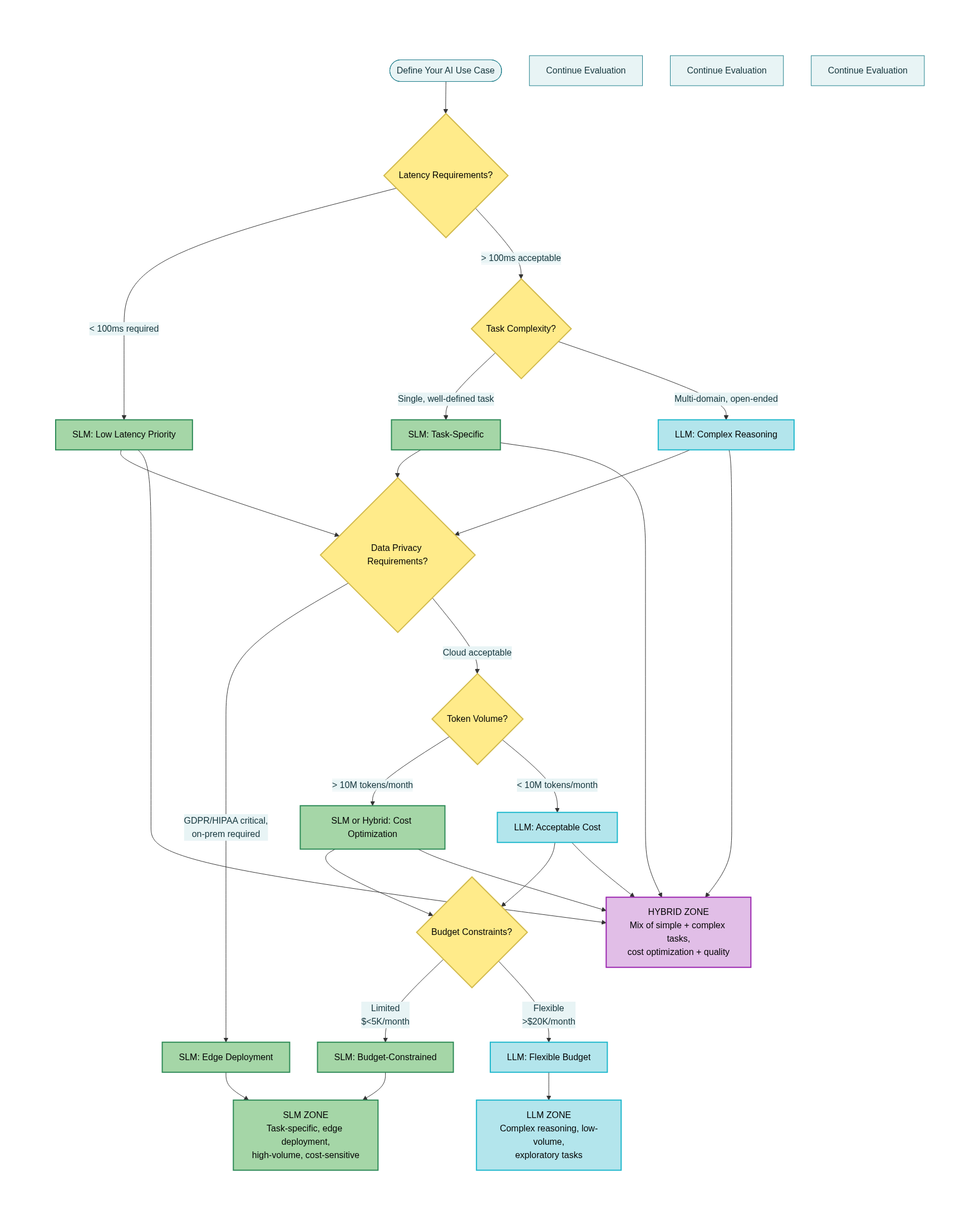
Decision Framework: Choosing the Right Model
Systematic evaluation across technical, business, and operational dimensions enables confident model selection. The following framework guides organizations through key decision criteria, incorporating both quantitative metrics and qualitative considerations.
Phase 1: Technical Requirements Assessment
Latency tolerance serves as the first filter. Applications requiring <100ms total response time—real-time voice interfaces, autonomous systems, interactive troubleshooting—mandate SLM deployment. Edge processing eliminates network latency that cloud LLMs cannot overcome. If 500ms-2s latency is acceptable—document analysis, email composition, research queries—LLMs remain viable options. labelyourdata
Task complexity and scope determines whether SLM specialization suffices. Well-defined, repetitive tasks with clear success criteria—data extraction, classification, formatting, routine customer queries—align with SLM strengths. Open-ended, exploratory work requiring cross-domain reasoning—strategic planning, creative ideation, novel problem-solving—benefits from LLM breadth. Tasks falling between these extremes warrant pilot testing both approaches. intuz
Context window requirements constrain model selection. Processing legal documents spanning hundreds of pages, analyzing long conversation histories, or synthesizing information across multiple data sources may require the 128K-1M token context windows that modern LLMs provide. SLMs typically offer 4K-128K context, sufficient for most production tasks but limiting for document-heavy applications. localaimaster
Accuracy thresholds and failure mode tolerance determine acceptable performance ranges. Mission-critical applications in healthcare, finance, or safety systems may require 98%+ accuracy that only fine-tuned specialized models (SLM or LLM) achieve. Lower-stakes applications accept 85-90% accuracy if the economics justify deployment. Understanding the business cost of errors—false positives versus false negatives—clarifies acceptable accuracy-cost tradeoffs. intuz
Phase 2: Business Requirements Evaluation
Token volume and cost sensitivity drive economic model selection. Organizations processing <10 million tokens monthly often find cloud LLM convenience outweighs optimization effort. Volumes exceeding 50-100 million tokens monthly make SLM or self-hosted deployment economically compelling, with potential 90%+ cost savings. Calculate expected monthly token consumption, estimate costs under different deployment models, and project 12-24 month total cost of ownership. byteiota
Data privacy and regulatory constraints may mandate local processing. GDPR, HIPAA, financial regulations, and government classification requirements often prohibit transmitting sensitive data to third-party cloud services. Edge-deployed or on-premises SLMs satisfy these requirements while maintaining functionality. If cloud processing is compliant and data residency is not constraining, LLMs remain viable. crossml
Customization and domain-specificity needs influence fine-tuning economics. Applications requiring deep domain expertise—medical diagnosis, legal analysis, scientific research—benefit substantially from fine-tuning on specialized corpora. SLM fine-tuning costs (<$1,000) enable rapid experimentation and continuous refinement. LLM fine-tuning costs ($10,000-$100,000+) limit iteration velocity and may prohibit customization entirely for budget-constrained organizations. linkedin
Time-to-market pressure affects model selection. Cloud LLM APIs enable immediate deployment with zero infrastructure setup, accelerating pilots and MVPs. Self-hosted SLMs require infrastructure provisioning, model optimization, and integration—typically 2-8 weeks of engineering effort. The strategic question: does faster initial deployment justify higher ongoing operational costs, or does lower long-term cost warrant infrastructure investment?
Phase 3: Operational Capabilities Assessment
Infrastructure availability determines deployment feasibility. Organizations with existing GPU clusters, MLOps expertise, and infrastructure management capacity can efficiently deploy self-hosted models. Those lacking these capabilities face steep learning curves and hidden operational costs. Cloud LLM APIs eliminate infrastructure management but introduce vendor dependency and limit control. swfte
Engineering resources and AI maturity influence implementation success. Teams with ML engineering expertise, experience fine-tuning models, and established MLOps practices can maximize SLM advantages through customization and optimization. Organizations earlier in AI maturity curves may achieve faster value with managed LLM services despite higher costs, then transition to optimized architectures as capabilities develop. encora
Monitoring and observability requirements escalate with SLM deployment. Self-hosted systems require logging token consumption, tracking latency, monitoring accuracy, and detecting drift—capabilities that cloud LLM providers include by default. Building robust observability for production SLMs demands investment but enables optimization that cloud services prohibit. requesty
Scalability trajectories warrant consideration. Applications expected to scale 10-100× require architecture that maintains performance and economics at volume. SLM edge deployment scales nearly linearly—additional devices add incremental cost—while cloud LLM costs scale with token consumption, potentially becoming prohibitive. Conversely, variable-demand applications benefit from cloud elasticity that self-hosted infrastructure provides inefficiently. byteiota
Decision Matrix Application
Organizations should score each dimension on a 1-5 scale, weight factors by business importance, and calculate total scores for SLM, LLM, and hybrid alternatives. A systematic approach might look like:
High SLM Score (18-25 points): Latency <100ms required (5), high token volume (5), strict data privacy (5), task-specific accuracy acceptable (4), infrastructure available (4)
High LLM Score (18-25 points): Latency >500ms acceptable (5), low token volume (5), complex reasoning required (5), exploratory tasks (4), cloud infrastructure preferred (4)
Hybrid Architecture Score (20-25 points): Mixed latency requirements (4), high volume with variable complexity (5), some privacy requirements (4), both routine and complex tasks (5), infrastructure available (4)
The framework serves as a starting point, not a prescriptive formula. Organizational context, strategic priorities, and risk tolerance influence weighting. Pilot deployments testing multiple approaches often reveal insights that desktop analysis cannot predict, justifying small-scale experimentation before architectural commitment.
Hybrid Architectures: The Pragmatic Middle Path
The most sophisticated enterprise AI architectures don't choose between SLMs and LLMs—they employ both strategically, routing workloads to appropriate models based on complexity, latency requirements, and cost optimization. This hybrid approach captures SLM efficiency for routine tasks while preserving LLM capabilities for situations demanding them.
Complexity-Based Routing Patterns
Tiered escalation architecture represents the simplest hybrid pattern. Incoming requests first attempt resolution with fast, inexpensive SLMs. If the SLM detects ambiguity, novel situation, or produces low-confidence output, the system escalates to LLM processing. If the LLM still cannot resolve satisfactorily, human experts engage. This pattern achieves 70-85% automated resolution at SLM cost levels while maintaining quality through selective escalation. forbes
Implementation requires robust confidence scoring. The SLM doesn't just produce an answer—it assesses its confidence based on semantic similarity to training examples, output consistency across sampling runs, and internal attention patterns. Confidence below threshold (typically 0.7-0.85) triggers escalation. Fine-tuning the threshold trades off cost versus quality: lower thresholds escalate more conservatively but incur higher LLM costs, while higher thresholds maximize SLM usage but risk more errors.
Pre-classification routing analyzes queries before processing and directs them to appropriate models. A lightweight classification SLM (often <1B parameters) evaluates query complexity, domain, and required reasoning depth, then routes to specialized SLMs, general-purpose LLMs, or domain-specific LLM fine-tunes. This upfront routing minimizes wasted compute—avoiding SLM attempts on inherently complex queries while preventing expensive LLM invocation for simple tasks. linkedin
The classification model trains on historical query data labeled with optimal routing decisions. Over time, it learns patterns: questions containing certain keywords, specific grammatical structures, or particular user personas consistently require LLM capabilities. This learned routing improves continuously as the system processes more queries, becoming increasingly cost-efficient while maintaining quality standards.
Pipeline and Workflow Hybrid Patterns
Serial processing pipelines decompose complex workflows into stages, assigning each to appropriate models. A document analysis pipeline might employ: lowtouch
- SLM for OCR correction and initial parsing (fast, high-volume)
- SLM for entity extraction and classification (specialized task)
- LLM for relationship identification and insight generation (complex reasoning)
- SLM for formatting and output structuring (deterministic task)
This division of labor optimizes each stage independently. The computationally expensive LLM processes only enriched, structured data from SLM preprocessing, reducing token consumption 40-70% compared to LLM-only approaches. Total pipeline cost typically runs 60-80% lower than LLM-only solutions while delivering equivalent or superior quality. inkeep
Parallel processing with result synthesis runs multiple models simultaneously and combines outputs. Customer support systems might invoke both specialized support SLM and general-purpose LLM in parallel, then use a lightweight synthesis model to select best response or combine elements from both. This redundancy increases cost but improves robustness for high-stakes interactions where single-model failure is unacceptable. lowtouch
Agentic and Multi-Model Systems
Agentic architectures employ multiple specialized agents (typically SLMs) coordinated by central orchestrator (often LLM). A procurement automation system might include: arxiv
- Vendor database agent (SLM): Retrieves supplier information, pricing, delivery terms
- Compliance agent (SLM): Verifies regulatory requirements, checks certifications
- Analysis agent (LLM): Compares options, identifies risks, generates recommendations
- Orchestrator agent (LLM): Manages workflow, handles exceptions, makes final decisions
Each agent specializes in narrow domain, achieving high accuracy at low cost. The LLM orchestrator handles high-level strategy and complex decision points that specialist SLMs cannot. This architecture scales efficiently—adding new capabilities requires deploying additional specialist agents rather than retraining monolithic models.
Retrieval-Augmented Generation (RAG) with tiered models combines vector databases with hybrid model selection. The system retrieves relevant documents, then selects processing model based on query complexity and retrieved content characteristics. Simple factual queries with clear document matches route to SLMs, while complex analytical queries requiring synthesis across multiple sources engage LLMs. This adaptive approach optimizes cost while maintaining quality across diverse query types. promptingguide
Economic and Performance Characteristics
Real-world hybrid deployments demonstrate compelling economics. Organizations report 40-70% total cost reduction versus LLM-only architectures while maintaining or improving quality metrics. The savings derive from processing the majority (70-85%) of workload volume with cost-efficient SLMs while reserving expensive LLMs for the minority of truly complex cases. inkeep
Latency profiles improve as well. SLM-first architectures deliver sub-second responses for routine queries—the majority of requests—while accepting multi-second latency for complex cases where quality justifies wait time. Average latency typically decreases 50-70% versus LLM-only approaches, significantly improving user experience. byteiota
The compound effect: hybrid architectures achieve superior cost efficiency, better average latency, maintained or improved quality, and architectural flexibility to continuously optimize model selection as capabilities evolve. This explains why sophisticated enterprises increasingly adopt hybrid approaches rather than monolithic model strategies. forbes
Implementation Best Practices
Successful model deployment requires systematic approach spanning data preparation, fine-tuning, optimization, and production operations. These field-tested practices minimize common pitfalls and accelerate time-to-value.
Data Preparation and Quality
Dataset curation determines fine-tuning success more than any other factor. High-quality, domain-specific training data enables specialized SLMs to outperform general-purpose LLMs on target tasks. Collect 1,000-10,000 representative examples covering expected production scenarios, including edge cases and failure modes. Ensure examples reflect actual user language, terminology, and interaction patterns rather than synthetic generated data. encora
Data labeling quality directly impacts model accuracy. Engage domain experts for labeling rather than generic annotators—medical professionals for healthcare applications, certified accountants for financial tasks. Implement multi-annotator agreement protocols, measuring inter-rater reliability and resolving disagreements through discussion. Budget 2-5× more time for quality labeling than initial estimates suggest—inadequate labeling consistently emerges as the root cause of underperforming models. alphabold
Balanced representation prevents bias and improves generalization. Ensure training data includes diverse scenarios, user types, and context variations. For customer support applications, include queries from technical experts and novice users, frustrated and satisfied customers, simple and complex problems. Imbalanced datasets cause models to over-optimize for common cases while failing on important minorities.
Fine-Tuning Strategy and Execution
Parameter-efficient fine-tuning (PEFT) techniques like LoRA and QLoRA enable cost-effective SLM customization. These methods update only small adapter layers rather than full model parameters, reducing compute requirements 10-20× while achieving comparable performance. For 7B parameter SLMs, LoRA fine-tuning completes in 4-8 hours on single GPU at $500-$2,000 cost—accessible for rapid experimentation. swfte
Learning rate scheduling requires careful tuning for fine-tuning stability. Start with low learning rate (typically 1e-5 to 5e-5), use short warmup phase (3-5% of total steps), then apply cosine or linear decay. Fine-tuning needs much lower rates than pre-training since model weights require gentle adjustment rather than dramatic shifts. Monitor validation loss closely—if it plateaus or increases while training loss continues decreasing, you're overfitting and should reduce learning rate or add regularization. sam-solutions
Hyperparameter optimization significantly impacts results but receives insufficient attention. Systematically experiment with batch size (larger generally better but memory-constrained), number of epochs (typically 3-10 for fine-tuning), and regularization techniques (dropout, weight decay). Allocate 20-30% of fine-tuning budget to hyperparameter search rather than assuming defaults will suffice. Small investments in optimization often yield 5-15% accuracy improvements. codoid
Evaluation rigor prevents overoptimistic performance estimates that collapse in production. Use K-fold cross-validation (typically 5-fold) rather than single train-test split to get robust performance estimates. Hold out separate test set never used during training or hyperparameter selection—this final evaluation approximates production performance. Monitor both aggregate metrics (accuracy, F1) and per-category breakdowns to identify systematic weaknesses. spaceo
Deployment and Operations
Gradual rollout strategy manages risk during production deployment. Start with 5-10% traffic routing to new model while monitoring quality metrics, latency, error rates, and user satisfaction. Implement automatic rollback triggers if key metrics degrade beyond thresholds. Expand to 25%, then 50%, then 100% over days or weeks, not minutes. This staged approach enables detecting issues before they impact entire user base. c4techservices
Comprehensive monitoring provides visibility into production model behavior. Track token consumption per request, per user, per application feature—identifying expensive patterns enables optimization. Monitor latency distributions (p50, p95, p99) not just averages—tail latencies reveal infrastructure bottlenecks and capacity constraints. Log model outputs and user feedback to detect drift, quality degradation, or emerging use cases. requesty
Performance optimization continues post-deployment. Implement dynamic batching to improve throughput without sacrificing individual request latency. Use caching for repeated queries or common sub-patterns, reducing computational cost 30-60% for typical workloads. Consider speculative decoding for latency-critical applications, using fast draft models verified by target models to reduce response time while maintaining quality. runpod
Model versioning and rollback capabilities prevent deployment disasters. Maintain multiple model versions in production with instant switchover capability. If new fine-tune performs poorly, revert to previous version within minutes rather than scrambling to retrain. Version training data, hyperparameters, and evaluation metrics alongside models to enable reproducibility and debugging when issues emerge. causalai.causalens
Common Technical Pitfalls
Overfitting represents the most frequent fine-tuning failure mode. Models memorize training examples rather than learning generalizable patterns, achieving 95%+ training accuracy but 70-80% production performance. Combat this through regularization (dropout, weight decay), data augmentation, early stopping based on validation loss, and ensuring adequate training data diversity. If validation and training accuracy diverge significantly, you're overfitting. codoid
Data leakage creates unrealistically optimistic evaluation results that fail in production. Ensure test data has no overlap with training data. For time-series applications, never use future information in past predictions—strictly enforce temporal splits. Avoid preprocessing that uses test set statistics (like normalization means computed across all data). This subtle bug consistently produces models that work wonderfully in evaluation but catastrophically in production. spaceo
Insufficient context window limits model utility for document-heavy applications. Ensure selected model's context window accommodates typical input size plus desired output length with comfortable margin. Truncating context to fit limits reduces quality dramatically. For applications regularly exceeding model context capacity, consider chunking strategies with cross-chunk synthesis or selecting models with larger context windows. turing
Ignoring deployment constraints wastes development effort. Early in project, verify that selected model and optimization strategy fit production infrastructure constraints—memory limits, latency requirements, cost budgets. Building sophisticated model that cannot deploy due to overlooked constraints (inference speed, model size, hardware requirements) represents pure waste. Test deployment feasibility in pilot environment before extensive training investment. gradientflow.substack
Systematic attention to these practices differentiates successful deployments from failed pilots. Allocate sufficient time and resources to data quality, rigorous evaluation, and operational excellence—not just model selection and training. The boring fundamentals determine outcomes more than sophisticated architectural choices.
Common Pitfalls and How to Avoid Them
Even technically sophisticated organizations fall into predictable traps during AI model selection and deployment. Understanding these failure patterns enables proactive mitigation.
Strategic and Planning Failures
Starting without clear objectives represents the most fundamental mistake. Organizations deploy AI because competitors are, leadership expects it, or technology seems interesting—without defining measurable business outcomes. This leads to scattered efforts, unclear success criteria, and inevitable disappointment when results fail to materialize. Solution: Define specific, measurable objectives before model selection: reduce customer support costs by 40%, decrease document processing time from 2 hours to 15 minutes, improve fraud detection accuracy to 95%+. These concrete targets guide architecture choices and enable objective success evaluation. redolentech
Optimizing for wrong metrics causes models that perform well on paper but fail in practice. Teams maximize accuracy when precision and recall matter more for business outcomes, ignoring actual costs of different error types. A fraud detection system with 98% accuracy but 60% false positive rate wastes investigation resources and frustrates customers. Solution: Calculate actual business cost of false positives versus false negatives. Create cost matrices showing impact of different errors. Align model optimization to business-relevant metrics, not convenient technical metrics. Validate metric selection with business stakeholders explicitly. spaceo
Underestimating data requirements dooms projects before training begins. Teams assume existing data suffices without assessing quality, relevance, or completeness. Gartner reports poor data quality costs organizations nearly $13 million annually, with AI projects particularly vulnerable. Solution: Conduct thorough data audit before model selection. Assess data quality, volume, diversity, and labeling. Budget time and resources for data cleaning, labeling, and augmentation—often 50-70% of total project effort. If data is insufficient, consider starting with data collection initiative before model development. alphabold
Model Selection Errors
Choosing overly complex models leads to overfitting, excessive costs, and maintenance nightmares. Organizations default to largest available models assuming bigger means better, ignoring that specialized smaller models often outperform generalist giants on specific tasks. Solution: Start simple and increase complexity based on evidence, not assumptions. Establish baseline with straightforward approaches before deploying sophisticated architectures. Use learning curves to determine if more parameters actually improve performance or simply overfit training data. spaceo
Ignoring deployment constraints wastes development investment. Teams build models that cannot deploy due to latency requirements, memory limits, or cost budgets discovered too late. Solution: Document deployment constraints upfront—latency targets, hardware availability, cost budgets, inference throughput requirements. Test deployment feasibility in representative environment early in development. Involve infrastructure and operations teams in model selection from project start, not after training completes. gradientflow.substack
Unfair model comparison leads to suboptimal selection. Different preprocessing for different models, unequal hyperparameter tuning effort, or inconsistent evaluation protocols skew results toward models receiving more attention rather than truly superior options. Solution: Use identical data splits for all candidate models. Invest comparable tuning effort across alternatives. Automate comparison pipelines for consistency. Report all metrics using same evaluation protocol. Resist confirmation bias favoring initially preferred approaches. spaceo
Misjudging task complexity causes model-task mismatch. Teams deploy powerful LLMs for simple classification tasks where lightweight SLMs excel, or attempt complex reasoning with SLMs that lack necessary capabilities. Solution: Characterize task complexity explicitly—single-domain classification, multi-step reasoning, creative generation, cross-domain synthesis. Match model capabilities to actual requirements, neither over-provisioning nor under-provisioning. Pilot test candidate models on representative samples before full deployment. gradientflow.substack
Operational and Production Failures
Insufficient monitoring and observability prevents detecting problems before they escalate. Models deployed without comprehensive logging, quality tracking, or drift detection degrade silently until catastrophic failures emerge. Solution: Implement observability from day one—track token consumption, latency, accuracy, error rates, user satisfaction. Set automated alerts for metric degradation. Build dashboards providing real-time visibility into model behavior. Review metrics weekly initially, then monthly as stability establishes. dev
Neglecting model maintenance and updates allows performance to degrade over time. User behavior shifts, data distributions change, and models trained on historical patterns become progressively less relevant. Yet organizations deploy once and forget, watching accuracy silently decline. Solution: Schedule regular model evaluation (monthly or quarterly) against current production data. Establish degradation thresholds triggering retraining. Allocate ongoing budget for model updates and improvement—typically 20-30% of initial development cost annually. kiroframe
Excessive reliance on AI without human oversight creates catastrophic risk for high-stakes decisions. Models confidently hallucinate, perpetuate biases, or fail on edge cases. Organizations trusting outputs without verification face regulatory violations, reputational damage, and operational failures. Solution: Implement human-in-the-loop review for high-stakes decisions. Design systems where AI augments rather than replaces human judgment. Establish clear escalation paths for uncertain cases. Train users to critically evaluate AI outputs rather than accept blindly. kiroframe
Vendor lock-in and inadequate contingency planning creates single points of failure. Organizations building critical systems on proprietary APIs without migration strategies face pricing increases, service disruptions, or model deprecations with no alternatives. Solution: Design architecture enabling model swaps with minimal code changes. Evaluate multiple vendors and maintain relationships with alternates. For critical applications, maintain self-hosted fallback capability. Budget for occasional migration tests to ensure portability remains viable. redolentech
Process and Organizational Pitfalls
Inadequate cross-functional collaboration causes disconnect between technical capabilities and business needs. Data science teams optimize for technical metrics while business stakeholders expect different outcomes. Operations teams discover deployment constraints too late for addressing. Solution: Establish cross-functional project teams from initiation including data science, engineering, operations, and business stakeholders. Conduct regular reviews ensuring alignment. Involve operations in architecture decisions before development begins. alphabold
Underestimating implementation timeline leads to rushed deployments and quality compromises. Organizations expect 4-6 week pilot timelines for projects requiring 3-6 months of careful data preparation, training, evaluation, and deployment work. Solution: Build realistic project plans accounting for data collection (often 4-8 weeks), model development (4-12 weeks), evaluation (2-4 weeks), deployment (2-6 weeks), and iteration cycles. Add 30-50% buffer for inevitable delays and unexpected issues. Communicate realistic timelines to stakeholders rather than optimistic best-case scenarios. alphabold
Failing to measure ROI and business impact allows successful technical projects to be perceived as failures. Teams deploy accurate models but don't quantify business value, leaving executives questioning AI investments. Solution: Establish baseline metrics before deployment—current processing time, cost per transaction, accuracy rates. Measure identical metrics post-deployment and calculate quantitative business impact. Track leading indicators (adoption rate, user satisfaction) and lagging indicators (cost savings, revenue impact). Report business outcomes in stakeholder language, not technical metrics. redolentech
The common thread across these pitfalls: they're preventable through systematic process, clear communication, and realistic planning. Most AI project failures stem not from technical inadequacy but from organizational, process, and planning deficiencies that rigorous methodology addresses. Allocate resources to project management, stakeholder alignment, and risk mitigation—not just technical development.
FAQ: Your Model Selection Questions Answered
Which model architecture is most cost-effective for high-volume production workloads?
For organizations processing 50+ million tokens monthly, fine-tuned Small Language Models deployed on self-hosted or edge infrastructure deliver 90-96% cost savings versus cloud-based Large Language Models. AT&T's production deployment achieved 90% cost reduction processing customer support and document workflows with fine-tuned SLMs versus their previous OpenAI and Anthropic spending. The break-even point typically occurs around 10-20 million tokens monthly—below this threshold, cloud LLM convenience outweighs optimization effort; above it, SLM economics become compelling. For specific task-focused applications with well-defined requirements, fine-tuned SLMs frequently match or exceed general-purpose LLM accuracy while consuming fraction of resources. byteiota
Can Small Language Models match Large Language Model accuracy?
Within their scope of specialization after fine-tuning, yes—SLMs routinely achieve 90-97% accuracy on domain-specific tasks, often matching or exceeding general-purpose LLM performance. Microsoft's Phi-3.5 Mini delivers 94.7% accuracy on educational content and code generation despite its compact 3.8B parameters. Healthcare SLMs trained on medical literature outperform GPT-4 on clinical documentation. The key qualification: this high performance applies to well-defined tasks within training distribution. For open-ended, multi-domain reasoning or queries outside training scope, LLMs' broader knowledge base provides advantages. The strategic insight: most production AI workloads involve repetitive, well-scoped tasks where specialized SLM accuracy equals or exceeds generalist LLMs at fraction of cost. intuz
How do these models compare for real-time applications requiring sub-100ms latency?
Small Language Models dominate real-time, latency-critical applications. SLMs achieve 50-300ms first-token latency depending on model size and hardware, with optimized implementations reaching sub-100ms on commodity CPUs. Large Language Models introduce 800ms-4s first-token delays under typical cloud deployment, making them unsuitable for real-time voice interfaces, autonomous systems, and interactive applications where human conversational flow demands <500ms responses. The latency gap widens under load: concurrent requests cause LLM queuing delays while SLMs maintain consistent performance. For applications where milliseconds matter—autonomous vehicles, industrial robotics, live translation, real-time monitoring—edge-deployed SLMs remain the only viable architecture. labelyourdata
Do Small Language Models support on-premises and edge deployment?
Yes, this represents one of SLMs' most strategically valuable capabilities. Unlike cloud-dependent LLMs requiring constant connectivity, SLMs run on edge devices, mobile phones, embedded systems, and on-premises infrastructure. Models like Llama 3.2 (1B and 3B parameters) operate on smartphones and Raspberry Pi devices after quantization. Phi-3.5 Mini runs effectively on laptops with 4GB RAM. This enables offline operation, eliminates network latency, ensures data privacy through local processing, and supports compliance with GDPR, HIPAA, and other regulations prohibiting cloud data transmission. Organizations in healthcare, finance, and government particularly value this capability for processing sensitive information without external exposure. hatchworks
What's the learning curve for development teams?
Teams with ML engineering experience, PyTorch or TensorFlow familiarity, and basic NLP understanding can productively deploy SLMs within 2-4 weeks. The learning curve for cloud LLM APIs is gentler—developers can integrate OpenAI or Anthropic APIs within days—but this convenience trades off control, cost efficiency, and customization capability. Fine-tuning SLMs requires deeper ML expertise than API integration but remains accessible to engineers with modern ML training. Parameter-efficient techniques like LoRA and QLoRA reduce complexity substantially versus full fine-tuning. Organizations should expect 4-12 weeks for initial SLM deployment including data preparation, fine-tuning, evaluation, and integration. LLM deployment via APIs completes faster (1-3 weeks) but locks in higher operational costs and limited customization. The strategic question: accept slower initial deployment for long-term cost efficiency and control, or prioritize immediate deployment accepting ongoing cost premiums. encora
How do I evaluate multiple models fairly for my specific use case?
Systematic evaluation requires identical data splits, comparable tuning effort, and consistent metrics across all candidates. Create representative test dataset covering expected production scenarios including edge cases (typically 500-2,000 examples). Evaluate all candidate models on identical test set without additional tuning. For models showing promise, invest equal hyperparameter optimization effort (e.g., 20 training runs each). Measure business-relevant metrics—not just accuracy but false positive/negative rates, latency, cost per inference, and task-specific quality dimensions. Conduct user testing with actual stakeholders evaluating outputs blind to model source. This rigorous comparison prevents confirmation bias and reveals which architecture actually performs best for your specific requirements versus which receives most tuning attention. spaceo
What are the privacy and compliance implications?
Edge-deployed SLMs process sensitive data locally without cloud transmission, enabling compliance with GDPR, HIPAA, financial regulations, and government classification requirements. Local processing ensures data residency, prevents unauthorized access during transmission, and maintains organizational control over information. Cloud-based LLMs typically require transmitting data to third-party providers, creating compliance challenges for healthcare, finance, and government applications. Organizations must execute Business Associate Agreements (BAAs) for HIPAA compliance and ensure vendors meet SOC 2, ISO 27001, and other security standards. For applications handling personally identifiable information (PII) or protected health information (PHI), edge SLM deployment often represents the only compliant architecture without extensive legal and technical controls around cloud processing. crossml
Should I build, buy, or use a hybrid approach?
For most organizations, hybrid architecture delivers optimal balance: deploy managed LLM APIs for low-volume exploration and complex reasoning tasks while building fine-tuned SLMs for high-volume, task-specific production workloads. This pragmatic approach captures cloud LLM convenience for appropriate use cases while achieving SLM cost efficiency where it matters most. Pure build strategies (entirely self-hosted) require substantial ML engineering capacity, infrastructure management, and ongoing maintenance—justified only for organizations with scale (100+ million tokens monthly) and technical capability. Pure buy strategies (entirely cloud LLMs) work for organizations prioritizing time-to-market over long-term costs and lacking ML engineering resources. The architectural maturity progression: start with cloud LLM APIs for rapid prototyping, identify high-volume production workloads worth optimizing, deploy fine-tuned SLMs for those specific tasks, maintain LLM access for everything else. forbes
Conclusion: Making the Right Choice in 2026
The model selection landscape has evolved from simplistic "bigger is better" thinking to nuanced understanding that different workload profiles demand different optimization strategies. The evidence is unmistakable: Small Language Models deliver 90%+ cost savings, sub-100ms latency, and equivalent task-specific accuracy for the majority of production AI workloads. Organizations that strategically deploy SLMs for high-volume, well-defined tasks while reserving LLMs for complex reasoning achieve superior cost efficiency, performance, and business outcomes. byteiota
The winning approach combines three elements: rigorous requirements analysis assessing latency needs, task complexity, privacy requirements, token volume, and budget constraints; systematic evaluation comparing candidate models on representative workloads using business-relevant metrics; and architectural pragmatism employing hybrid strategies that match each task to appropriate model capabilities.
AT&T, Microsoft, NVIDIA, and leading enterprises demonstrate that SLM-first architectures with selective LLM engagement represent operational maturity, not compromise. The edge AI market's 21.7% annual growth and SLM sector's 14.6% expansion signal that sophisticated buyers recognize this reality. Organizations clinging to LLM-only strategies face escalating costs and competitive disadvantage as peers achieve order-of-magnitude efficiency gains through strategic model selection. grandviewresearch
The strategic imperative: conduct honest assessment of your AI workload characteristics, pilot test both SLM and LLM approaches on representative samples, measure actual performance and costs rather than assuming based on marketing claims, and architect systems employing the most appropriate model for each specific task. This disciplined approach transforms AI from cost center into competitive advantage.
Call-to-Action
Ready to optimize your AI architecture for 90% cost savings? Our AI infrastructure consultancy has guided 50+ Fortune 500 enterprises through strategic model selection and deployment. We provide:
- Comprehensive workload analysis identifying opportunities for SLM optimization
- Proof-of-concept development comparing SLM, LLM, and hybrid approaches on your data
- Fine-tuning services creating domain-specific SLMs matching LLM quality at fraction of cost
- Production deployment support ensuring reliable, scalable, compliant AI infrastructure