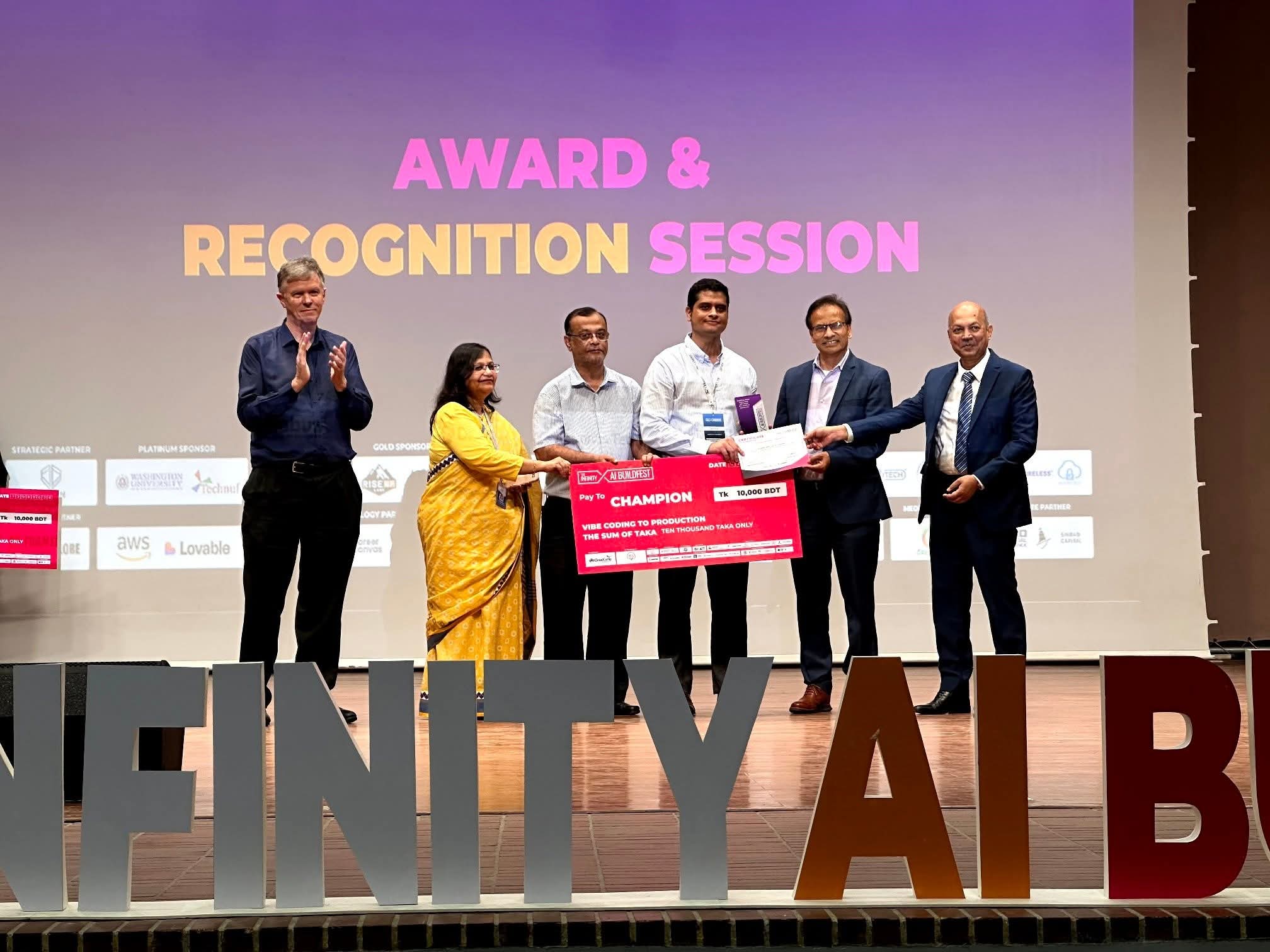
Inside Bangladesh's Largest AI Hackathon: Expert Judge Md. Bazlur Rahman Likhon on What Makes AI Production-Ready
Expert Judge · THE INFINITY AI BUILDFEST 2026 · CloudCamp Bangladesh × BRAC University · 12 June 2026
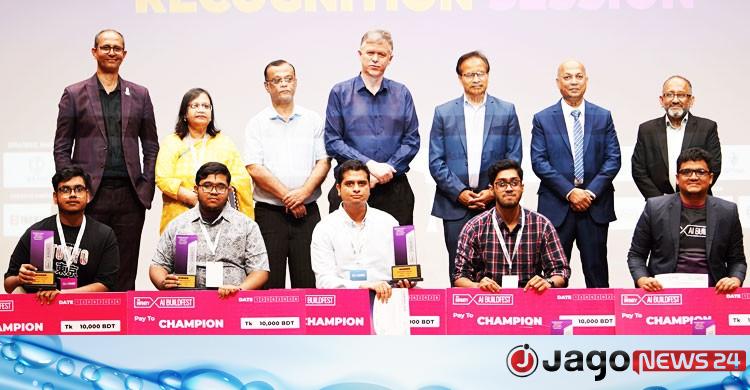
When CloudCamp Bangladesh assembled eleven independent expert judging panels for THE INFINITY AI BUILDFEST 2026, the qualification they were looking for was straightforward: practitioners with direct experience building and deploying the categories of AI systems they were being asked to evaluate.
Md. Bazlur Rahman Likhon was among the practitioners selected to serve as an Expert Judge at the event.
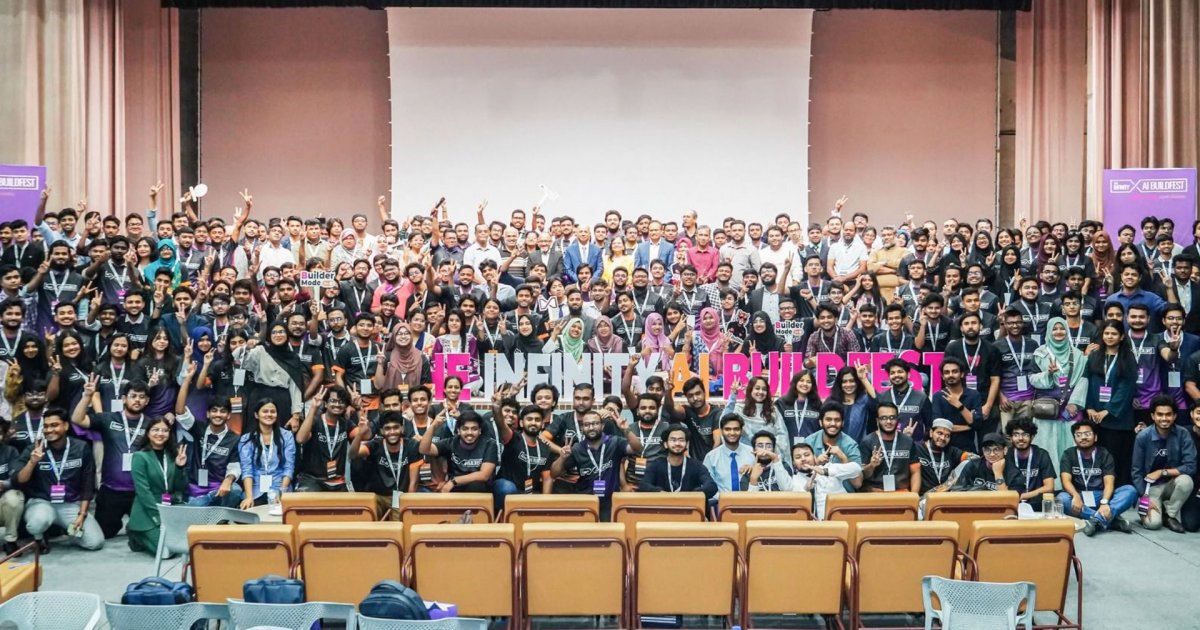
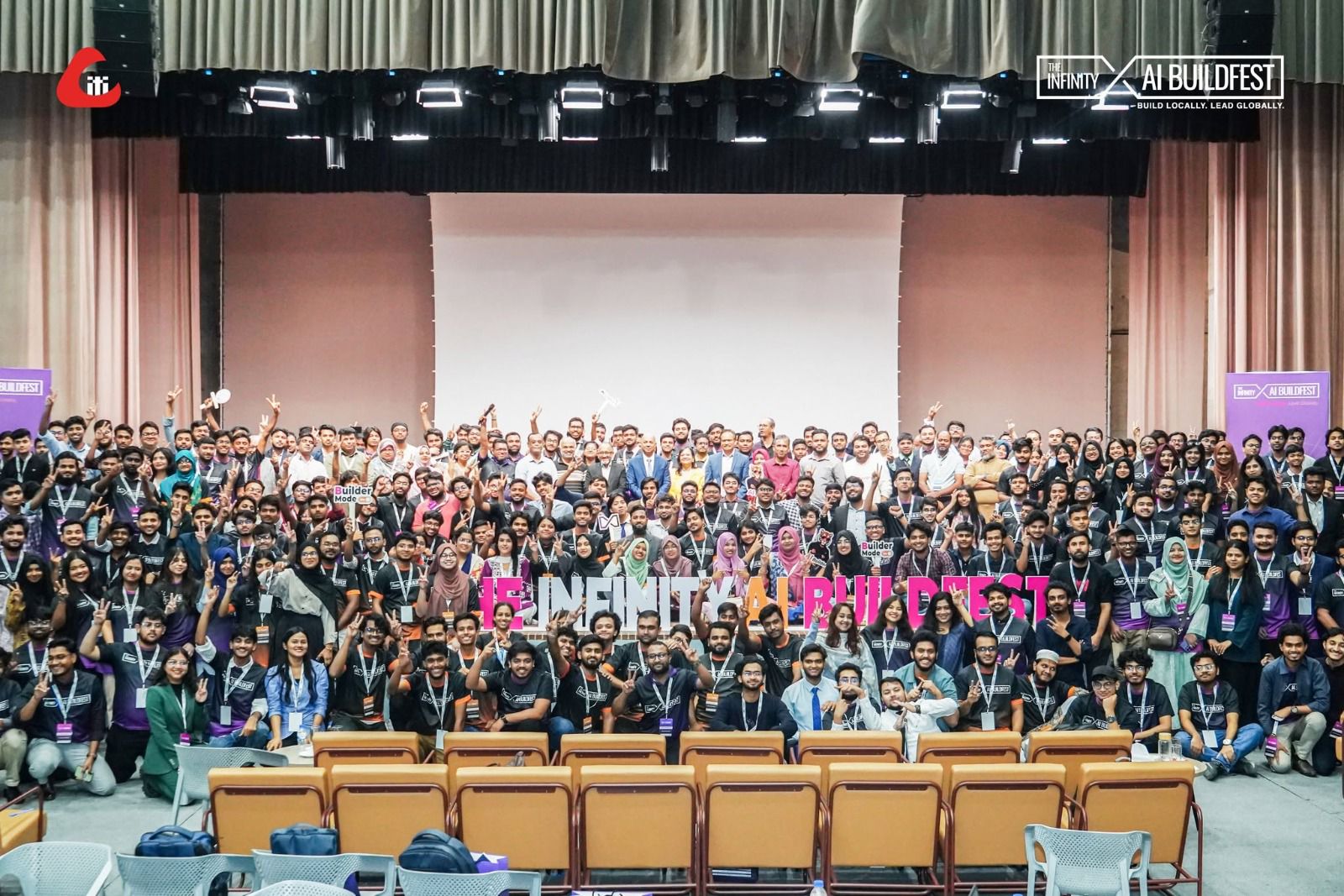
On 12 June 2026, at BRAC University's Dhaka campus, Likhon joined ten other expert judges in evaluating more than 200 live AI system demonstrations across five innovation tracks — before senior officials from Bangladesh's government and national media coverage spanning seven outlets. The event, organized by CloudCamp Bangladesh and co-organized by BRAC University, attracted 3,500+ registrations, brought 208 selected teams to the final round, and drew over 1,000 on-site AI builders — making it Bangladesh's largest AI hackathon to date.
The Event That Raised the Bar
THE INFINITY AI BUILDFEST 2026 was not a university showcase or a weekend sprint. It was a full-day national AI competition — 7:00 AM to 8:00 PM — structured around live demonstrations, independent panel scoring, and an award ceremony attended by senior government figures including Chief Guest Dr. Nazrul Islam, Secretary of the Ministry of Foreign Affairs; Special Guest Dr. Dave Dowland, Registrar of BRAC University; and Special Guest Muhammad Anwar Uddin, Additional Secretary of the ICT Division.
The closing ceremony was hosted by Mohammad Mahdee-uz-Zaman, Founder and Chairman of CloudCamp Bangladesh, with co-host representation from Associate Professor Dr. Sadia Hamid Kazi of the Department of CSE, BRAC University — who also co-signed Likhon's Certificate of Appreciation.
The tagline — Build Locally. Lead Globally. — was a deliberate positioning statement: that Bangladeshi engineers are not merely consumers of global AI tools but builders capable of producing solutions competitive at any scale. The track results bore that out:
| Track | Champion | Runner-Up |
|---|---|---|
| MarTech | Breaking BRAC (BRAC University) | InnoAiVerse (Flowgenx.ai) |
| EdTech | The Tokenizers (Daffodil International University) | Orbit SaaS (RUET) |
| HealthTech | Duoguard (Daffodil International University) | Team CCN (CUET) |
| E-Commerce | Ghost Hunter (Milestone College) | NITER_Xenovariants (NITER) |
| InfoTech | CyberShield AI (BIJA) | NISH / RoBenDevs |
Eleven independent expert judging panels evaluated 208 finalist teams across five innovation tracks: EdTech, MarTech, HealthTech, E-Commerce, and InfoTech. Teams presented working systems rather than slide decks and were assessed on technical depth, practical feasibility, production readiness, real-world impact, and quality of execution. Despite the diversity of domains, the strongest teams shared a common set of characteristics. Certain patterns emerged repeatedly throughout the day.
What Experienced Judges See That Others Miss
The phrase "production-ready" is one of the most overused in the AI industry — and one of the most revealing when applied under pressure. Evaluating 200-plus live systems in a single day compresses what normally takes months of code review, architecture discussions, and integration testing into a focused, real-time assessment. What emerges, for an experienced practitioner, is a set of signals that consistently separate deployable work from impressive demos.
Failure mode awareness. The teams that scored best were not necessarily the ones with the most impressive outputs. They were the ones that understood where their system would break. When a judge asks "what happens when the input data is noisy?" or "how does the model behave at the edge of its training distribution?", the quality of the answer tells more about production readiness than any demo can. Teams that had mapped their failure surfaces — and built around them — were immediately distinguishable from teams that had only optimized for the ideal case.[1]
Architecture over feature count. A team that built one thing on a sound, scalable architecture consistently showed more production potential than a team that built five features on brittle scaffolding. Feature count is a vanity metric in production AI. The architectural question is whether the system can absorb change — in data, in load, in requirements — without collapsing. That judgment requires having been on the receiving end of a production system under stress. It is not something a rubric captures.
Problem-solution precision. Some of the most technically impressive submissions had the loosest connection between the AI system and the stated problem. Conversely, some of the most compelling work was architecturally modest but precisely calibrated to a real and specific need. The ability to define a problem clearly enough that an AI solution can actually solve it — not approximate it, not correlate with it, but solve it — is the most underrated competency in applied AI. It showed in the teams that came with user research, domain constraints, and defined failure criteria rather than just a working model.
Deployment thinking. The distance between "we built this" and "we deployed this" is where most AI projects stall. Judges noticed immediately when teams had thought through latency, cost at scale, data privacy, and integration surface — the operational layer that a research-mode engineer rarely touches. Teams that could speak to inference costs, API rate limits, or data governance were signaling something more important than technical capability: operational maturity.
Ownership of limitations. The most credible presentations were not the ones that claimed the most. They were the ones that clearly stated what the system does not do, where it underperforms, and what the next development milestone is. Intellectual honesty in a competition context is a rare quality — and a reliable proxy for how a team will behave when a production system fails at 2:00 AM.
These observations are not specific to a Bangladesh AI hackathon. They are consistent with what distinguishes production-grade AI engineering from prototype culture in any market. What made the BuildFest valuable as a judging experience was the density: 208 teams across five domains in a single day forces a calibration that months of individual client engagements do not.
The Official Recognition
The Certificate of Appreciation and Judge's crest issued to Md. Bazlur Rahman Likhon by CloudCamp Bangladesh and BRAC University, 12 June 2026.
Likhon's judging role is formally documented through the Certificate of Appreciation jointly issued by CloudCamp Bangladesh and BRAC University, signed by Founder & Chairman Mohammad Mahdee-uz-Zaman and Associate Professor Dr. Sadia Hamid Kazi.
The certificate reads: "Your guidance, expertise, evaluation, and professional insight played an important role in supporting young AI builders and strengthening practical AI solution development." The accompanying Judge's crest is inscribed: JUDGE — Md. Bazlur Rahman Likhon — Senior Cloud AI Engineer — UPSTRA COMMUNICATIONS LIMITED.
Seven national media outlets covered the event — The Daily Star, Daily ICT News, ITV BD, TechVision24, BV News 24, Jago News 24, and Spotlight News 24 — providing independent third-party documentation of both the event's scale and its participants.




About Md. Bazlur Rahman Likhon
Md. Bazlur Rahman Likhon is a Senior Cloud & AI Engineer based in Dhaka, Bangladesh. Over the past six years, he has delivered AI and cloud solutions for organizations across Bangladesh, the United States, the United Kingdom, Japan, and China. His work spans enterprise Generative AI platforms, Retrieval-Augmented Generation systems, voice AI automation, biometric identity platforms, intelligent document processing, and multi-cloud AI infrastructure.
Earlier in 2026, Likhon ranked #3 among 192,660 participants in the Google Cloud Gen AI Academy APAC Edition 2026, becoming the only Bangladeshi to place in the Top 10 across nine Asia-Pacific countries. His finalist project, CropMind, was later presented at the APAC Virtual Finale.
He holds professional certifications across Google Cloud, Microsoft Azure, Oracle Cloud, and Proofpoint, spanning machine learning engineering, data infrastructure, cloud security, and generative AI.
Why Practitioners Matter in AI Evaluation
Ecosystem events like THE INFINITY AI BUILDFEST 2026 move an ecosystem forward only when the practitioners in the room take the evaluation seriously. Likhon spent 12 June 2026 doing exactly that — not as a figurehead, but as one of eleven working judges applying production-engineering standards to 208 teams of Bangladesh's most ambitious AI builders.
The certificate and the crest formally recognize the contribution. The more important outcome is less visible: helping establish the standards by which Bangladesh's next generation of AI builders will be evaluated. In an industry crowded with prototypes, those standards matter.