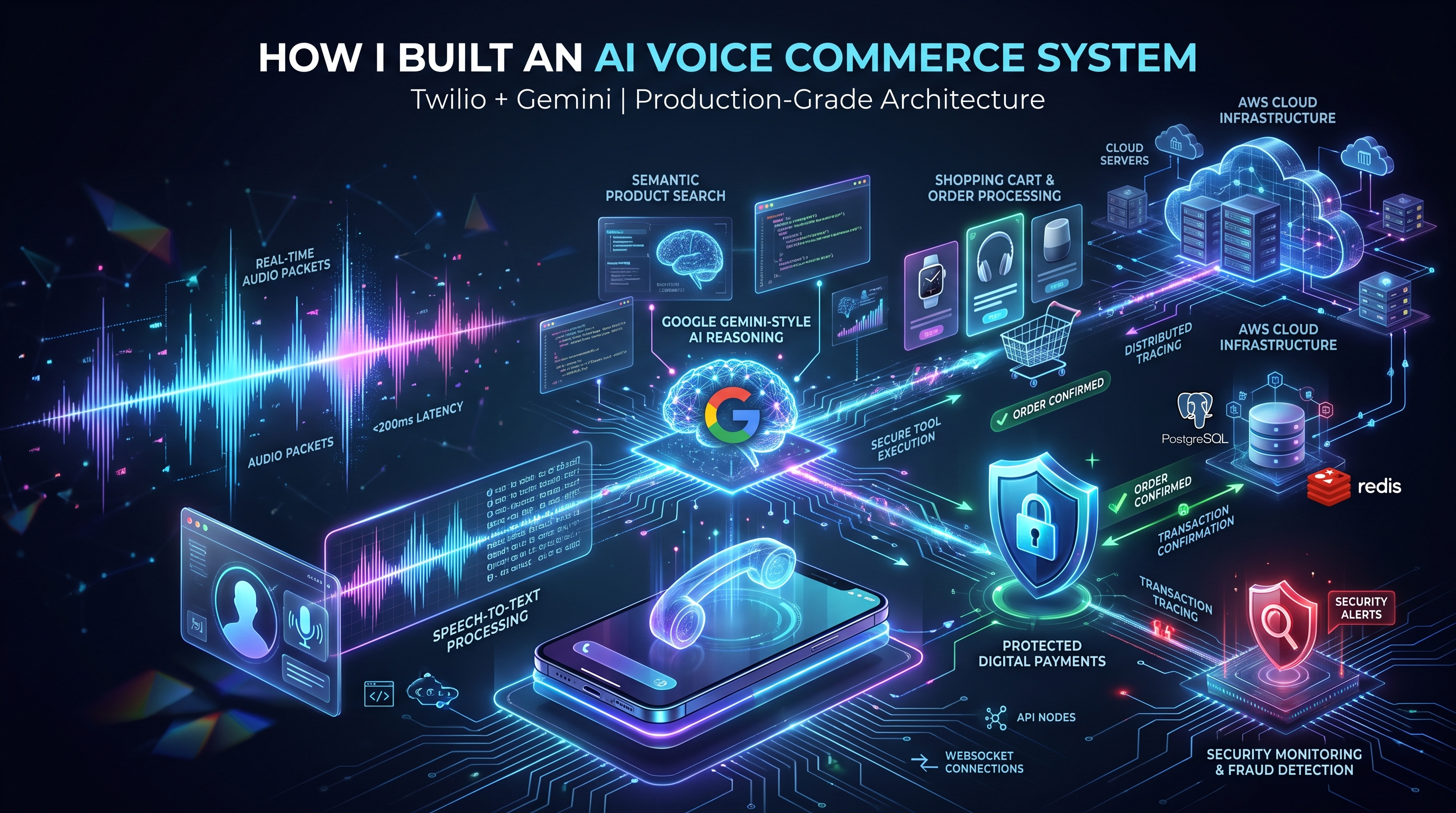
How to Build an AI Voice Commerce System with Twilio, Gemini, FastAPI, and PostgreSQL
A modern phone call can do far more than route a customer through an interactive voice response menu. With real-time media streaming, speech recognition, a language model, controlled backend tools, and transactional services, a call can become a conversational interface for product discovery, order management, customer support, and commerce.
This article presents a production-oriented reference architecture for an AI voice commerce system built with:
- Twilio Programmable Voice and Media Streams
- Google Cloud Speech-to-Text
- the Gemini API
- Python and FastAPI
- PostgreSQL with pgvector
- Redis
- AWS ECS on Fargate
- OpenTelemetry
- a PCI-compliant payment provider
The goal is not to present a universal benchmark or a copy-and-paste production system. Real latency, accuracy, throughput, availability, and cost depend on call geography, model choice, network conditions, audio quality, traffic patterns, and implementation details. Instead, this guide focuses on architectural patterns that can be tested, measured, and hardened for a specific deployment.
Table of Contents
- What Is AI Voice Commerce?
- System Goals and Non-Goals
- High-Level Architecture
- Technology Stack
- Twilio Call Ingress and Media Streaming
- Real-Time Speech-to-Text
- Gemini as a Controlled Reasoning Layer
- Conversation State and Orchestration
- Semantic Product Search with PostgreSQL and pgvector
- Safe Tool Invocation
- Order and Payment Architecture
- Latency Engineering
- Security and Abuse Prevention
- AWS Deployment Architecture
- Scaling and High Availability
- Observability and Monitoring
- Cost Modeling
- Common Implementation Mistakes
- Production Readiness Checklist
- Final Thoughts
What Is AI Voice Commerce?
AI voice commerce combines telephony, speech processing, language models, business logic, data systems, and payment infrastructure to let customers complete commercial tasks through natural conversation.
A typical system includes the following layers:
| Component | Responsibility |
|---|---|
| Telephony platform | Receives and controls PSTN or VoIP calls |
| Media streaming | Sends call audio to the application and, for bidirectional streams, sends generated audio back |
| Speech-to-text | Converts live audio into interim and final transcripts |
| Language model | Classifies intent, extracts entities, generates responses, or requests approved tools |
| Orchestrator | Maintains state, applies business rules, handles retries, and coordinates services |
| Product search | Retrieves relevant products using structured filters, full-text search, vectors, or a hybrid approach |
| Transaction services | Checks inventory, creates orders, applies idempotency, and handles payment workflows |
| Security controls | Validates requests, limits abuse, constrains model actions, and protects sensitive data |
| Observability | Captures traces, metrics, logs, business outcomes, and security events |
The important distinction is that the language model should not be the system of record. It can interpret a request and propose an action, but deterministic application code must validate and execute that action.
System Goals and Non-Goals
A practical AI voice commerce platform may support:
- conversational product discovery
- product comparison and question answering
- authenticated order status checks
- cart creation and order confirmation
- payment handoff or tokenized payment flows
- CRM and support-system updates
- escalation to a human agent
- interruption handling and conversation recovery
- multilingual or locale-specific experiences
The architecture should also define what the assistant cannot do. Examples include changing prices without authorization, exposing internal prompts, reading full payment credentials, issuing unrestricted refunds, or executing arbitrary functions.
A production target should be written as a set of measurable service-level indicators rather than a marketing claim. Useful indicators include:
- time to first transcript
- final-transcript delay after the user stops speaking
- model time to first token
- tool execution latency
- text-to-speech time to first audio
- end-to-end response-start latency
- task-completion rate
- transfer-to-human rate
- order error rate
- payment failure rate
- security challenge and block rates
High-Level Architecture
The core call path looks like this:
Caller
  |
  v
Twilio Programmable Voice
  |
  |  TwiML + secure WebSocket
  v
FastAPI Voice Gateway
  |
  +--> Streaming Speech-to-Text
  |
  +--> Conversation Orchestrator
  |       |
  |       +--> Gemini reasoning / structured decision
  |       +--> Customer and session data
  |       +--> Product search
  |       +--> Inventory and order services
  |       +--> Payment provider
  |       +--> CRM or support platform
  |
  +--> Text-to-Speech or audio-generation service
  |
  v
Twilio bidirectional Media Stream
  |
  v
Caller
Twilio's TwiML instruction sends call audio to a WebSocket server in near real time. creates a unidirectional stream, while creates a bidirectional stream that can receive audio from the application. Twilio requires a secure wss URL for Media Streams. Twilio documents these behaviors in its reference.
For bidirectional streams, Twilio sends inbound call audio as base64-encoded audio/x-mulaw at 8 kHz with one channel, and the application must use the same format when sending audio back. The WebSocket message reference documents the event types and media format.
Technology Stack
| Layer | Suggested technology | Why it fits |
|---|---|---|
| Telephony | Twilio Programmable Voice | PSTN connectivity, TwiML, webhooks, call control, and Media Streams |
| API and WebSocket gateway | FastAPI | Python async support, HTTP endpoints, and WebSocket handling |
| Speech recognition | Google Cloud Speech-to-Text | Streaming recognition and interim results |
| Reasoning | Gemini API | Structured outputs and function-calling support |
| Primary database | PostgreSQL | Transactional consistency and relational modeling |
| Vector search | pgvector | Vector similarity search inside PostgreSQL |
| Session and hot cache | Redis | Fast external session storage and rate-limit counters |
| Runtime | Amazon ECS on AWS Fargate | Managed container execution without managing EC2 hosts |
| Load balancing | Application Load Balancer | HTTP/HTTPS routing to ECS services |
| Observability | OpenTelemetry plus a telemetry backend | Vendor-neutral traces, metrics, and logs |
| Payments | Stripe or another PCI-compliant provider | Tokenized payment collection and payment orchestration |
Model names and API versions change. For production, pin an explicitly supported stable model instead of relying on an experimental alias. Google's model documentation recommends specific stable model identifiers for production applications and lists preview, latest, experimental, and deprecated variants separately. Review the current Gemini models before deployment.
Twilio Call Ingress and Media Streaming
1. Receive the call webhook
When a customer calls a Twilio number, Twilio sends an HTTP request to the configured voice webhook. The application responds with TwiML that controls the call.
A simplified FastAPI handler can return a bidirectional stream:
import os

from fastapi import FastAPI, HTTPException, Request
from fastapi.responses import Response
from twilio.request_validator import RequestValidator

app = FastAPI()


def external_request_url(request: Request) -> str:
    """Return the exact public URL Twilio used.

    In deployments behind a reverse proxy or load balancer, configure trusted
    forwarded headers and reconstruct the public scheme and host correctly.
    """
    return str(request.url)


@app.post("/twilio/voice")
async def handle_voice_webhook(request: Request) -> Response:
    form = await request.form()
    signature = request.headers.get("X-Twilio-Signature", "")

    validator = RequestValidator(os.environ["TWILIO_AUTH_TOKEN"])
    is_valid = validator.validate(
        external_request_url(request),
        dict(form),
        signature,
    )

    if not is_valid:
        raise HTTPException(status_code=403, detail="Invalid Twilio signature")

    twiml = """<?xml version="1.0" encoding="UTF-8"?>


"""

    return Response(content=twiml, media_type="application/xml")
Twilio cryptographically signs webhook requests and sends the signature in the X-Twilio-Signature header. Twilio recommends validating the signature with an official SDK and using the exact URL and request parameters seen by Twilio. Reverse proxies can change the scheme or host visible to the application, so proxy configuration must be tested carefully. Twilio's security guide explains the validation process, and its Python tutorial uses RequestValidator. See the official Python validation example.
2. Process WebSocket events
Twilio sends connected, start, media, and stop events to the WebSocket server. A minimal receiver looks like this:
import base64
from fastapi import WebSocket, WebSocketDisconnect


@app.websocket("/ws/media")
async def media_stream(websocket: WebSocket) -> None:
    await websocket.accept()
    call_sid: str | None = None
    stream_sid: str | None = None

    try:
        while True:
            message = await websocket.receive_json()
            event = message.get("event")

            if event == "start":
                call_sid = message["start"]["callSid"]
                stream_sid = message["start"]["streamSid"]
                await start_call_session(call_sid, stream_sid)

            elif event == "media":
                audio_bytes = base64.b64decode(
                    message["media"]["payload"]
                )
                await enqueue_audio(call_sid, audio_bytes)

            elif event == "stop":
                await close_call_session(call_sid)
                break

    except WebSocketDisconnect:
        await close_call_session(call_sid)
In a real implementation, keep the receive loop lightweight. Decode, validate, timestamp, and enqueue audio; do not block the WebSocket while waiting for speech recognition, model inference, database queries, or text-to-speech.
3. Support interruption
A voice agent should stop speaking when the caller interrupts. For a bidirectional Twilio Media Stream, the application can send a clear message to remove buffered outbound audio. Use mark messages to correlate sent audio with playback completion. These message types are documented in Twilio's Media Streams WebSocket reference.
Real-Time Speech-to-Text
Batch transcription is a poor fit for conversational telephony because the application needs partial results while the caller is speaking. Google Cloud Speech-to-Text supports streaming recognition, which returns recognition results as audio is processed. Google documents streaming recognition and provides language-specific samples.
Twilio's inbound media format is μ-law, 8 kHz, mono. Google Cloud Speech-to-Text supports MULAW, and its documentation describes μ-law as 8-bit companded audio. See Google's audio-encoding documentation.
A simplified configuration is:
from google.cloud import speech_v1 as speech

recognition_config = speech.RecognitionConfig(
    encoding=speech.RecognitionConfig.AudioEncoding.MULAW,
    sample_rate_hertz=8000,
    language_code="en-US",
    enable_automatic_punctuation=True,
    model="phone_call",
)

streaming_config = speech.StreamingRecognitionConfig(
    config=recognition_config,
    interim_results=True,
    single_utterance=False,
)
Interim versus final transcripts
Use interim transcripts for low-risk speculative work, such as:
- detecting likely intent
- prefetching a customer profile
- warming a product search
- preparing a likely response template
Do not place an order, charge a payment method, cancel an order, or change customer data from an interim transcript. Commit side effects only after the final transcript is available and the business rules are satisfied.
Improve recognition quality
Telephony audio is narrowband and lossy, so accuracy varies with line quality, background noise, accent, language, and product vocabulary. Improve results by:
- using the audio's native sample rate instead of unnecessary resampling
- selecting a suitable recognition model and locale
- supplying phrase hints or adaptation for product names where supported
- tracking confidence and re-prompting when confidence is low
- adding DTMF or human-agent fallback for critical identifiers
- testing with real call recordings collected under an appropriate consent and retention policy
Avoid publishing a universal word-error-rate claim unless it comes from a reproducible evaluation set that matches the deployment environment.
Gemini as a Controlled Reasoning Layer
The language model should interpret conversation, not own business state or directly execute unrestricted actions.
Gemini supports structured outputs that follow a JSON Schema and function calling that lets the model request application-defined tools. Google's documentation distinguishes the two: structured output is suitable when the final model response must match a schema, while function calling is designed for requesting actions or external data. The application remains responsible for executing the function. See the Gemini structured-output guide and function-calling guide.
Use a stable SDK and model
Google's current Python SDK is google-genai:
pip install google-genai pydantic
The SDK is maintained in Google's official googleapis/python-genai repository. Review the official SDK repository and release notes.
Define a structured decision contract
import os
from typing import Literal

from google import genai
from google.genai import types
from pydantic import BaseModel, Field


class ProductFilters(BaseModel):
    category: str | None = None
    minimum_price: float | None = Field(default=None, ge=0)
    maximum_price: float | None = Field(default=None, ge=0)
    requested_features: list[str] = Field(default_factory=list)


class VoiceDecision(BaseModel):
    intent: Literal[
        "product_search",
        "product_question",
        "select_product",
        "place_order",
        "check_order_status",
        "cancel_order",
        "request_human",
        "clarify",
    ]
    confidence: float = Field(ge=0, le=1)
    filters: ProductFilters | None = None
    product_id: int | None = None
    response_text: str


client = genai.Client(api_key=os.environ["GEMINI_API_KEY"])

SYSTEM_INSTRUCTION = """
You are a voice-commerce reasoning component.
Return only information allowed by the supplied response schema.
Never claim that an action succeeded until the application provides a tool result.
Never request a tool outside the approved workflow.
For payments, refunds, cancellations, or order placement, require explicit confirmation.
Keep spoken responses concise and easy to understand over a phone call.
"""


def decide(transcript: str, context_summary: str) -> VoiceDecision:
    response = client.models.generate_content(
        model=os.environ.get("GEMINI_MODEL", "gemini-3.6-flash"),
        contents=(
            f"Conversation context:\n{context_summary}\n\n"
            f"Customer transcript:\n{transcript}"
        ),
        config=types.GenerateContentConfig(
            system_instruction=SYSTEM_INSTRUCTION,
            response_mime_type="application/json",
            response_json_schema=VoiceDecision,
            temperature=0.2,
        ),
    )
    return VoiceDecision.model_validate_json(response.text)
Before deploying, verify that the selected model identifier is available in the target API and region. Model availability and deprecation status change over time.
Do not expose private chain-of-thought
A production schema does not need an unrestricted reasoning field. Store auditable decision data such as intent, confidence, selected policy, tool requested, validation result, and tool outcome. This provides operational traceability without relying on hidden model reasoning.
Conversation State and Orchestration
Voice conversations are not linear. Callers interrupt, revise constraints, ask follow-up questions, and change goals. A finite-state machine or workflow engine makes allowed transitions explicit.
from enum import StrEnum


class CallState(StrEnum):
    GREETING = "greeting"
    LISTENING = "listening"
    SEARCHING = "searching"
    REVIEWING = "reviewing"
    AWAITING_CONFIRMATION = "awaiting_confirmation"
    PROCESSING_ORDER = "processing_order"
    COMPLETED = "completed"
    ESCALATING = "escalating"
    ENDED = "ended"


ALLOWED_TRANSITIONS: dict[CallState, set[CallState]] = {
    CallState.GREETING: {CallState.LISTENING},
    CallState.LISTENING: {
        CallState.SEARCHING,
        CallState.REVIEWING,
        CallState.ESCALATING,
        CallState.ENDED,
    },
    CallState.SEARCHING: {
        CallState.REVIEWING,
        CallState.LISTENING,
        CallState.ESCALATING,
    },
    CallState.REVIEWING: {
        CallState.SEARCHING,
        CallState.AWAITING_CONFIRMATION,
        CallState.LISTENING,
        CallState.ESCALATING,
    },
    CallState.AWAITING_CONFIRMATION: {
        CallState.PROCESSING_ORDER,
        CallState.REVIEWING,
        CallState.ENDED,
    },
    CallState.PROCESSING_ORDER: {
        CallState.COMPLETED,
        CallState.REVIEWING,
        CallState.ESCALATING,
    },
    CallState.COMPLETED: {CallState.LISTENING, CallState.ENDED},
    CallState.ESCALATING: {CallState.ENDED},
    CallState.ENDED: set(),
}
The orchestrator should own:
- the current state
- a compact conversation summary
- selected products and quantities
- authentication status
- confirmation status
- idempotency keys
- tool outcomes
- retry counts
- risk decisions
- human-handoff context
Keep state outside individual application containers. Redis is useful for short-lived call sessions, while PostgreSQL should store durable business records and audit events.
Semantic Product Search with PostgreSQL and pgvector
Voice queries often describe needs rather than exact product names:
“I need a lightweight laptop for travel with strong battery life and a budget under $1,000.”
A robust search flow combines:
- deterministic filters for price, availability, brand, region, and policy constraints
- full-text or lexical search for exact terms and identifiers
- vector similarity for semantic relevance
- optional re-ranking using business rules or a dedicated ranking model
pgvector adds vector similarity search to PostgreSQL and supports exact and approximate nearest-neighbor search, including cosine distance. Its <=> operator represents cosine distance, and cosine similarity can be calculated as 1 - distance. See the official pgvector documentation.
SELECT
    id,
    name,
    description,
    price,
    1 - (embedding <=> $1::vector) AS cosine_similarity
FROM products
WHERE is_active = TRUE
  AND inventory_available > 0
  AND price >= $2
  AND price <= $3
ORDER BY embedding <=> $1::vector
LIMIT 5;
Do not tell a caller that a product is available or at a specific price based only on a vector index. Read authoritative inventory and pricing data before presenting or confirming the result.
Hybrid-search design
A useful ranking formula might combine:
final_score =
    semantic_similarity
  + lexical_match_weight
  + availability_weight
  + business_priority_weight
  - policy_penalty
Document every weight, test it on a labeled query set, and monitor whether ranking changes hurt conversion, relevance, or fairness.
Safe Tool Invocation
The model may select an action, but backend code must authorize it.
from collections.abc import Awaitable, Callable
from typing import Any

Tool = Callable[..., Awaitable[dict[str, Any]]]


class ToolRegistry:
    def __init__(self) -> None:
        self._tools: dict[str, Tool] = {
            "search_products": search_products,
            "get_product_details": get_product_details,
            "create_order": create_order,
            "check_order_status": check_order_status,
        }

        self._intent_acl: dict[str, set[str]] = {
            "product_search": {"search_products"},
            "product_question": {"get_product_details"},
            "place_order": {"create_order"},
            "check_order_status": {"check_order_status"},
        }

    async def dispatch(
        self,
        *,
        intent: str,
        tool_name: str,
        arguments: dict[str, Any],
        session: "CallSession",
    ) -> dict[str, Any]:
        if tool_name not in self._intent_acl.get(intent, set()):
            raise PermissionError("Tool is not allowed for this intent")

        validated = validate_tool_arguments(tool_name, arguments)
        enforce_session_permissions(tool_name, session)
        enforce_confirmation_policy(tool_name, session)

        tool = self._tools.get(tool_name)
        if tool is None:
            raise LookupError("Unknown tool")

        return await tool(**validated)
Required guardrails include:
- strict tool allowlists
- typed argument validation
- authorization based on the authenticated customer
- explicit confirmation for consequential actions
- quantity and value limits
- idempotency keys
- timeouts and bounded retries
- safe error mapping
- audit logging without sensitive payloads
OWASP identifies prompt injection, insecure output handling, and excessive agency as important risks in LLM applications. The practical response is layered control: treat model output as untrusted, validate it, minimize available privileges, and require deterministic authorization before executing actions. See the OWASP GenAI Security Project.
Order and Payment Architecture
Order placement should be a transactional workflow, not a single model response.
1. Re-read authoritative product price and availability
2. Confirm product, quantity, delivery details, and total
3. Create an idempotency key for the confirmed action
4. Reserve inventory or use an equivalent concurrency control
5. Create the payment request through the payment provider
6. Commit the order only after the required payment state is reached
7. Release inventory when the workflow fails or expires
8. Generate the receipt from persisted order data
Never collect raw card data in the model context
Use the payment provider's approved collection and tokenization flow. Stripe describes tokenization as collecting sensitive payment details directly and exchanging them for a token so sensitive card data does not touch the merchant's server. PCI compliance remains a shared responsibility between the payment provider and the business. See Stripe's token documentation and integration security guide.
Depending on jurisdiction, provider capability, and risk appetite, a voice workflow may:
- send a secure payment link by SMS
- transfer the caller to a PCI-compliant payment flow
- use a previously stored payment method after strong customer verification
- collect non-sensitive confirmation while the provider handles sensitive fields
Consult qualified security, privacy, payments, and legal specialists before processing payment information over voice.
Latency Engineering
There is no universal latency number that every voice commerce system can guarantee. A meaningful latency budget must separate user speech time, endpointing, network transport, recognition, model inference, tool execution, synthesis, and playback.
Track at least these timestamps:
t0: last inbound audio frame for the utterance
t1: final transcript emitted
t2: model request started
t3: first model output or decision available
t4: tool request started
t5: tool result available
t6: first TTS/audio chunk available
t7: first outbound audio sent
t8: first outbound audio played to caller
Useful derived metrics include:
endpointing_delay = t1 - t0
model_latency = t3 - t2
tool_latency = t5 - t4
tts_time_to_first_audio = t6 - t5
response_start_latency = t8 - t0
Techniques that reduce perceived delay
Stream each stage
Use streaming recognition, streaming model output where appropriate, and streaming audio generation. Google's Gemini documentation supports streaming responses, while Twilio's bidirectional stream can receive outbound media frames.
Parallelize independent work
Fetch customer context and prepare likely product data while the intent decision is running, provided the work has no side effects.
profile_task = asyncio.create_task(load_customer_profile(customer_id))
decision_task = asyncio.create_task(classify_intent(transcript, context))

profile, decision = await asyncio.gather(profile_task, decision_task)
Keep connections warm
Reuse HTTP clients, database pools, Redis connections, and model clients. Avoid loading large local embedding models inside a request handler.
Use short spoken turns
A phone response should usually present one decision or a small set of options at a time. Shorter output improves comprehension, interruption handling, and time to first useful information.
Prefetch carefully
Interim transcripts can trigger read-only prefetching, but side effects must wait for final input, authorization, and confirmation.
Benchmark honestly
Publish latency percentiles only when the test method is documented. Include:
- test region and caller geography
- number of calls and duration
- warm versus cold traffic
- audio format and language
- concurrency distribution
- exact model and API versions
- whether values are server-side or caller-perceived
- P50, P95, and P99
- failure and timeout definitions
Security and Abuse Prevention
An internet-facing telephony application has several attack surfaces: public webhooks, WebSockets, the model interface, tool APIs, payment workflows, customer identity flows, and operational dashboards.
Defense-in-depth flow
Incoming call or webhook
  |
  +--> TLS and Twilio signature validation
  +--> account, number, and network-level rate controls
  +--> session and replay checks
  +--> customer authentication when required
  +--> transcript and input policy checks
  +--> constrained model decision
  +--> schema validation
  +--> tool allowlist and authorization
  +--> explicit confirmation for consequential actions
  +--> idempotent transaction execution
  +--> redacted audit and security logging
Prompt injection
Prompt injection cannot be solved by a system prompt alone. Treat every transcript, retrieved product description, CRM note, and tool result as untrusted data.
Practical controls include:
- separate instructions from user and retrieved data
- provide the model with the minimum necessary context
- use typed outputs or function declarations
- reject unknown intents, fields, and tools
- validate model output before use
- restrict tool permissions by task and customer identity
- require confirmation for purchases, cancellations, refunds, and account changes
- cap tool loops, token use, and execution time
- monitor unusual tool-request patterns
- keep secrets and payment data out of prompts
Rate limiting and abuse controls
Rate limits should not rely on a single identifier. Combine signals such as:
- account or tenant
- destination number
- source number, where appropriate
- call velocity
- repeated failed authentication
- repeated payment failures
- repeated identical requests
- unusual order value or quantity
- infrastructure-level network signals
A risk score should guide proportional actions such as monitoring, requiring additional verification, limiting high-risk tools, transferring to a human, or blocking. Test the system for false positives and review the privacy and fairness implications of any behavioral features.
Sensitive-data handling
- redact or avoid storing full transcripts when they are not required
- never log card details, secrets, access tokens, or authentication answers
- encrypt data in transit and at rest
- use a documented retention schedule
- limit employee and service access by role
- record administrative access to sensitive systems
- provide appropriate call-recording and AI-use disclosures
- comply with applicable consent, privacy, consumer-protection, and telemarketing laws
AWS Deployment Architecture
A straightforward AWS deployment can use:
Route 53
  |
AWS WAF
  |
Application Load Balancer
  |
Amazon ECS Service on AWS Fargate
  |        |         |
  |        |         +--> OpenTelemetry Collector / telemetry backend
  |        +------------> ElastiCache for Redis
  +---------------------> Amazon RDS for PostgreSQL
                           |
                           +--> Multi-AZ high availability
                           +--> optional read replicas for read scaling
Amazon ECS services can maintain a desired number of tasks, replace failed tasks, run behind a load balancer, and use Application Auto Scaling. AWS documents Application Load Balancers for HTTP/HTTPS routing to ECS tasks and Network Load Balancers for layer-4 TCP or UDP requirements. See the ECS load-balancing guide.
AWS Fargate charges for requested compute, memory, operating system, architecture, and storage resources for running tasks. See the official AWS Fargate pricing page.
Correctly separate high availability from read scaling
For Amazon RDS for PostgreSQL:
- a Multi-AZ deployment provides high availability and failover
- a traditional standby in a Multi-AZ DB instance deployment does not serve read traffic
- read replicas are used to scale read-heavy workloads and use asynchronous replication
AWS documents these distinctions in its RDS Multi-AZ guide and read-replica guide.
Scaling and High Availability
Keep application tasks stateless
Do not depend on one container's memory for durable call state. Store session state in Redis or another shared store and persist business state in PostgreSQL.
import json


class SessionStore:
    def __init__(self, redis_client) -> None:
        self.redis = redis_client

    async def save(self, call_sid: str, payload: dict) -> None:
        await self.redis.set(
            f"call-session:{call_sid}",
            json.dumps(payload),
            ex=3600,
        )

    async def load(self, call_sid: str) -> dict | None:
        value = await self.redis.get(f"call-session:{call_sid}")
        return json.loads(value) if value else None
Scale on workload indicators
CPU alone may not reflect voice workload pressure. Consider a combination of:
- active WebSocket sessions per task
- event-loop lag
- queued audio duration
- speech-recognition backlog
- model request concurrency
- tool-call latency
- memory use
- error and timeout rate
ECS Service Auto Scaling uses Application Auto Scaling and CloudWatch metrics to adjust the desired task count. AWS supports target tracking and step scaling. See the ECS auto-scaling guidance.
Design for failure
- use timeouts around every external call
- use bounded retries with jitter only for retryable operations
- make order and payment actions idempotent
- provide a deterministic fallback response
- support DTMF for critical flows
- transfer to a human when confidence or system health is poor
- test dependency failures, partial outages, and deployment rollbacks
- drain WebSocket sessions during deployments where possible
Observability and Monitoring
OpenTelemetry is a vendor-neutral framework for generating, collecting, and exporting traces, metrics, and logs. It is not an observability backend by itself. See the OpenTelemetry documentation.
Trace one conversational turn
A trace can include spans for:
voice.turn
  +-- stt.finalize
  +-- context.load
  +-- model.decide
  +-- product.search
  +-- inventory.check
  +-- order.create
  +-- tts.first_audio
  +-- twilio.send_audio
Do not attach raw payment data or unrestricted transcripts to spans. Prefer identifiers, durations, statuses, error classes, and redacted metadata.
Essential technical metrics
- active calls and streams
- call setup failure rate
- WebSocket disconnect rate
- audio queue depth
- time to interim and final transcript
- model latency and error rate
- schema-validation failure rate
- tool-call count, latency, and error rate
- TTS time to first audio
- end-to-end response-start latency
- Redis and database latency
- rate-limit and security-rule activations
Essential business metrics
- task-completion rate
- product-search success rate
- order-confirmation rate
- purchase conversion rate
- average order value
- human-transfer rate
- caller abandonment rate
- cancellation and refund rate
- repeat-call rate
Use separate dashboards for system health, conversation quality, business outcomes, and security. Correlate them by privacy-safe call and trace identifiers.
Cost Modeling
Do not publish a universal cost per call. Twilio pricing varies by country, number type, call direction, and features. Speech-to-Text pricing depends on processed audio and tier. Gemini pricing depends on the selected model, input and output tokens, modality, caching, and service tier. AWS cost depends on region and requested resources. Review Twilio Voice pricing for the target country, Google Cloud Speech-to-Text pricing, Gemini API pricing, and AWS Fargate pricing when building the estimate.
A transparent monthly model is:
telephony_cost = inbound_minutes * telephony_rate
stt_cost = processed_audio_minutes * stt_rate
llm_cost = input_tokens * input_rate + output_tokens * output_rate
tts_cost = synthesized_units * tts_rate
compute_cost = task_vcpu_time + task_memory_time + storage
platform_cost = database + cache + load_balancer + WAF + secrets
observability_cost = ingest + retention + queries
network_cost = data_transfer + cross-region traffic
support_cost = provider_support + operational staffing

total_monthly_cost = sum(all cost categories)
unit_cost = total_monthly_cost / successfully_completed_calls
Track both cost per connected call and cost per successful outcome. A cheap call that fails to complete the task may be more expensive to the business than a slightly longer successful call.
Practical optimization levers
- route simple intents to cheaper, faster models when quality is acceptable
- cap conversation history and use a compact state summary
- cache stable catalog and FAQ data with appropriate invalidation
- avoid sending unnecessary fields to the model
- stop model generation when enough response text is available
- keep spoken answers concise
- batch offline embedding generation
- right-size Fargate, database, and Redis capacity
- use autoscaling based on actual workload signals
- sample high-volume debug telemetry while retaining errors and security events
Common Implementation Mistakes
1. Giving the model excessive authority
Risk: The model can call any function with arbitrary arguments.
Better design: Use a small tool allowlist, typed schemas, authorization, value limits, confirmation, and idempotency.
2. Treating an interim transcript as final
Risk: The system acts on words that the recognizer later changes.
Better design: Use interim results only for read-only prediction and prefetching.
3. Claiming success before a tool succeeds
Risk: The assistant says an order was placed even though the transaction failed.
Better design: Generate the confirmation from persisted tool output.
4. Mixing catalog search with authoritative commerce data
Risk: Semantic search returns an outdated price or unavailable product.
Better design: Use vectors for candidate retrieval, then re-read authoritative price and inventory.
5. Storing sessions only in process memory
Risk: A deployment or task failure loses the conversation.
Better design: Externalize session state and persist durable events.
6. Logging too much
Risk: Transcripts, payment data, or identity information leak into logs and traces.
Better design: Minimize, redact, encrypt, restrict, and expire sensitive data.
7. Using a fixed latency claim without a test method
Risk: A server-side microbenchmark is presented as caller-perceived performance.
Better design: Define timestamps, publish percentile distributions, and document conditions.
8. Confusing Multi-AZ with read scaling
Risk: The architecture assumes a standby replica handles queries.
Better design: Use Multi-AZ for availability and explicit read replicas for read scaling where appropriate.
9. Hard-coding experimental or deprecated model names
Risk: The application breaks when a model is removed.
Better design: Pin a stable supported model, monitor deprecation notices, and test upgrades.
Production Readiness Checklist
Telephony and media
- Twilio webhook signatures are validated
- the public webhook URL is reconstructed correctly behind proxies
- WebSocket authentication and origin controls are defined
- inbound media format is handled correctly
- outbound audio matches Twilio's required μ-law format
- interruption,
clear, and playback tracking are tested - call recording and AI disclosure requirements are reviewed
AI and orchestration
- model output follows a typed schema
- every intent and action is allowlisted
- consequential actions require confirmation
- the model cannot directly access secrets or unrestricted tools
- low-confidence and ambiguous requests have fallback paths
- human escalation is available
- model and SDK versions are pinned and monitored
Commerce and payments
- price and inventory are revalidated before confirmation
- orders and payments are idempotent
- raw card data never enters prompts or application logs
- the payment flow follows provider and PCI guidance
- failed workflows release reservations safely
- receipts are generated from persisted transaction data
Reliability and security
- external calls have timeouts and bounded retries
- session state survives task replacement
- rate limits use multiple signals
- sensitive data is minimized, redacted, encrypted, and expired
- dependency failures and partial outages are tested
- audit events are immutable enough for investigation needs
Observability and cost
- end-to-end traces cover each conversational turn
- latency is measured at P50, P95, and P99
- business outcomes are correlated with technical performance
- security events are monitored separately from normal errors
- provider usage and spend have budgets and alerts
- cost is measured per successful outcome, not only per call
Final Thoughts
AI voice commerce is best understood as a distributed transaction system with a conversational interface.
The phone and media layer carries audio. Speech recognition converts audio into text. Gemini interprets the request or proposes an approved action. The orchestrator enforces state and policy. PostgreSQL and commerce services remain authoritative. The payment provider handles sensitive payment workflows. Security controls constrain every transition, and observability shows whether the system is fast, reliable, safe, and commercially useful.
The most important production principle is simple:
Let the model interpret. Let deterministic systems authorize, execute, and record.
That separation makes the platform easier to test, safer to operate, and more resilient as telephony providers, speech models, language models, and infrastructure continue to evolve.
Verified Sources
- Twilio TwiML
reference - Twilio Media Streams WebSocket messages
- Twilio webhook security and signature validation
- Twilio Python request-validation tutorial
- Google Cloud Speech-to-Text streaming recognition
- Google Cloud Speech-to-Text audio encodings
- Gemini model catalog and lifecycle
- Gemini structured outputs
- Gemini function calling
- Google Gen AI Python SDK
- pgvector documentation
- OWASP Top 10 for Large Language Model Applications
- Stripe tokenization
- Stripe integration security guide
- Amazon ECS load balancing
- Amazon ECS service auto scaling
- Amazon RDS Multi-AZ deployments
- Amazon RDS read replicas
- OpenTelemetry documentation
- Twilio Voice pricing
- Google Cloud Speech-to-Text pricing
- Gemini API pricing
- AWS Fargate pricing