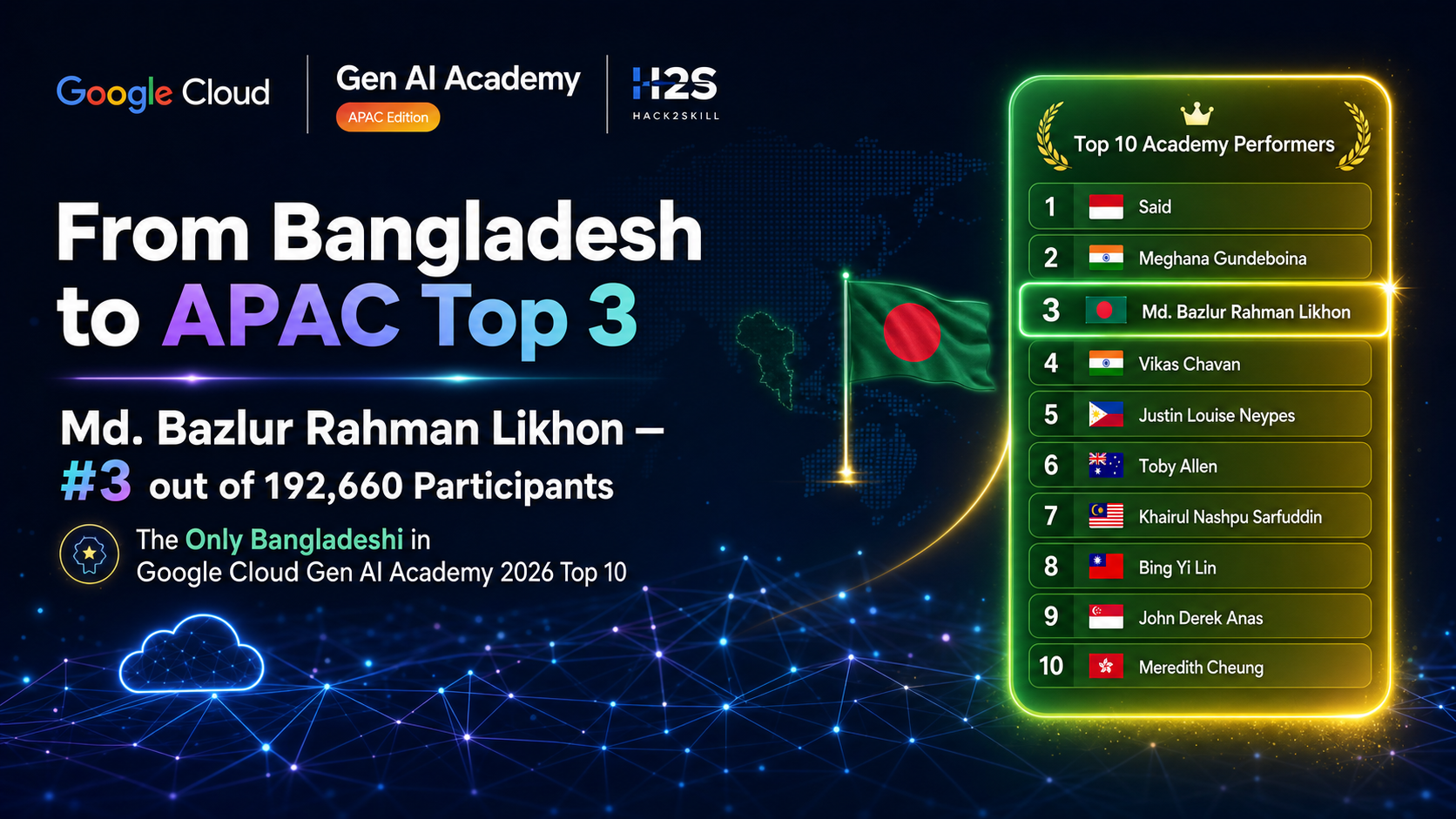
From Bangladesh to APAC Top 3: Md. Bazlur Rahman Likhon Ranked #3 Out of 192,660 Participants and Became the Only Bangladeshi in Google Cloud Gen AI Academy 2026's Top 10
In one of Asia-Pacific's largest Google Cloud Generative AI competitions, Md. Bazlur Rahman Likhon — Senior Cloud & AI Engineer from Bangladesh — placed #3 in the official Top 10 Academy Performers of the Google Cloud Gen AI Academy APAC Edition 2026 (Cohort 1), outperforming participants across nine countries from a pool of 192,660 APAC-wide registrations, and standing as the only Bangladeshi in the Top 10 — a milestone that reflects both his individual engineering depth and the rising caliber of AI talent emerging from South Asia.
Introduction
At the Virtual Finale of the Google Cloud Gen AI Academy APAC Edition 2026, Md. Bazlur Rahman Likhon's name appeared on a list that very few engineers across an entire region ever reach. Out of 192,660 registered participants spanning professional developers, students, freelancers, and startup founders from across Asia-Pacific, he ranked #3 in the official Top 10 Academy Performers — the only engineer from Bangladesh to make the list.
This is not a participation recognition. The Google Cloud Gen AI Academy is a structured, multi-stage learning and project competition program that measures both technical depth and the practical application of Generative AI on Google Cloud infrastructure. Reaching the Top 10 — and specifically the Top 3 — required competing at the same level as engineers from countries with significantly larger developer populations and more mature AI ecosystems: Indonesia, India, the Philippines, Australia, Taiwan, and Japan were all represented.
For engineering leaders, founders, and AI practitioners evaluating technical talent at the regional level, Md. Bazlur Rahman Likhon's result is a precise and verifiable signal. The competition demanded production-grade systems thinking, hands-on delivery, and the ability to build AI that works in the real world — not just in a controlled demo environment. His placement at #3 out of 192,660 reflects exactly that.
What Is the Google Cloud Gen AI Academy APAC 2026?
The Google Cloud Gen AI Academy is a multi-stage, challenge-based learning and competitive program designed to advance practical Generative AI engineering skills across the Asia-Pacific region. Cohort 1 of the APAC Edition 2026 was organized by Google Cloud in partnership with Hack2skill (H2S) — one of Asia's leading hackathon and innovation platform operators.
The program is structured as a "Build-First" experience. Participants do not just watch lectures — they complete hands-on skill labs, Codelabs assessments, and submit production-grade AI projects for competitive evaluation. Three technical tracks guided participants through different dimensions of applied AI:
- Track 1: Build and deploy AI agents using Gemini, ADK, and Cloud Run
- Track 2: Connect AI agents to real-world data and tools using Model Context Protocol (MCP)
- Track 3: Build AI-powered applications using AI-ready databases such as AlloyDB
The program is zero-cost and open to all eligible APAC participants, reflecting Google Cloud's investment in regional AI talent development at scale.
The Virtual Finale was the program's culminating event: streamed live on YouTube, it featured finalist project presentations, participant profile showcases, and the official Top 10 Academy Performers reveal on a Google Cloud–branded presentation screen. (source: Google Cloud Gen AI Academy APAC 2026 Virtual Finale)
Program Participation Statistics — Cohort 1
| Metric | Count |
|---|---|
| Total APAC-Wide Registrations | 192,660 |
| Professional Developers | 90,383 |
| Student Developers | 93,418 |
| Freelancers | 4,743 |
| Startups | 4,117 |
| Total Skill Lab Submissions | 7,541 |
| Total Codelabs Submissions | 17,602 |
| Live Session Views | 10,189 |
(Source: Official statistics, Google Cloud Gen AI Academy APAC 2026 Virtual Finale)
The breadth of this participant base is significant. Nearly half were professional developers — not students building academic projects, but working engineers applying production AI thinking to real problems. That composition makes the Top 10 a genuinely cross-sectoral, cross-experience leaderboard.
The Official Top 10 — APAC's Elite Gen AI Builders
At the Virtual Finale, the following ten engineers were officially announced as the Top 10 Academy Performers of Google Cloud Gen AI Academy APAC Edition 2026, Cohort 1:
| Rank | Name | Country |
|---|---|---|
| 1 | Said | Indonesia |
| 2 | Vikas Chavan | India |
| 3 | Md. Bazlur Rahman Likhon | Bangladesh |
| 4 | Khairul Nashpu Sarfuddin | Malaysia |
| 5 | John Derek Arias | Philippines |
| 6 | Meghana Gundeboina | India |
| 7 | Justin Louise Neyses | Philippines |
| 8 | Toby Allen | Australia |
| 9 | Bing Yi Lin | Taiwan |
| 10 | Meredith Cheung | Japan |
(Source: Official Top 10 slide, Google Cloud Gen AI Academy APAC 2026 Virtual Finale)
Ten engineers. Nine countries. The geographic distribution spans Southeast Asia (Indonesia, Malaysia, Philippines), South Asia (India, Bangladesh), East Asia (Taiwan, Japan), and Oceania (Australia) — a genuine cross-section of the Indo-Pacific developer corridor.
Md. Bazlur Rahman Likhon is the sole Bangladeshi representative in this cohort's Top 10, and one of only three South Asian engineers on the list — alongside India's Vikas Chavan (#2) and Meghana Gundeboina (#6). His placement at #3 means he finished above participants from Malaysia, the Philippines, Australia, Taiwan, and Japan — all countries with significant, well-resourced AI engineering ecosystems.
What #3 Out of 192,660 Actually Means
Numbers like "192,660 registrations" are easy to cite and easy to skim. The weight behind that figure deserves sharper framing.
Asia-Pacific is one of the most competitive developer environments on the planet. The region encompasses some of the world's fastest-growing technical talent pools: India's enormous professional developer base, Indonesia's rapidly expanding tech sector, the Philippines' deep engineering workforce, and the well-established innovation ecosystems of Australia, Taiwan, and Japan. This is not a regional competition where a Top 3 finish comes from navigating a thin field.
The program's own registration breakdown reinforces that picture:
- Southeast Asia: 12,984 registrations — top performer from Indonesia
- ANZ (Australia & New Zealand): 6,050 registrations — top performer from Australia
- Greater China: 1,642 registrations — top performer from Taiwan
Md. Bazlur Rahman Likhon placed #3 overall despite Bangladesh not featuring among the highest-volume registration zones. That is not a geographic footnote — it is a performance statement. He did not benefit from registration density or a home-country advantage built on raw volume. He earned his position through demonstrated technical output, evaluated on the same terms as every other participant.
What further distinguishes this result is the nature of the competition itself. The Google Cloud Gen AI Academy is not a course-completion leaderboard where the participant who watches the most hours wins. The program required hands-on Skill Lab submissions (7,541 total), Codelabs completions (17,602 total), and — for finalists — the delivery of production-grade AI projects presented live at the Virtual Finale. Performance was measured in output, not in hours logged.
A Top 3 finish in that environment — from a developer competing across a 192,660-person APAC-wide cohort — is a precise and verifiable marker of production engineering capability.
CropMind: The Project Behind the Ranking
Between timestamps 44:11 and 45:00 of the Virtual Finale live stream, Md. Bazlur Rahman Likhon's profile was officially displayed on the Google Cloud Gen AI Academy presentation screen as a Cohort 1 finalist. His project — the work that helped secure a Top 3 ranking — was CropMind.
The official description, as presented at the finale:
"CropMind is a production-grade Autonomous Multi-Agent Intelligence Platform designed to close the 'Information Gap' for smallholder farmers, extension officers, and agritech enterprises across the APAC region."
Every word in that description carries engineering weight.
The Problem CropMind Addresses
The agricultural information gap is a structural and persistent challenge across Asia-Pacific. Smallholder farmers — who collectively represent a significant share of APAC's agricultural workforce and food production — frequently operate without access to timely, localized, or contextualized agronomic intelligence. Soil conditions, pest outbreaks, weather risk, crop disease management, and market pricing information are often fragmented, delayed, or entirely unavailable at the field level.
Extension officers, who are supposed to bridge the gap between agricultural research institutions and farming communities, face chronic capacity constraints: there are not enough of them, they cannot reach remote communities consistently, and the information they carry quickly becomes outdated. Agritech enterprises, meanwhile, need platforms that can scale across APAC's extraordinary geographic, linguistic, and crop-type diversity — without collapsing under that complexity.
CropMind's design goal is to close that gap using AI — specifically through autonomous, multi-agent reasoning that can retrieve, synthesize, and deliver agricultural intelligence without requiring constant human mediation at every step.
The Architecture
CropMind is built on an Autonomous Multi-Agent Intelligence framework powered by Google Cloud AI (Gemini) — directly reflecting the Google Cloud Gen AI Academy's core technology stack. This is not a chatbot with a farming interface. Multi-agent architectures operate at a fundamentally different level of complexity: they require careful orchestration design, defined agent roles and responsibilities, robust state management across agent interactions, graceful degradation under failure conditions, and trust mechanisms that ensure the system's outputs are accurate enough to influence real decisions.
In an agricultural context, the stakes of a system failure or a hallucinated recommendation are not a degraded user experience. They are a failed crop, a lost income season, or a public health risk. Building a production-grade system for that environment — not a prototype, not a demo — is what CropMind represents.
The explicit "production-grade" designation is not a marketing qualifier. It signals a set of architectural commitments: resilience, scalability, deployment readiness, data pipeline integrity, and real-world operational viability that goes substantially beyond what most competition submissions achieve.
(Source: Google Cloud Gen AI Academy APAC 2026 Virtual Finale — Finalist Presentation)
Why Agentic AI for Agriculture Is a Serious Engineering Problem
The current discourse around agentic AI — autonomous, multi-agent systems that reason and act — is heavily centered on enterprise software automation, productivity tooling, and knowledge work. Agriculture, particularly smallholder agriculture at APAC scale, represents a harder, less discussed, and ultimately more consequential deployment environment.
Building reliably for that environment involves a compounding set of technical and contextual challenges:
-
Linguistic and cultural diversity. APAC's agricultural communities speak hundreds of distinct languages and regional dialects. A system that operates only in English — or only in a dominant national language — cannot serve the communities it is designed for.
-
Variable connectivity. Smallholder farming regions frequently have intermittent or low-bandwidth internet access. Multi-agent systems designed for high-connectivity enterprise environments require significant architectural adaptation to function reliably where connectivity is unreliable.
-
Trust and adoption gaps. Farmers making crop decisions based on AI outputs need systems that communicate with transparency and earn trust incrementally. Model accuracy, while necessary, is insufficient. The system must also explain its reasoning in ways that are accessible, actionable, and contextually appropriate.
-
Agronomic diversity. The APAC region encompasses tropical, subtropical, temperate, and semi-arid agricultural zones, with thousands of distinct crop varieties and highly localized pest, disease, and weather risk profiles. No single training corpus covers this breadth adequately.
-
Data scarcity at the ground level. High-quality, localized agronomic training data for smallholder farming contexts is genuinely scarce. Production AI systems must reason effectively under uncertainty — not just when clean, structured input is available.
These are not problems that can be solved with standard enterprise AI playbooks. They require a kind of cross-disciplinary systems thinking that is earned through real-world delivery experience — not coursework.
Md. Bazlur Rahman Likhon brings that experience directly. With six-plus years of delivering production AI systems across enterprise clients in Bangladesh, the United States, the United Kingdom, Japan, and China, his engineering portfolio includes enterprise RAG platforms, AI-powered call center automation, biometric identity systems, document AI, OCR, KYC infrastructure, and multi-cloud AI deployment. The breadth and depth of that delivery background is precisely what equips an engineer to build for environments — like smallholder agriculture in APAC — where the distance between a prototype and a trustworthy system is enormous.
What This Achievement Signals for Bangladesh's AI Engineering Community
Bangladesh has a well-established profile in global technology outsourcing, and a growing presence in cloud infrastructure and software development. What Md. Bazlur Rahman Likhon's result adds to that picture is something more specific and more significant: evidence that Bangladeshi engineers are now competing — and winning — at the applied frontier of Generative AI, under evaluation conditions designed and administered by Google Cloud.
This matters analytically, not rhetorically.
Competing at regional scale in a Google Cloud-organized program requires more than certification completions or course enrollment. The Google Cloud Gen AI Academy measured production-grade systems thinking: how to architect AI systems that behave reliably at scale, how to deploy across cloud infrastructure, and how to solve problems that create real value for real users. The 192,660-person cohort included developers from countries with deep, well-funded AI engineering ecosystems and decades-long developer community infrastructure.
A #3 finish from Bangladesh in that context reflects the kind of engineering capability that enterprise buyers, agritech investors, international technology partners, and AI-forward organizations should take seriously when evaluating technical talent and collaboration potential from the region.
It also reflects a broader structural shift: the global availability of cloud infrastructure, open-source tooling, and rigorous programs like the Google Cloud Gen AI Academy has meaningfully reduced the geographic barriers to world-class AI engineering. The frontier of applied Generative AI is increasingly populated by engineers from markets that global talent evaluators have historically underestimated — and Md. Bazlur Rahman Likhon's result is a concrete data point in that trajectory.
About Md Bazlur Rahman Likhon
Md. Bazlur Rahman Likhon is a Senior Cloud & AI Engineer with more than six years of experience designing and delivering production-grade AI systems for enterprise clients across four continents. His technical practice spans Generative AI, Retrieval-Augmented Generation (RAG), voice AI, computer vision, biometric identity systems, OCR and document intelligence, KYC infrastructure, and secure multi-cloud deployment.
He has delivered projects for clients in Bangladesh, the United States, the United Kingdom, Japan, and China — bringing production AI from architecture to deployment across industries including financial services, healthcare-adjacent systems, agriculture, enterprise process automation, and contact center intelligence.
His recognition as #3 Top Academy Performer in the Google Cloud Gen AI Academy APAC Edition 2026 — out of 192,660 participants, as the only Bangladeshi in the Top 10 — is the most recent in a series of platform-specific recognitions spanning Google Cloud, AWS, Microsoft Azure, and Oracle Cloud.
Professional Certifications
| Platform | Certification |
|---|---|
| Google Cloud | Professional Machine Learning Engineer |
| Google Cloud | Professional Data Engineer |
| Google Cloud | Professional Cloud Database Engineer |
| Google Cloud | Professional Security Operations Engineer |
| Google Cloud | Generative AI Leader |
| Microsoft Azure | AI Engineer Associate |
| Microsoft | Fabric Data Engineer Associate |
| Oracle Cloud Infrastructure | 2024 Generative AI Certified Professional |
| Oracle Cloud Infrastructure | 2025 AI Foundations Associate |
| Proofpoint | Certified AI Data Security Specialist 2025 |
Recognitions
- #3 Top Academy Performer — Google Cloud Gen AI Academy APAC Edition 2026, Cohort 1 (out of 192,660 APAC-wide registrations; the only Bangladeshi in the Top 10)
- CropMind — Official Finalist Project, Google Cloud Gen AI Academy APAC 2026 (showcased live at the Virtual Finale)
- AWS AI & ML Scholar '24
- Top Contributor — Google Cloud Community 2022
- AWS Machine Learning Scholarship
Frequently Asked Questions
What is the Google Cloud Gen AI Academy APAC?
The Google Cloud Gen AI Academy APAC is a structured, challenge-based learning and project competition program for the Asia-Pacific region, organized by Google Cloud in partnership with Hack2skill (H2S). It combines hands-on skill labs, Codelabs assessments, and a real-world project competition that culminates in a Virtual Finale where finalists present production-grade AI projects and the official Top 10 Academy Performers are publicly announced.
How many people participated in Google Cloud Gen AI Academy APAC 2026, Cohort 1?
The program registered 192,660 participants across Asia-Pacific, including 90,383 professional developers, 93,418 student developers, 4,743 freelancers, and 4,117 startup representatives. The cohort generated 7,541 Skill Lab submissions and 17,602 Codelabs submissions, with 10,189 live session views.
Who is Md. Bazlur Rahman Likhon?
Md. Bazlur Rahman Likhon is a Senior Cloud & AI Engineer based in Bangladesh, with 6+ years of experience building production-grade Generative AI, RAG, voice AI, computer vision, and multi-cloud systems for enterprise clients across Bangladesh, the USA, the UK, Japan, and China. He holds ten professional certifications across Google Cloud, Microsoft Azure, Oracle Cloud, and Proofpoint platforms.
How did Md. Bazlur Rahman Likhon rank in Google Cloud Gen AI Academy APAC 2026?
He ranked #3 in the official Top 10 Academy Performers of Google Cloud Gen AI Academy APAC Edition 2026, Cohort 1 — making him the highest-ranked Bangladeshi engineer in the cohort and the only participant from Bangladesh in the Top 10. The ranking was officially revealed at the Virtual Finale, streamed live on YouTube on May 11, 2026. (source: Virtual Finale)
What is CropMind?
CropMind is a production-grade Autonomous Multi-Agent Intelligence Platform developed by Md. Bazlur Rahman Likhon. It was his official finalist project at the Google Cloud Gen AI Academy APAC 2026 Virtual Finale, where it was showcased live to all attendees. CropMind is built on a Google Cloud AI (Gemini) powered multi-agent architecture and is designed for deployment-ready, real-world use — not as a prototype.
What problem does CropMind solve?
CropMind is designed to close the "Information Gap" for smallholder farmers, extension officers, and agritech enterprises across the APAC region. It addresses the structural challenge that agricultural communities — particularly smallholder farmers across Asia-Pacific — frequently lack access to timely, localized, and actionable agronomic intelligence, limiting their ability to make informed decisions about crop management, pest control, and market timing.
What certifications does MD Bazlur Rahman Likhon hold?
He holds ten professional certifications: five from Google Cloud (Professional Machine Learning Engineer, Professional Data Engineer, Professional Cloud Database Engineer, Professional Security Operations Engineer, and Generative AI Leader), two from Microsoft (Azure AI Engineer Associate and Fabric Data Engineer Associate), two from Oracle Cloud Infrastructure (2024 Generative AI Certified Professional and 2025 AI Foundations Associate), and one from Proofpoint (Certified AI Data Security Specialist 2025).
What does this achievement mean for AI development in Bangladesh?
It signals that Bangladesh's AI engineering community is operating and competing at the frontier of applied Generative AI at regional scale — not in a niche sub-track, but in a Google Cloud-organized competition that drew nearly 200,000 registered participants from across Asia-Pacific. A #3 finish in that environment demonstrates that production-grade AI engineering talent exists in Bangladesh, is internationally competitive, and is increasingly visible to the global technology community.
A Forward-Looking Close
Md. Bazlur Rahman Likhon's recognition as APAC Top 3 at the Google Cloud Gen AI Academy 2026 is not a culmination — it is a public validation of a body of work already in production.
His engineering practice has never been confined to certifications or competition leaderboards. It is grounded in six years of building systems that run in real environments, for real clients, across multiple countries and cloud platforms. CropMind — a production-grade autonomous multi-agent system designed for APAC's most complex agricultural deployment conditions — is the most visible expression of that practice to date.
For organizations working at the intersection of enterprise AI, agritech intelligence, production Generative AI systems, or multi-cloud infrastructure, Md. Bazlur Rahman Likhon represents the kind of engineering depth that is both regionally recognized and internationally delivery-tested.
Collaboration inquiries — whether in AI engineering, agritech AI platform development, enterprise RAG systems, or production GenAI consulting — are welcome.